
Textbook Question
Use synthetic division to show that 5 is a solution of x^4−4x^3−9x^2+16x+20=0. Then solve the polynomial equation.
676
views

 Verified step by step guidance
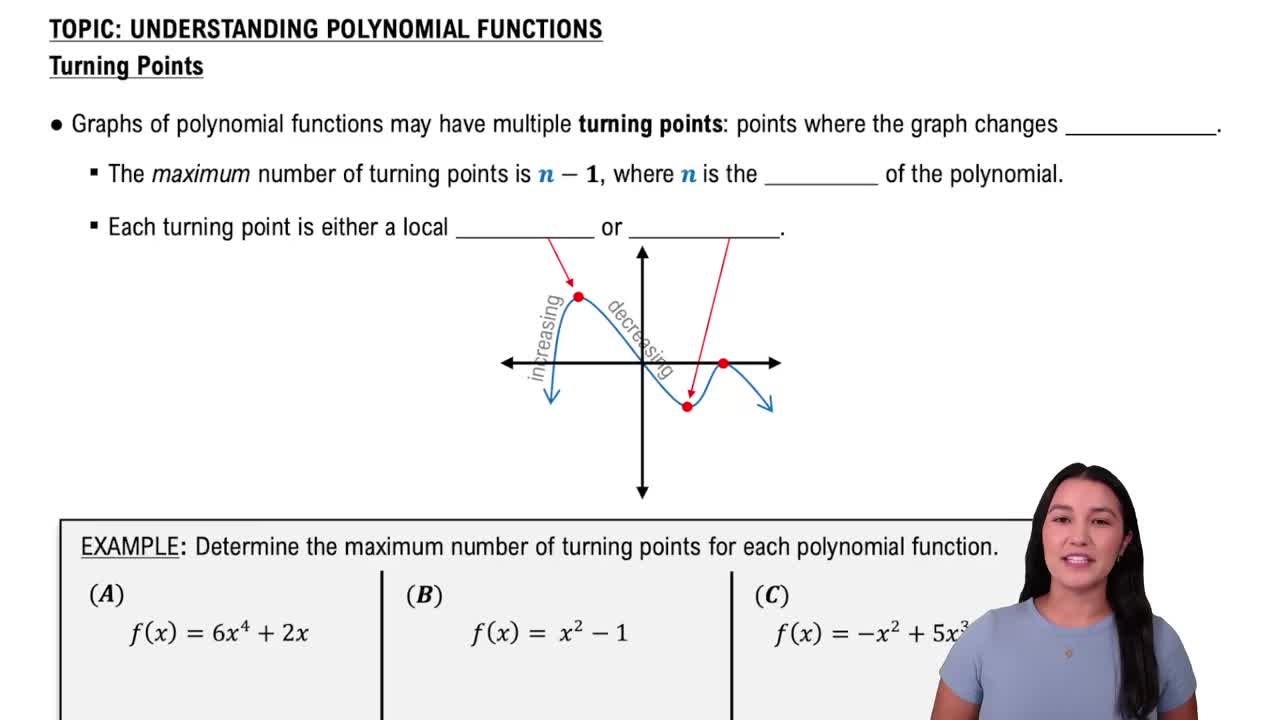
 02:44
02:44
 06:36
06:36 05:02
05:02Use synthetic division to show that 5 is a solution of x^4−4x^3−9x^2+16x+20=0. Then solve the polynomial equation.
In Exercises 57–80, follow the seven steps to graph each rational function. f(x)=(3x2+x−4)/(2x2−5x)
In Exercises 57–80, follow the seven steps to graph each rational function. f(x)=(x2+x−12)/(x2−4)
Solve the variation problems in Exercises 77–82. The pitch of a musical tone varies inversely as its wavelength. A tone has a pitch of 660 vibrations per second and a wavelength of 1.6 feet. What is the pitch of a tone that has a wavelength of 2.4 feet?
In Exercises 81–88, a. Find the slant asymptote of the graph of each rational function and b. Follow the seven-step strategy and use the slant asymptote to graph each rational function. f(x)=(x2−1)/x
When 2x2−7x+9 is divided by a polynomial, the quotient is 2x-3 and the remainder is 3. Find the polynomial.