
Textbook Question
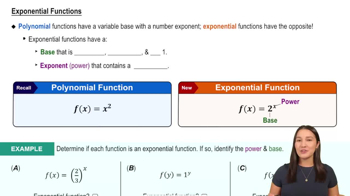
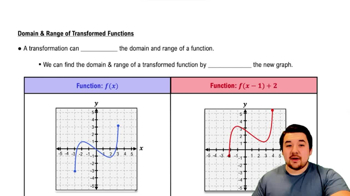
Graph f(x) = 2^x and g(x) = log2 x in the same rectangular coordinate system. Use the graphs to determine each function's domain and range.
1634
views

 Verified step by step guidance
 6:13
6:13
 4:22
4:22 4:48
4:48Graph f(x) = 2^x and g(x) = log2 x in the same rectangular coordinate system. Use the graphs to determine each function's domain and range.
Evaluate each expression without using a calculator. log2 (1/√2)
Use properties of logarithms to expand each logarithmic expression as much as possible. Where possible, evaluate logarithmic expressions without using a calculator. log ∛(x/y)
Solve each exponential equation in Exercises 23–48. Express the solution set in terms of natural logarithms or common logarithms. Then use a calculator to obtain a decimal approximation, correct to two decimal places, for the solution. e(1−5x)=793
Solve each exponential equation in Exercises 23–48. Express the solution set in terms of natural logarithms or common logarithms. Then use a calculator to obtain a decimal approximation, correct to two decimal places, for the solution. 5ex=23
Solve each exponential equation in Exercises 23–48. Express the solution set in terms of natural logarithms or common logarithms. Then use a calculator to obtain a decimal approximation, correct to two decimal places, for the solution. 3e5x=1977