Ch. 4 - Exponential and Logarithmic Functions
Blitzer - College Algebra 8th Edition
Blitzer8th EditionCollege AlgebraISBN: 9780136970514Not the one you use?Change textbook
Chapter 5, Problem 143

Without using a calculator, find the exact value of: [log3 81 - log𝝅 1]/[log2√2 8 - log 0.001]

Verified step by step guidance
1
Rewrite each logarithm in terms of simpler expressions or known values. For example, recognize that 81 can be written as a power of 3, and 8 can be written as a power of 2.
Use the logarithm power rule: logabcn = n logabc, to simplify the logarithms of powers.
Apply the logarithm subtraction rule: logabx - logaby = logabxy, to combine the logarithms in the numerator and denominator where possible.
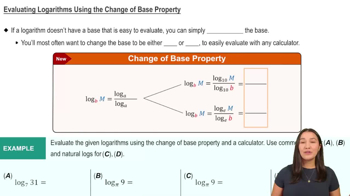
Convert all logarithms to a common base if necessary, using the change of base formula: logabc = logdclogdb, where d is a convenient base such as 10 or e.
After simplifying numerator and denominator separately, divide the two results to find the exact value of the original expression.

Verified video answer for a similar problem:

This video solution was recommended by our tutors as helpful for the problem above.
Video duration:
5m
Was this helpful?

Key Concepts

Here are the essential concepts you must grasp in order to answer the question correctly.

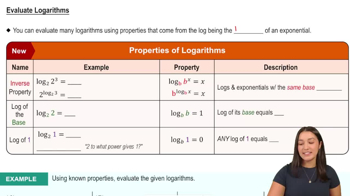
Properties of Logarithms

Logarithms have key properties such as the product, quotient, and power rules that simplify expressions. For example, log_b(x) - log_b(y) = log_b(x/y), and log_b(x^k) = k * log_b(x). These properties allow rewriting and simplifying complex logarithmic expressions without a calculator.
Recommended video:
5:36
Change of Base Property

Change of Base Formula

The change of base formula, log_a(b) = log_c(b) / log_c(a), allows converting logarithms with any base to a common base, often base 10 or e. This is useful for comparing or simplifying logarithms with different bases, especially when exact values are needed without a calculator.
Recommended video:
5:36
Change of Base Property

Evaluating Logarithms of Powers and Roots

Understanding how to evaluate logarithms of numbers expressed as powers or roots is essential. For example, 81 = 3^4, √2 = 2^(1/2), and 8 = 2^3. Recognizing these forms helps rewrite logarithms in terms of their bases and exponents, enabling exact calculation of their values.
Recommended video:
5:14
Evaluate Logarithms