In Exercises 5–18, solve each system by the substitution method.
Ch. 5 - Systems of Equations and Inequalities

Chapter 6, Problem 7
In Exercises 1–18, solve each system by the substitution method.
Verified step by step guidance1
Start with the given system of equations: \(x^2 + y^2 = 25\) and \(x - y = 1\).
From the second equation, solve for one variable in terms of the other. For example, express \(x\) as \(x = y + 1\).
Substitute the expression for \(x\) into the first equation to replace \(x\) with \(y + 1\), resulting in \((y + 1)^2 + y^2 = 25\).
Expand the squared term and combine like terms to form a quadratic equation in terms of \(y\): \(y^2 + 2y + 1 + y^2 = 25\).
Simplify the equation and solve the quadratic for \(y\). Then, use the values of \(y\) to find the corresponding \(x\) values using \(x = y + 1\).

Verified video answer for a similar problem:
This video solution was recommended by our tutors as helpful for the problem above.
Video duration:
5mWas this helpful?
Key Concepts
Here are the essential concepts you must grasp in order to answer the question correctly.
Substitution Method
The substitution method involves solving one equation for one variable and then substituting that expression into the other equation. This reduces the system to a single equation with one variable, making it easier to solve. It is especially useful when one equation is already solved or easily solvable for one variable.
Recommended video:
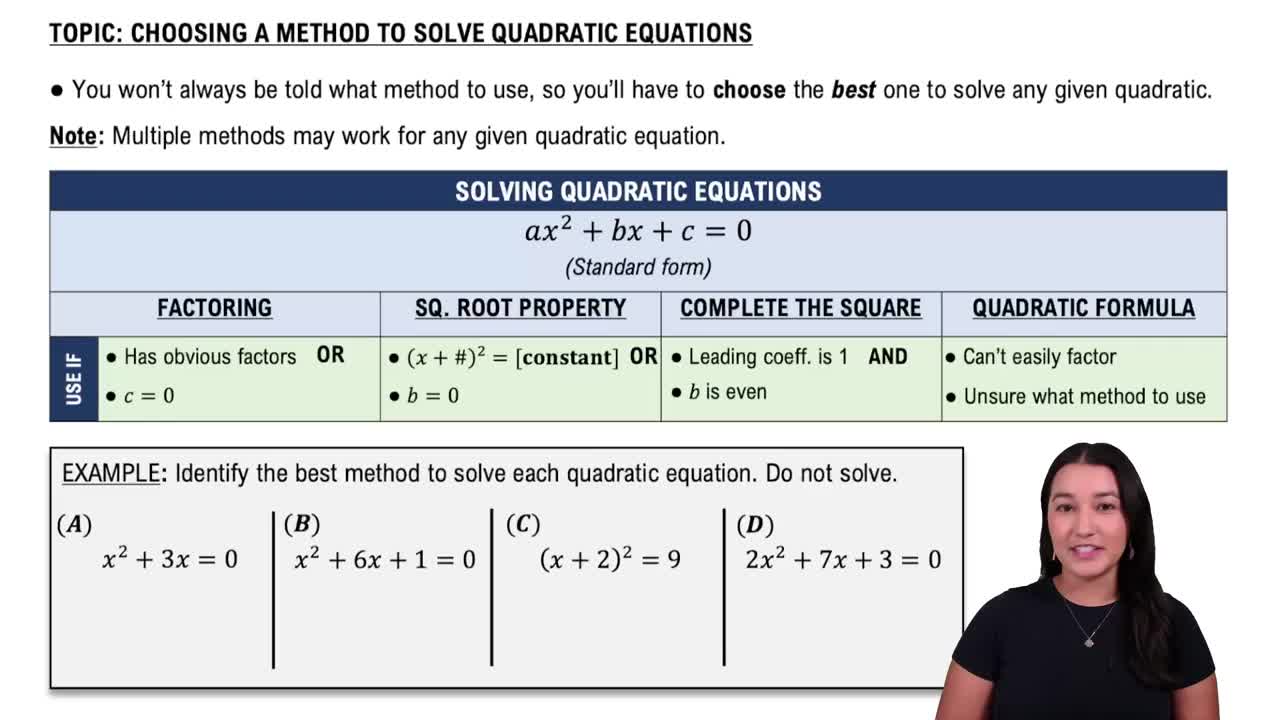
Choosing a Method to Solve Quadratics
Solving Quadratic Equations
When substitution leads to a quadratic equation, you must solve it using methods such as factoring, completing the square, or the quadratic formula. Quadratic equations can have two, one, or no real solutions, which correspond to the number of intersection points between the curves represented by the system.
Recommended video:
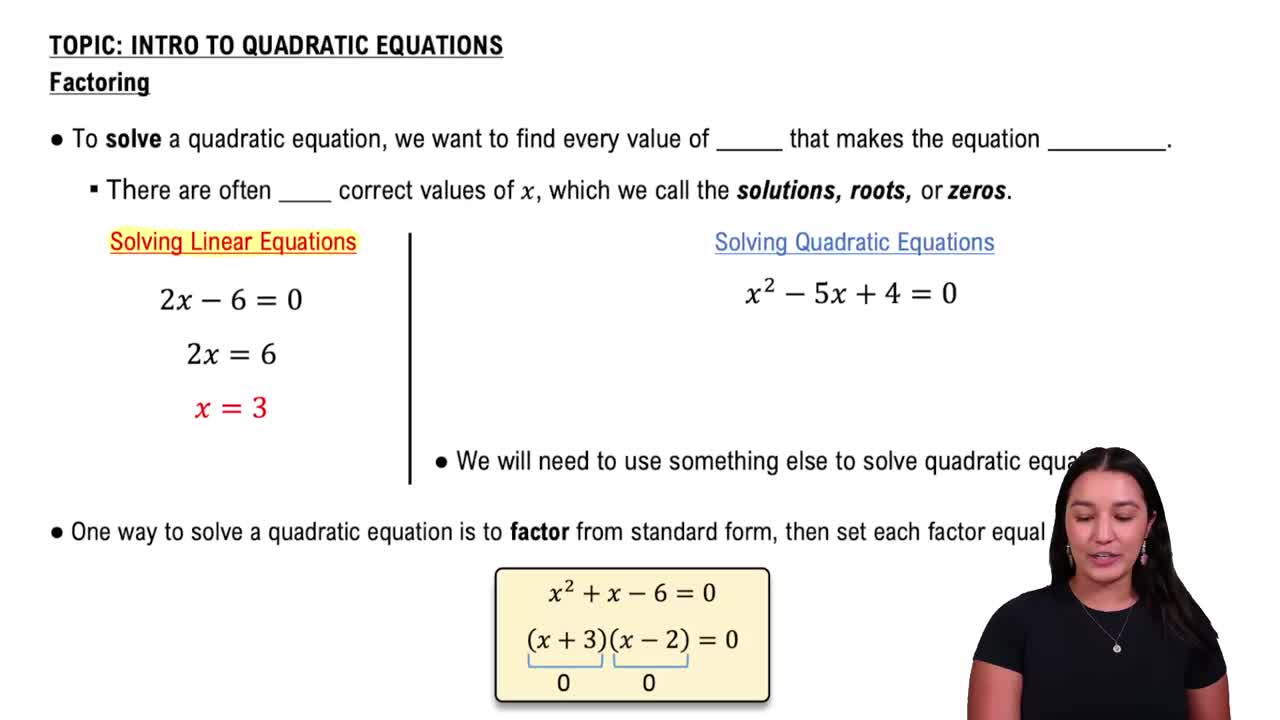
Solving Quadratic Equations by Factoring
Systems of Nonlinear Equations
A system involving equations like x² + y² = 25 (a circle) and x - y = 1 (a line) is nonlinear. Understanding the geometric interpretation helps: solutions correspond to intersection points of the circle and line. Such systems may have zero, one, or two solutions depending on how the line intersects the circle.
Recommended video:
Guided course
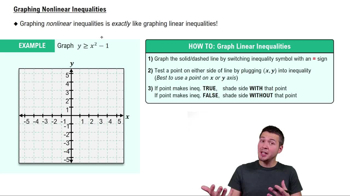
Nonlinear Inequalities
Related Practice
Textbook Question
774
views
Textbook Question
Graph each inequality. y>2x−1
624
views
Textbook Question
Write the form of the partial fraction decomposition of the rational expression. It is not necessary to solve for the constants.
737
views
Textbook Question
Solve each system in Exercises 5–18.
629
views
Textbook Question
Solve each system in Exercises 5–18.
609
views
Textbook Question
An objective function and a system of linear inequalities representing constraints are given. a. Graph the system of inequalities representing the constraints. b. Find the value of the objective function at each corner of the graphed region. c. Use the values in part (b) to determine the maximum value of the objective function and the values of x and y for which the maximum occurs.
578
views