In Exercises 47–52, solve each system by the method of your choice.
Ch. 5 - Systems of Equations and Inequalities

Chapter 6, Problem 47
Graph the solution set of each system of inequalities or indicate that the system has no solution.
Verified step by step guidance1
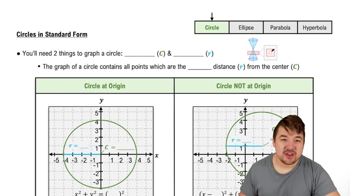
Identify the first inequality: \(x^{2} + y^{2} \leq 36\). This represents all points inside or on the circle centered at the origin \((0,0)\) with radius \(6\), since \(\sqrt{36} = 6\).
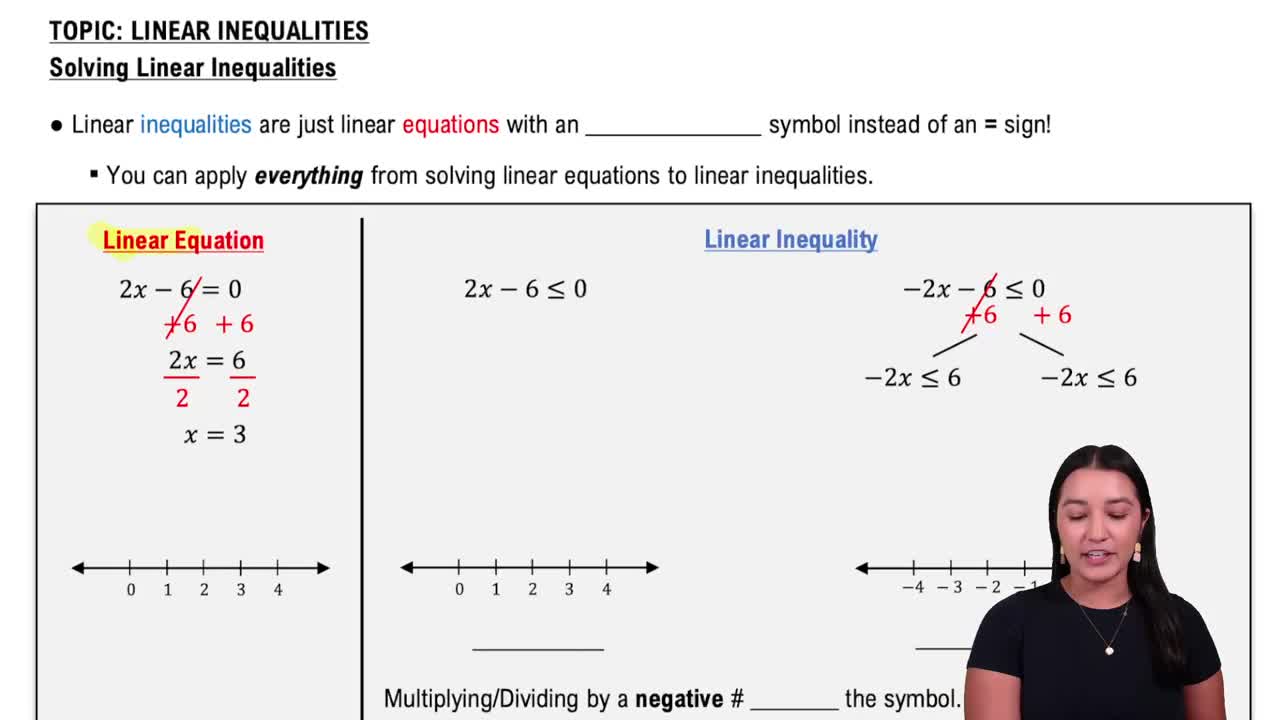
Identify the second inequality: \(3x + y > 6\). This is a linear inequality representing all points above the line \(3x + y = 6\).
Rewrite the linear inequality in slope-intercept form to better understand the boundary line: \(y > -3x + 6\). This line has a slope of \(-3\) and a y-intercept at \((0,6)\).
Graph the circle \(x^{2} + y^{2} = 36\) as a solid boundary because the inequality includes equality (\(\leq\)), meaning points on the circle are included.
Graph the line \(y = -3x + 6\) as a dashed line because the inequality is strict (\(>\)), meaning points on the line are not included. Then shade the region above this line where \(y > -3x + 6\).
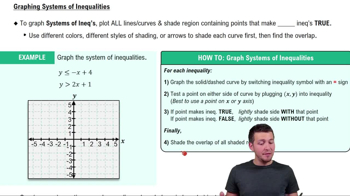
The solution set to the system is the intersection of the shaded region inside the circle and above the line. This means you look for points that satisfy both inequalities simultaneously.

Verified video answer for a similar problem:
This video solution was recommended by our tutors as helpful for the problem above.
Video duration:
4mWas this helpful?
Key Concepts
Here are the essential concepts you must grasp in order to answer the question correctly.
Graphing Circles and Inequalities
The inequality x² + y² ≤ 36 represents all points inside or on the circle centered at the origin with radius 6. Understanding how to graph this region involves recognizing the circle's boundary (x² + y² = 36) and shading the interior where the inequality holds true.
Recommended video:
Circles in Standard Form
Graphing Linear Inequalities
The inequality 3x + y > 6 represents a half-plane above the line 3x + y = 6. To graph it, first plot the boundary line, then determine which side satisfies the inequality by testing a point, shading the region where the inequality is true.
Recommended video:
Linear Inequalities
Solution Set of a System of Inequalities
The solution set of the system is the intersection of the regions satisfying each inequality. It includes points inside the circle and above the line simultaneously. Identifying this overlap is key to correctly graphing the system and understanding if solutions exist.
Recommended video:
Guided course
Systems of Inequalities
Related Practice
Textbook Question
479
views
Textbook Question
In Exercises 47–48, solve each system by the method of your choice. (x + 2)/2 - (y + 4)/3 = 3 (x + y)/5 = (x - y)/2 - 5/2
864
views
Textbook Question
In Exercises 47–48, solve each system by the method of your choice. (x - y)/3 = (x + y)/2 - 1/2 (x + 2)/2 - 4 = (y + 4)/3
739
views
Textbook Question
In Exercises 46–55, graph the solution set of each system of inequalities or indicate that the system has no solution.
This
is a piecewise function. Refer to the textbook.
577
views
Textbook Question
Graph the solution set of each system of inequalities or indicate that the system has no solution.
560
views
Textbook Question
In Exercises 46–55, graph the solution set of each system of inequalities or indicate that the system has no solution.
This
is a piecewise function. Refer to the textbook.
603
views