Solve each system for x and y, expressing either value in terms of a or b, if necessary. Assume that a ≠ 0 and b ≠ 0. For the linear function f(x) = mx + b, f(−2) = 11 and ƒ(3) = -9. Find m and b.
Ch. 5 - Systems of Equations and Inequalities

Chapter 6, Problem 51
Graph the solution set of each system of inequalities or indicate that the system has no solution.
Verified step by step guidance1
Identify the inequalities as representing circles centered at (2, -2). The first inequality \(\left(x - 2\right)^2 + \left(y + 2\right)^2 < 9\) describes all points inside a circle with radius 3 (since \(\sqrt{9} = 3\)).
The second inequality \(\left(x - 2\right)^2 + \left(y + 2\right)^2 \geq 4\) describes all points outside or on the boundary of a circle with radius 2 (since \(\sqrt{4} = 2\)).
To find the solution set of the system, look for points that satisfy both inequalities simultaneously. This means points must lie inside the larger circle (radius 3) but outside or on the smaller circle (radius 2).
Graphically, this solution set is the region between the two circles, including the boundary of the smaller circle but excluding the boundary of the larger circle.
To sketch the solution, draw two concentric circles centered at (2, -2) with radii 2 and 3. Shade the area between them, making sure the inner circle's boundary is included (solid line) and the outer circle's boundary is excluded (dashed line).

Verified video answer for a similar problem:
This video solution was recommended by our tutors as helpful for the problem above.
Video duration:
5mWas this helpful?
Key Concepts
Here are the essential concepts you must grasp in order to answer the question correctly.
Graphing Circles from Inequalities
Inequalities involving expressions like (x - h)² + (y - k)² < r² represent the interior of a circle centered at (h, k) with radius r. The inequality < indicates points inside the circle, while ≤ includes the boundary. Understanding how to graph these regions is essential for visualizing solution sets.
Recommended video:
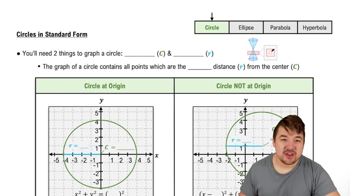
Circles in Standard Form
Systems of Inequalities
A system of inequalities requires finding the set of points that satisfy all inequalities simultaneously. This often involves identifying overlapping regions on the graph. Recognizing how to combine solution sets helps determine the feasible region or if no solution exists.
Recommended video:
Guided course
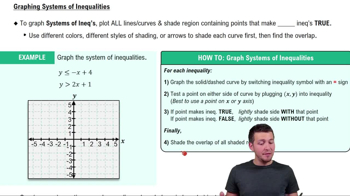
Systems of Inequalities
Inequalities with 'Greater Than or Equal To' and 'Less Than' Signs
Inequalities with ≥ or > define regions outside or on the boundary of a circle, while < or ≤ define regions inside or on the boundary. Distinguishing between strict and inclusive inequalities affects whether the boundary circle is part of the solution set, influencing the graph's shading and boundary style.
Recommended video:
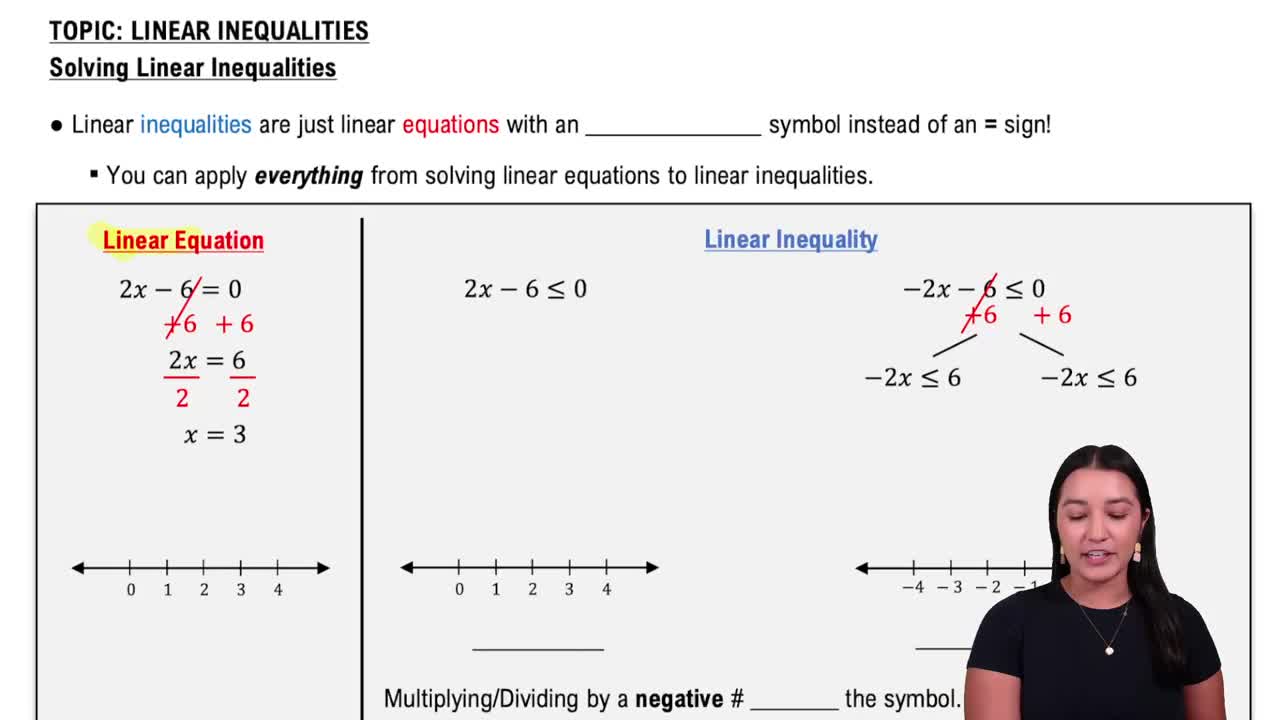
Linear Inequalities
Related Practice
Textbook Question
143
views
1
rank
Textbook Question
In Exercises 27–62, graph the solution set of each system of inequalities or indicate that the system has no solution. x2+y2<16, y≥2x
488
views
Textbook Question
In Exercises 47–52, solve each system by the method of your choice.
530
views
Textbook Question
In Exercises 27–62, graph the solution set of each system of inequalities or indicate that the system has no solution. x2+y2≤1, y−x2>0
-4.">
511
views
Textbook Question
Find the value of the objective function z = 2x + 3y at each corner of the graphed region shown. What is the maximum value of the objective function? What is the minimum value of the objective function?
624
views
Textbook Question
Find the partial fraction decomposition for 1/x(x+1) and use the result to find the following sum:
657
views