In Exercises 9–42, write the partial fraction decomposition of each rational expression. 1/x(x-1)
Ch. 5 - Systems of Equations and Inequalities

Chapter 6, Problem 9
In Exercises 5–18, solve each system by the substitution method.
Verified step by step guidance1
Since both equations are equal to \(x\), set the right-hand sides of the equations equal to each other: \(4y - 2 = 6y + 8\).
Next, solve the equation \(4y - 2 = 6y + 8\) for \(y\). Start by subtracting \$4y\( from both sides to get \)-2 = 2y + 8$.
Then, subtract 8 from both sides to isolate the term with \(y\): \(-2 - 8 = 2y\), which simplifies to \(-10 = 2y\).
Divide both sides by 2 to solve for \(y\): \(y = \frac{-10}{2}\).
Finally, substitute the value of \(y\) back into either original equation (for example, \(x = 4y - 2\)) to find the corresponding value of \(x\).

Verified video answer for a similar problem:
This video solution was recommended by our tutors as helpful for the problem above.
Video duration:
2mWas this helpful?
Key Concepts
Here are the essential concepts you must grasp in order to answer the question correctly.
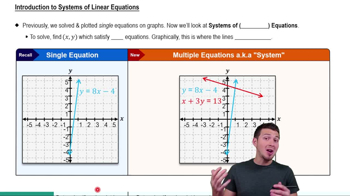
System of Linear Equations
A system of linear equations consists of two or more linear equations with the same variables. The solution is the set of variable values that satisfy all equations simultaneously. Understanding how to interpret and represent these systems is fundamental to solving them.
Recommended video:
Guided course
Introduction to Systems of Linear Equations
Substitution Method
The substitution method involves solving one equation for one variable and then substituting that expression into the other equation. This reduces the system to a single equation with one variable, making it easier to solve. It is especially useful when one variable is already isolated.
Recommended video:
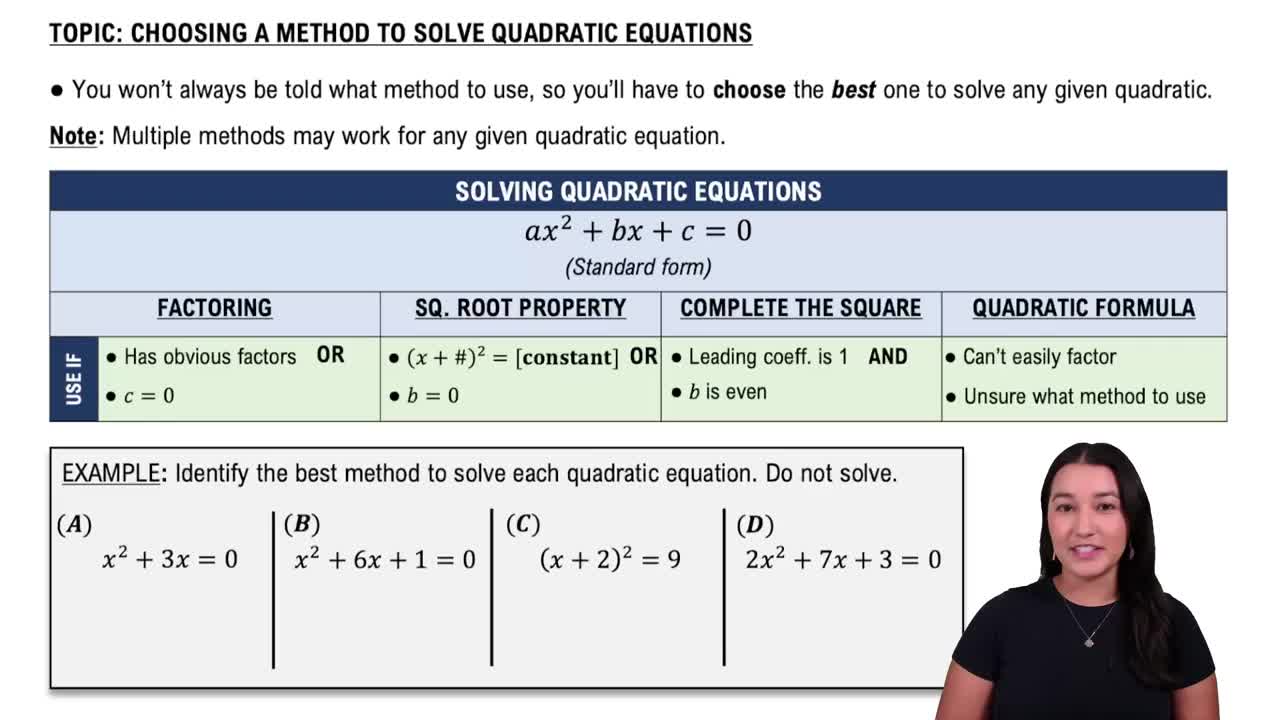
Choosing a Method to Solve Quadratics
Solving Linear Equations
Solving linear equations means finding the value(s) of the variable(s) that make the equation true. This often involves simplifying expressions, isolating variables, and performing arithmetic operations. Mastery of these skills is essential for solving systems effectively.
Recommended video:
Solving Linear Equations with Fractions
Related Practice
Textbook Question
674
views
Textbook Question
Solve each system in Exercises 5–18.
669
views
Textbook Question
In Exercises 1–18, solve each system by the substitution method.
581
views
Textbook Question
An objective function and a system of linear inequalities representing constraints are given. a. Graph the system of inequalities representing the constraints. b. Find the value of the objective function at each corner of the graphed region. c. Use the values in part (b) to determine the maximum value of the objective function and the values of x and y for which the maximum occurs.
626
views
Textbook Question
The perimeter of a table tennis top is 28 feet. The difference between 4 times the length and 3 times the width is 21 feet. Find the dimensions.
<Image>
731
views
Textbook Question
Write the partial fraction decomposition of each rational expression. x/(x-2)(x-3)
702
views