Ch. 6 - Matrices and Determinants
Blitzer - College Algebra 8th Edition
Blitzer8th EditionCollege AlgebraISBN: 9780136970514Not the one you use?Change textbook
Chapter 7, Problem 43

In Exercises 37–44, use Cramer's Rule to solve each system. {x+2z=42yz=52x+3y=13\(\begin{cases}\)x + 2z = 4 \\2y - z = 5 \\2x + 3y = 13\(\end{cases}\)

Verified step by step guidance
1
Write the system of equations in standard form, aligning variables x, y, and z: \(\begin{cases} x + 0y + 2z = 4 \\ 0x + 2y - z = 5 \\ 2x + 3y + 0z = 13 \end{cases}\)
Form the coefficient matrix \(A\) from the coefficients of \(x\), \(y\), and \(z\): \(A = \begin{bmatrix} 1 & 0 & 2 \\ 0 & 2 & -1 \\ 2 & 3 & 0 \end{bmatrix}\)
Calculate the determinant of matrix \(A\), denoted as \(\det(A)\), to ensure it is not zero (which would mean the system has a unique solution).
Form matrices \(A_x\), \(A_y\), and \(A_z\) by replacing the respective columns of \(A\) with the constants vector \(\begin{bmatrix} 4 \\ 5 \\ 13 \end{bmatrix}\): - \(A_x\) replaces the first column, - \(A_y\) replaces the second column, - \(A_z\) replaces the third column.
Calculate the determinants \(\det(A_x)\), \(\det(A_y)\), and \(\det(A_z)\), then use Cramer's Rule to find the variables: \( x = \frac{\det(A_x)}{\det(A)}\), \( y = \frac{\det(A_y)}{\det(A)}\), \( z = \frac{\det(A_z)}{\det(A)}\).

Verified video answer for a similar problem:

This video solution was recommended by our tutors as helpful for the problem above.
Video duration:
9m
Was this helpful?

Key Concepts

Here are the essential concepts you must grasp in order to answer the question correctly.

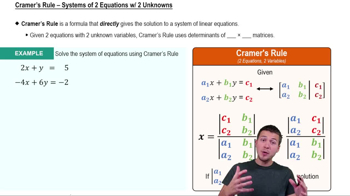
Cramer's Rule

Cramer's Rule is a method for solving systems of linear equations using determinants. It applies when the system has the same number of equations as unknowns and the coefficient matrix has a non-zero determinant. Each variable is found by replacing the corresponding column in the coefficient matrix with the constants vector and calculating the determinant ratio.
Recommended video:
Guided course
6:54
Cramer's Rule - 2 Equations with 2 Unknowns

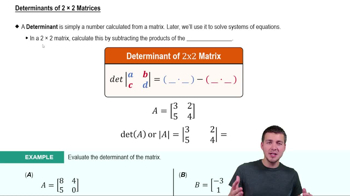
Determinants of Matrices

The determinant is a scalar value that can be computed from a square matrix and provides important properties about the matrix, such as invertibility. For a 3x3 matrix, the determinant is calculated using a specific formula involving minors and cofactors. A non-zero determinant indicates the system has a unique solution.
Recommended video:
Guided course
4:36
Determinants of 2×2 Matrices

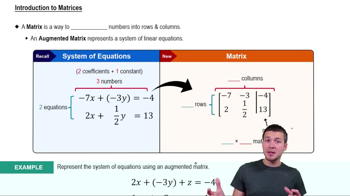
Setting up the Coefficient Matrix and Constants Vector

To apply Cramer's Rule, the system of equations must be expressed in matrix form: Ax = b, where A is the coefficient matrix, x is the vector of variables, and b is the constants vector. Correctly identifying coefficients and constants from the equations is essential for forming these matrices accurately.
Recommended video:
Guided course
4:35
Introduction to Matrices
Related Practice
Textbook Question

In Exercises 37 - 44, perform the indicated matrix operations given that A, B and C are defined as follows. If an operation is not defined, state the reason.

A=[403501],B=[5122],C=[1111]A=\(\begin{bmatrix}\)4 & 0\\ -3 & 5\\ 0 & 1\(\end{bmatrix}\),B=\(\begin{bmatrix}\)5 & 1\\ -2 & -2\(\end{bmatrix}\),C=\(\begin{bmatrix}\)1 & -1\\ -1 & 1\(\end{bmatrix}\)

A(BC)

841
views
Textbook Question

Solve the system: (Hint: Let A = ln w, B = ln x, C = ln y, and D = ln z. Solve the system for A, B, C, and D. Then use the logarithmic equations to find w, x, y, and z.)

{2lnw+lnx+3lny2lnz=64lnw+3lnx+lnylnz=2lnw+lnx+lny+lnz=5lnw+lnxlnylnz=5\(\begin{cases}\)2 \(\ln\) w + \(\ln\) x + 3 \(\ln\) y - 2 \(\ln\) z = -6 \\4 \(\ln\) w + 3 \(\ln\) x + \(\ln\) y - \(\ln\) z = -2 \(\ln\) w + \(\ln\) x + \(\ln\) y + \(\ln\) z = -5 \(\ln\) w + \(\ln\) x - \(\ln\) y - \(\ln\) z = 5\(\end{cases}\)

933
views
Textbook Question

In Exercises 46–51, evaluate each determinant.

985
views
Textbook Question

In Exercises 45–48, explain why the system of equations cannot be solved using Cramer's Rule. Then use Gaussian elimination to solve the system.

967
views
Textbook Question

In Exercises 43–44, (a) Write each linear system as a matrix equation in the form AX = B (b) Solve the system using the inverse that is given for the coefficient matrix.

671
views
Textbook Question

In Exercises 37–44, use Cramer's Rule to solve each system. {x+y+z=4x2y+z=7x+3y+2z=4\(\begin{cases}\)x + y + z = 4 \(\x\) - 2y + z = 7 \(\x\) + 3y + 2z = 4\(\end{cases}\)

864
views