In Exercises 1–4, find the focus and directrix of each parabola with the given equation. Then match each equation to one of the graphs that are shown and labeled (a)–(d). x^2 = - 4y
Ch. 7 - Conic Sections

Chapter 8, Problem 3
Graph the ellipse and locate the foci. 9x^2 + 4y^2 - 18x + 8y -23 = 0
Verified step by step guidance1
Rewrite the given equation in standard form by grouping the x-terms and y-terms together: \( 9x^2 - 18x + 4y^2 + 8y = 23 \).
Complete the square for the x-terms. Factor out the coefficient of \(x^2\) (which is 9) from \(9x^2 - 18x\): \(9(x^2 - 2x)\). Then, complete the square inside the parentheses by adding and subtracting \((\frac{-2}{2})^2 = 1\): \(9(x^2 - 2x + 1 - 1) = 9((x - 1)^2 - 1)\).
Complete the square for the y-terms. Factor out the coefficient of \(y^2\) (which is 4) from \(4y^2 + 8y\): \(4(y^2 + 2y)\). Then, complete the square inside the parentheses by adding and subtracting \((\frac{2}{2})^2 = 1\): \(4(y^2 + 2y + 1 - 1) = 4((y + 1)^2 - 1)\).
Substitute the completed squares back into the equation: \(9((x - 1)^2 - 1) + 4((y + 1)^2 - 1) = 23\). Simplify the constants: \(9(x - 1)^2 - 9 + 4(y + 1)^2 - 4 = 23\), which simplifies further to \(9(x - 1)^2 + 4(y + 1)^2 = 36\).
Divide through by 36 to express the equation in standard form: \(\frac{(x - 1)^2}{4} + \frac{(y + 1)^2}{9} = 1\). From this, identify the center \((1, -1)\), the semi-major axis length \(3\), the semi-minor axis length \(2\), and calculate the foci using \(c = \sqrt{a^2 - b^2}\), where \(a = 3\) and \(b = 2\).

Verified video answer for a similar problem:
This video solution was recommended by our tutors as helpful for the problem above.
Video duration:
9mWas this helpful?
Key Concepts
Here are the essential concepts you must grasp in order to answer the question correctly.
Ellipse Standard Form
An ellipse is defined by its standard form equation, which typically looks like (x-h)²/a² + (y-k)²/b² = 1, where (h, k) is the center, a is the semi-major axis, and b is the semi-minor axis. To graph an ellipse, it is essential to convert the given equation into this standard form, allowing for easy identification of its key features.
Recommended video:
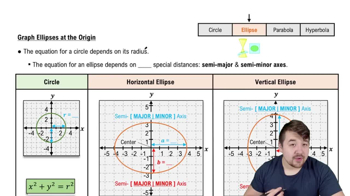
Graph Ellipses at Origin
Completing the Square
Completing the square is a method used to transform a quadratic equation into a perfect square trinomial. This technique is crucial for rewriting the ellipse equation in standard form, as it helps isolate the variables and identify the center and axes of the ellipse. It involves manipulating the equation to create a squared term for both x and y.
Recommended video:
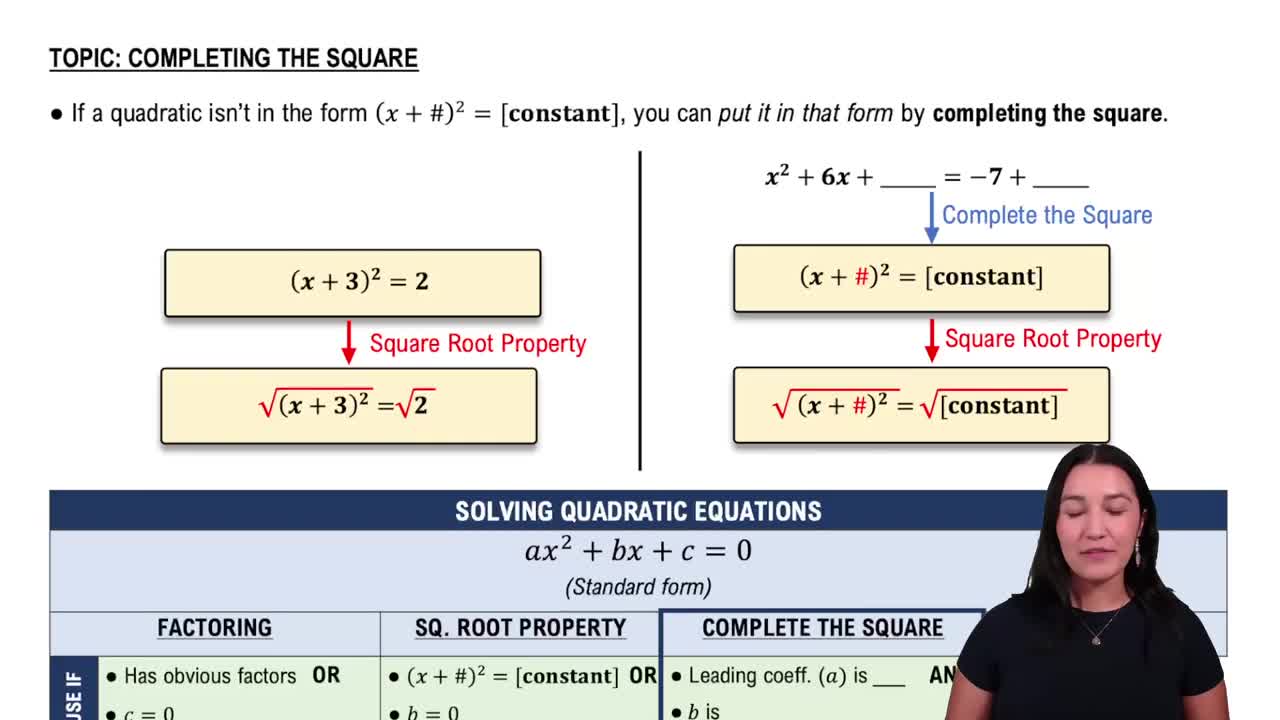
Solving Quadratic Equations by Completing the Square
Foci of an Ellipse
The foci of an ellipse are two fixed points located along the major axis, which are essential for defining the shape of the ellipse. The distance from the center to each focus is denoted as c, where c² = a² - b². Identifying the foci is important for understanding the ellipse's properties, such as its eccentricity and how it relates to the distance from any point on the ellipse to the foci.
Recommended video:
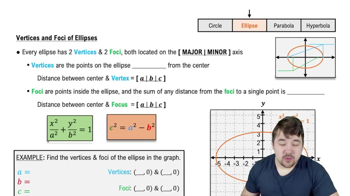
Foci and Vertices of an Ellipse
Related Practice
Textbook Question
1112
views
Textbook Question
Graph each ellipse and locate the foci. x2/9 +y2/36= 1
866
views
Textbook Question
In Exercises 1–4, find the focus and directrix of each parabola with the given equation. Then match each equation to one of the graphs that are shown and labeled (a)–(d). x^2 = 4y
885
views
Textbook Question
Graph the ellipse and locate the foci. (y^2)/25 + (x^2)/16 = 1
1098
views
Textbook Question
Find the vertices and locate the foci of each hyperbola with the given equation. Then match each equation to one of the graphs that are shown and labeled (a)–(d).
a. b. c. d.
y2/4−x2/1=1
875
views
Textbook Question
In Exercises 1–4, find the focus and directrix of each parabola with the given equation. Then match each equation to one of the graphs that are shown and labeled (a)–(d). y^2 = - 4x
918
views