Ch. 7 - Conic Sections
Blitzer - College Algebra 8th Edition
Blitzer8th EditionCollege AlgebraISBN: 9780136970514Not the one you use?Change textbook
Chapter 8, Problem 39

Use the center, vertices, and asymptotes to graph each hyperbola. Locate the foci and find the equations of the asymptotes. (x−3)2−4(y+3)2=4

Verified step by step guidance
1
Rewrite the given equation in standard form by dividing both sides by 4 to isolate the right side as 1: \(\frac{(x-3)^2}{4} - \frac{(y+3)^2}{1} = 1\).
Identify the center of the hyperbola from the equation: the center is at \((h, k) = (3, -3)\).
Determine the values of \(a^2\) and \(b^2\) from the denominators: here, \(a^2 = 4\) and \(b^2 = 1\). Since the positive term is with \((x-3)^2\), the hyperbola opens left and right.
Find the vertices by moving \(a\) units left and right from the center along the x-axis: vertices are at \((3 \pm 2, -3)\).
Calculate the foci using \(c^2 = a^2 + b^2\): find \(c\), then locate the foci at \((3 \pm c, -3)\). Write the equations of the asymptotes using the formula \(y - k = \pm \frac{b}{a}(x - h)\), which becomes \(y + 3 = \pm \frac{1}{2}(x - 3)\).

Verified video answer for a similar problem:

This video solution was recommended by our tutors as helpful for the problem above.
Video duration:
9m
Was this helpful?

Key Concepts

Here are the essential concepts you must grasp in order to answer the question correctly.

Standard Form of a Hyperbola

A hyperbola's equation can be written in standard form to identify its center, vertices, and orientation. For example, (x−h)^2/a^2 − (y−k)^2/b^2 = 1 represents a hyperbola centered at (h, k) opening left-right. Recognizing and rewriting the given equation into this form is essential for graphing and further analysis.
Recommended video:
5:50
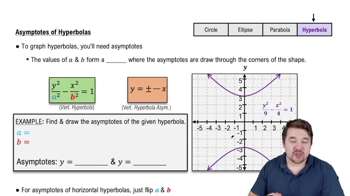
Asymptotes of Hyperbolas

Foci and Vertices of a Hyperbola

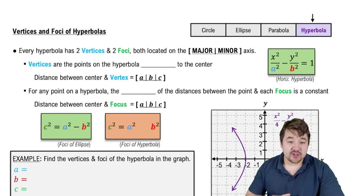
Vertices are points where the hyperbola intersects its transverse axis, and foci are fixed points used to define the hyperbola. The distance from the center to each vertex is 'a', and to each focus is 'c', where c^2 = a^2 + b^2. Locating these points helps in accurately sketching the hyperbola.
Recommended video:
5:22
Foci and Vertices of Hyperbolas

Equations of Asymptotes

Asymptotes are lines that the hyperbola approaches but never touches, guiding its shape. For a hyperbola centered at (h, k), the asymptotes have equations y − k = ±(b/a)(x − h) or y − k = ±(a/b)(x − h), depending on orientation. Finding these lines is crucial for graphing the hyperbola's behavior at infinity.
Recommended video:
6:24
Introduction to Asymptotes