Ch. 7 - Conic Sections
Blitzer - College Algebra 8th Edition
Blitzer8th EditionCollege AlgebraISBN: 9780136970514Not the one you use?Change textbook
Chapter 8, Problem 47

In Exercises 43–50, convert each equation to standard form by completing the square on x and y. Then graph the hyperbola. Locate the foci and find the equations of the asymptotes. 4x29y216x+54y101=04x^2−9y^2−16x+54y−101=0

Verified step by step guidance
1
Start with the given equation: \(4x^{2} - 9y^{2} - 16x + 54y - 101 = 0\).
Group the \(x\) terms and \(y\) terms together: \(4x^{2} - 16x - 9y^{2} + 54y = 101\).
Factor out the coefficients of the squared terms from each group: \(4(x^{2} - 4x) - 9(y^{2} - 6y) = 101\).
Complete the square for each group inside the parentheses: - For \(x^{2} - 4x\), take half of \(-4\) which is \(-2\), square it to get \(4\), so add and subtract \(4\) inside the parentheses. - For \(y^{2} - 6y\), take half of \(-6\) which is \(-3\), square it to get \(9\), so add and subtract \(9\) inside the parentheses.
Rewrite the equation including the completed squares and adjust the right side accordingly: \(4(x^{2} - 4x + 4 - 4) - 9(y^{2} - 6y + 9 - 9) = 101\). Then express the perfect square trinomials as squares: \(4((x - 2)^{2} - 4) - 9((y - 3)^{2} - 9) = 101\). Finally, distribute and move constants to the right side to isolate the squared terms.

Key Concepts

Here are the essential concepts you must grasp in order to answer the question correctly.

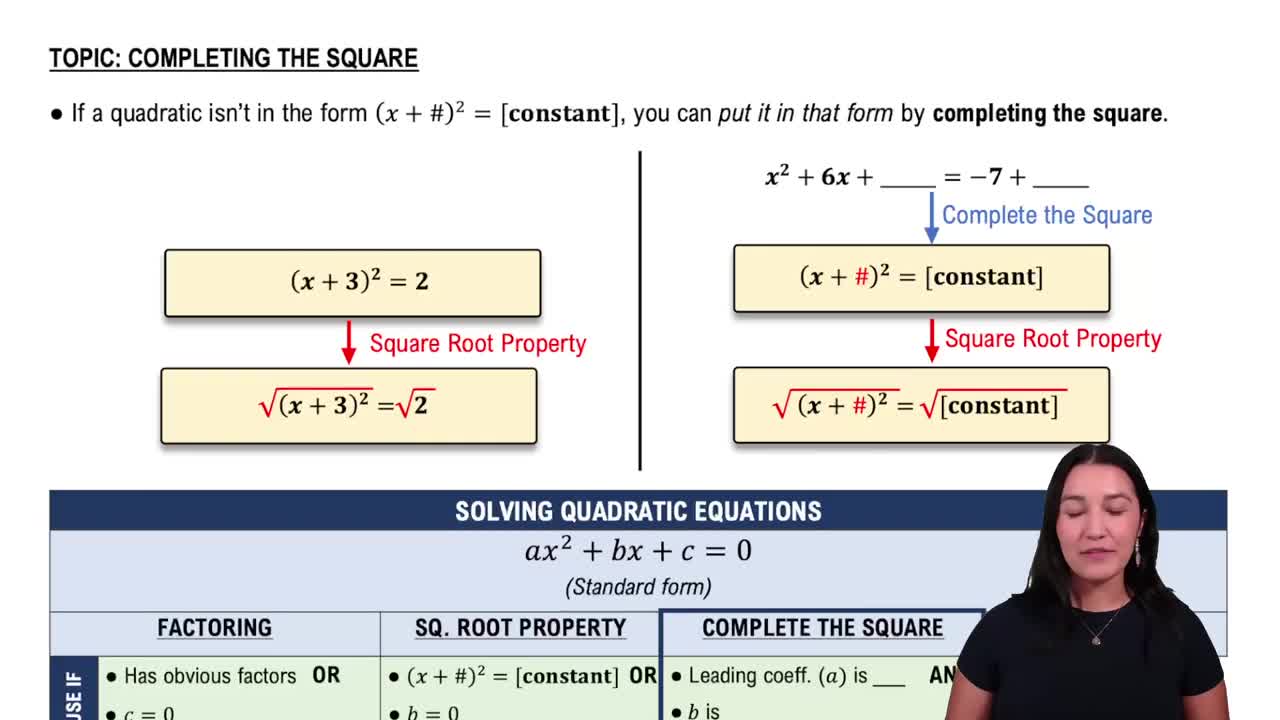
Completing the Square

Completing the square is a method used to rewrite quadratic expressions in the form (x - h)² or (y - k)² by adding and subtracting terms. This technique helps convert the given equation into standard form, making it easier to identify the center and other properties of conic sections like hyperbolas.
Recommended video:
06:24
Solving Quadratic Equations by Completing the Square

Standard Form of a Hyperbola

The standard form of a hyperbola equation is either (x - h)²/a² - (y - k)²/b² = 1 or (y - k)²/a² - (x - h)²/b² = 1, where (h, k) is the center. Converting to this form reveals key features such as the orientation, vertices, and helps in graphing the hyperbola accurately.
Recommended video:
5:50
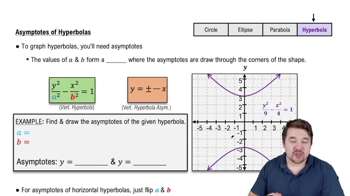
Asymptotes of Hyperbolas

Foci and Asymptotes of a Hyperbola

The foci are two fixed points inside the hyperbola that define its shape, located using the relationship c² = a² + b². Asymptotes are lines that the hyperbola approaches but never touches, given by equations derived from the center and slopes ±b/a or ±a/b, guiding the graph's behavior at infinity.
Recommended video:
5:50
Asymptotes of Hyperbolas