Ch. 8 - Sequences, Induction, and Probability
Blitzer - College Algebra 8th Edition
Blitzer8th EditionCollege AlgebraISBN: 9780136970514Not the one you use?Change textbook
Chapter 9, Problem 78

A club with 15 members is to choose four officers–president, vice president, secretary, and treasurer. In how many ways can these offices be filled?

Verified step by step guidance
1
Step 1: Recognize that this is a permutation problem because the order in which the officers are chosen matters (e.g., president is different from vice president).
Step 2: Use the formula for permutations, which is P(n, r) = n! / (n - r)!, where n is the total number of items (15 members) and r is the number of items to choose (4 officers).
Step 3: Substitute the values into the formula: P(15, 4) = 15! / (15 - 4)!.
Step 4: Simplify the denominator: (15 - 4)! = 11!, so the formula becomes P(15, 4) = 15! / 11!.
Step 5: Cancel out the common factorial terms (11!) in the numerator and denominator, leaving P(15, 4) = 15 × 14 × 13 × 12. Multiply these terms to find the total number of ways the offices can be filled.

Verified video answer for a similar problem:

This video solution was recommended by our tutors as helpful for the problem above.
Video duration:
3m
Was this helpful?

Key Concepts

Here are the essential concepts you must grasp in order to answer the question correctly.

Permutations

Permutations refer to the different arrangements of a set of items where the order matters. In this scenario, the positions of president, vice president, secretary, and treasurer are distinct, meaning that the arrangement of members in these roles is crucial. The formula for permutations is n! / (n - r)!, where n is the total number of items, and r is the number of items to arrange.
Recommended video:
7:11
Introduction to Permutations

Factorial

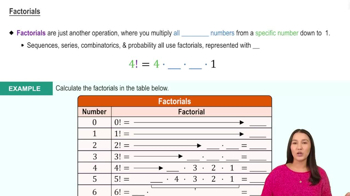
A factorial, denoted as n!, is the product of all positive integers up to n. It is a fundamental concept in combinatorics used to calculate permutations and combinations. For example, 5! equals 5 × 4 × 3 × 2 × 1 = 120. Understanding factorials is essential for determining the number of ways to arrange members in the club's officer positions.
Recommended video:
5:22
Factorials

Combinatorial Counting

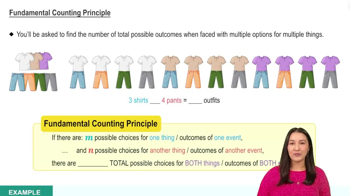
Combinatorial counting involves calculating the number of ways to select or arrange items based on specific criteria. In this question, we are interested in how to fill four distinct officer roles from a group of 15 members. This requires applying the principles of permutations, as the order of selection is important, leading to a systematic approach to counting the arrangements.
Recommended video:
4:04
Fundamental Counting Principle