Use mathematical induction to prove that each statement is true for every positive integer n. 1/(1 · 2) + 1/(2 · 3) + 1/(3 · 4) + ... + 1/(n(n+1)) = n/(n + 1)
Ch. 8 - Sequences, Induction, and Probability

Chapter 9, Problem 24
Find 3 + 6 + 9 + ... + 300, the sum of the first 100 positive multiples of 3.
Verified step by step guidance1
Recognize that the series 3 + 6 + 9 + ... + 300 is an arithmetic sequence where each term increases by a common difference of 3.
Identify the first term \( a_1 = 3 \) and the last term \( a_n = 300 \).
Determine the number of terms \( n \). Since the problem states the first 100 positive multiples of 3, \( n = 100 \).
Use the formula for the sum of an arithmetic series: \[ S_n = \frac{n}{2} (a_1 + a_n) \], where \( S_n \) is the sum of the first \( n \) terms.
Substitute the known values into the formula: \[ S_{100} = \frac{100}{2} (3 + 300) \] and simplify step-by-step to find the sum.

Verified video answer for a similar problem:
This video solution was recommended by our tutors as helpful for the problem above.
Video duration:
2mWas this helpful?
Key Concepts
Here are the essential concepts you must grasp in order to answer the question correctly.
Arithmetic Sequence
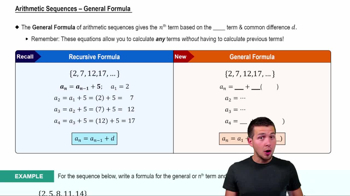
An arithmetic sequence is a list of numbers with a constant difference between consecutive terms. In this problem, the multiples of 3 form an arithmetic sequence starting at 3 with a common difference of 3.
Recommended video:
Guided course
Arithmetic Sequences - General Formula
Number of Terms in a Sequence
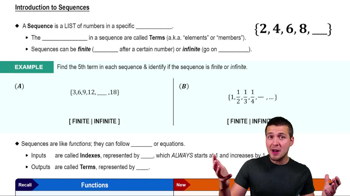
Determining the number of terms involves identifying how many elements are in the sequence. Here, the problem states the first 100 positive multiples of 3, so the sequence has exactly 100 terms.
Recommended video:
Guided course
Introduction to Sequences
Sum of an Arithmetic Series
The sum of an arithmetic series can be found using the formula S = n/2 * (first term + last term), where n is the number of terms. This formula allows efficient calculation of the total sum without adding each term individually.
Recommended video:
Guided course
Arithmetic Sequences - General Formula
Related Practice
Textbook Question
652
views
Textbook Question
Write a formula for the general term (the nth term) of each arithmetic sequence. Do not use a recursion formula. Then use the formula for an to find a20, the 20th term of the sequence. 1, 5, 9, 13,...
883
views
Textbook Question
Write a formula for the general term (the nth term) of each geometric sequence. Then use the formula for an to find a7, the seventh term of the sequence. 0.0004, - 0.0004, 0.04, - 0.04, ...
898
views
Textbook Question
Write a formula for the general term (the nth term) of each arithmetic sequence. Do not use a recursion formula. Then use the formula for an to find a20, the 20th term of the sequence. 7,3,-1,-5,...
870
views
Textbook Question
Use the formula for the sum of the first n terms of an arithmetic sequence to find the indicated sum.
1180
views
Textbook Question
Evaluate each factorial expression. 18!/16!
707
views