Ch. 1 - Equations and Inequalities
Lial - College Algebra 13th Edition
Lial13th EditionCollege AlgebraISBN: 9780136881063Not the one you use?Change textbook
Chapter 2, Problem 96

Answer each question. Find the values of a, b, and c for which the quadratic equation. ax2+bx+c=0ax^2 + bx + c = 0 has the given numbers as solutions. (Hint: Use the zero-factor property in reverse.)
3,2-3, 2

Verified step by step guidance
1
Recall that if a quadratic equation has solutions (roots) \( r_1 \) and \( r_2 \), then it can be written in factored form as \( a(x - r_1)(x - r_2) = 0 \).
Given the solutions \( -3 \) and \( 2 \), substitute these values into the factored form: \( a(x - (-3))(x - 2) = 0 \), which simplifies to \( a(x + 3)(x - 2) = 0 \).
Expand the factors \( (x + 3)(x - 2) \) by using the distributive property (FOIL method): \( x \cdot x + x \cdot (-2) + 3 \cdot x + 3 \cdot (-2) \).
Simplify the expression from the previous step to get a quadratic expression in standard form: \( x^2 + (\text{sum of coefficients})x + (\text{constant term}) \).
Identify the coefficients \( a \), \( b \), and \( c \) from the expanded quadratic expression \( a x^2 + b x + c = 0 \). Note that \( a \) can be any nonzero constant, often taken as 1 for simplicity.

Verified video answer for a similar problem:

This video solution was recommended by our tutors as helpful for the problem above.
Video duration:
3m
Was this helpful?

Key Concepts

Here are the essential concepts you must grasp in order to answer the question correctly.

Quadratic Equation Standard Form

A quadratic equation is expressed as ax^2 + bx + c = 0, where a, b, and c are constants and a ≠ 0. Understanding this form is essential because it defines the structure of the equation whose roots or solutions we seek.
Recommended video:
04:34
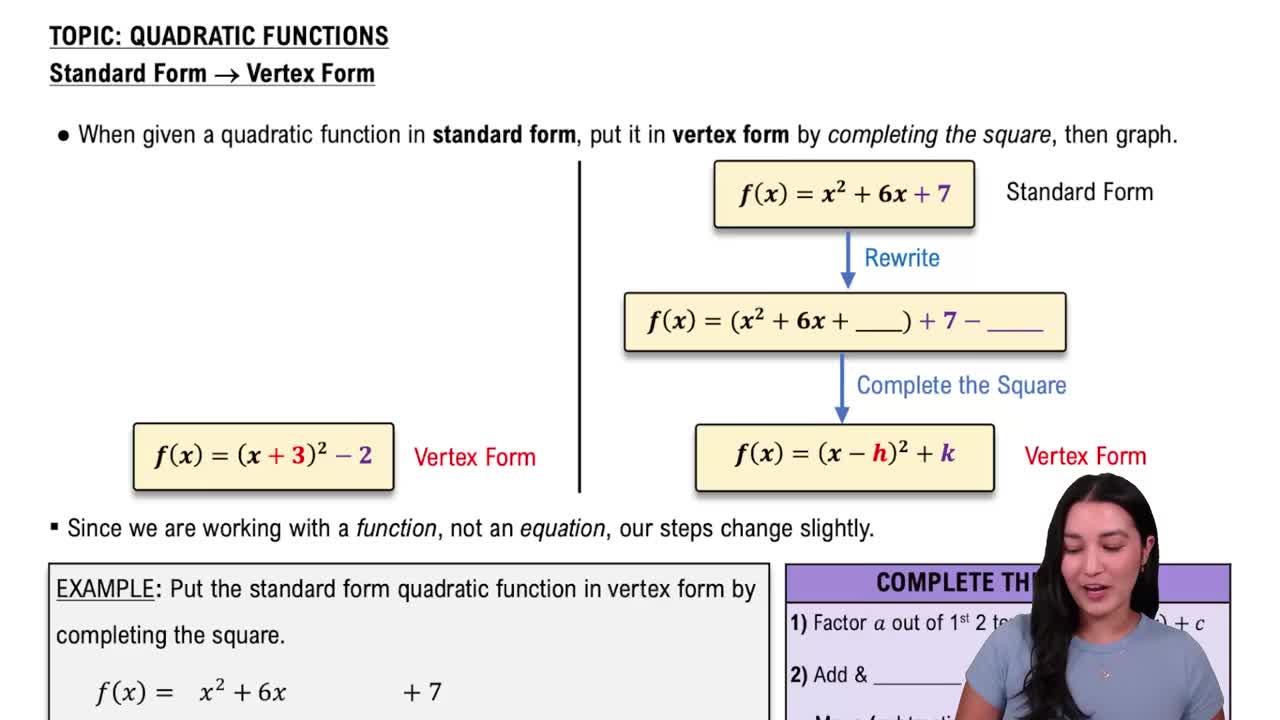
Converting Standard Form to Vertex Form

Zero-Factor Property

The zero-factor property states that if the product of two factors equals zero, then at least one of the factors must be zero. This property is used to find solutions of quadratic equations by factoring and setting each factor equal to zero.
Recommended video:
Guided course
07:30
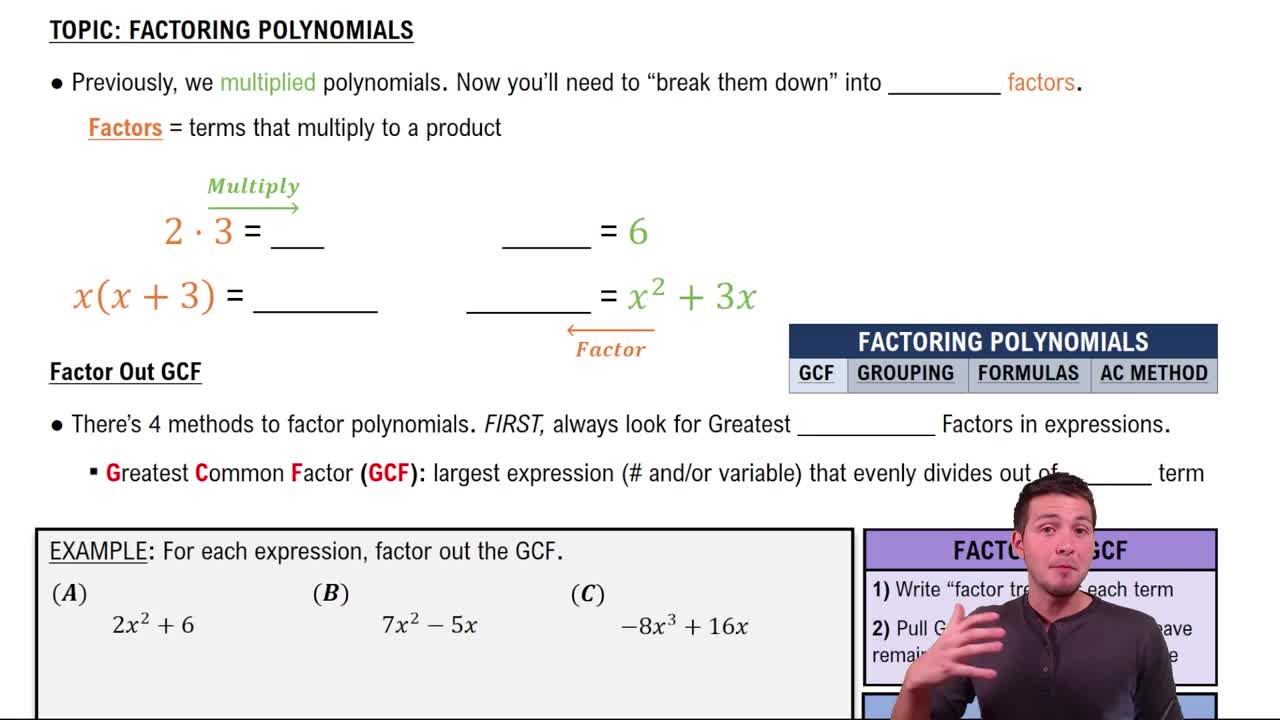
Introduction to Factoring Polynomials

Forming Quadratic Equations from Roots

Given the roots of a quadratic equation, you can reconstruct the equation by writing it as (x - root1)(x - root2) = 0 and then expanding. This reverse process helps find the coefficients a, b, and c based on the given solutions.
Recommended video:
06:12
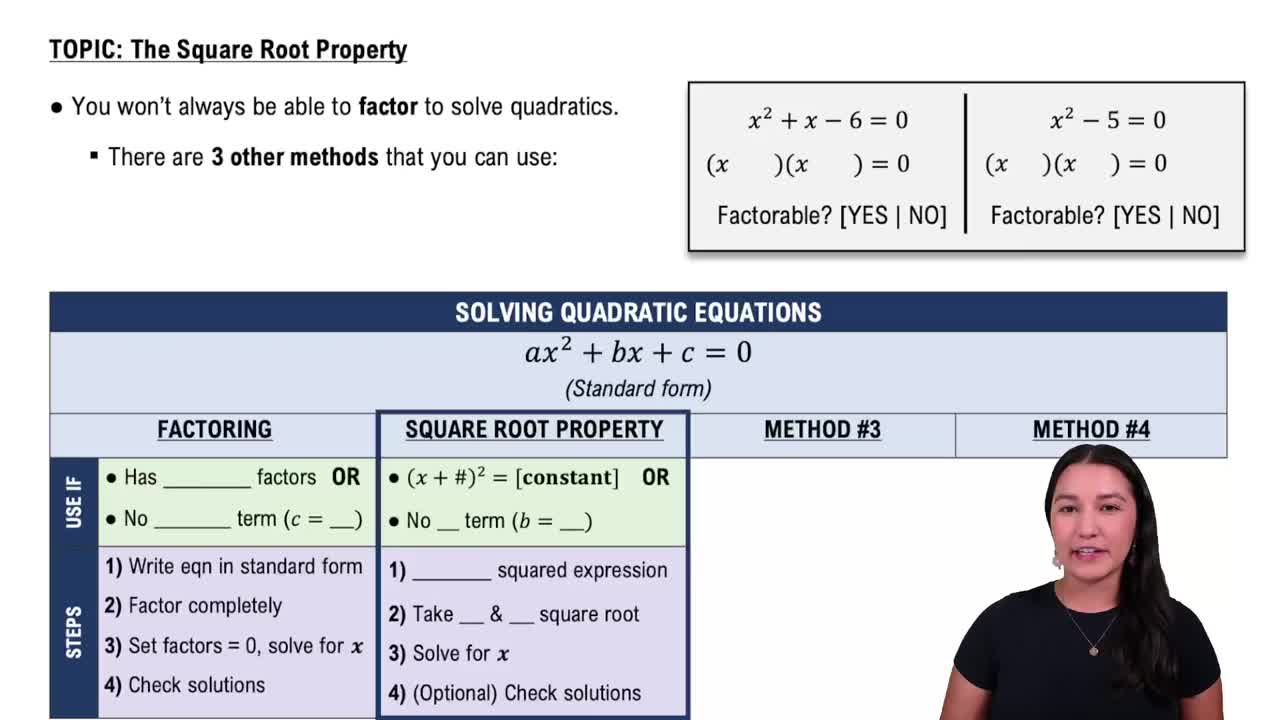
Solving Quadratic Equations by the Square Root Property