Ch. 1 - Equations and Inequalities
Lial - College Algebra 13th Edition
Lial13th EditionCollege AlgebraISBN: 9780136881063Not the one you use?Change textbook
Chapter 2, Problem 105

Answer the following. Why can 3 not be in the solution set of 14x+9 / x-3 < 0? (Do not solve the inequality.)

Verified step by step guidance
1
Identify the expression given in the inequality: \(\frac{14x + 9}{x - 3} < 0\).
Recognize that the denominator \(x - 3\) cannot be zero because division by zero is undefined in mathematics.
Set the denominator equal to zero to find values that are not allowed: \(x - 3 = 0\).
Solve for \(x\): \(x = 3\).
Conclude that \(x = 3\) cannot be in the solution set because it makes the denominator zero, which is undefined, so it must be excluded from the domain of the inequality.

Verified video answer for a similar problem:

This video solution was recommended by our tutors as helpful for the problem above.
Video duration:
1m
Was this helpful?

Key Concepts

Here are the essential concepts you must grasp in order to answer the question correctly.

Domain Restrictions in Rational Expressions

A rational expression is undefined where its denominator equals zero. Since division by zero is undefined, any value that makes the denominator zero cannot be part of the solution set. Here, x = 3 makes the denominator zero, so it must be excluded.
Recommended video:
05:21
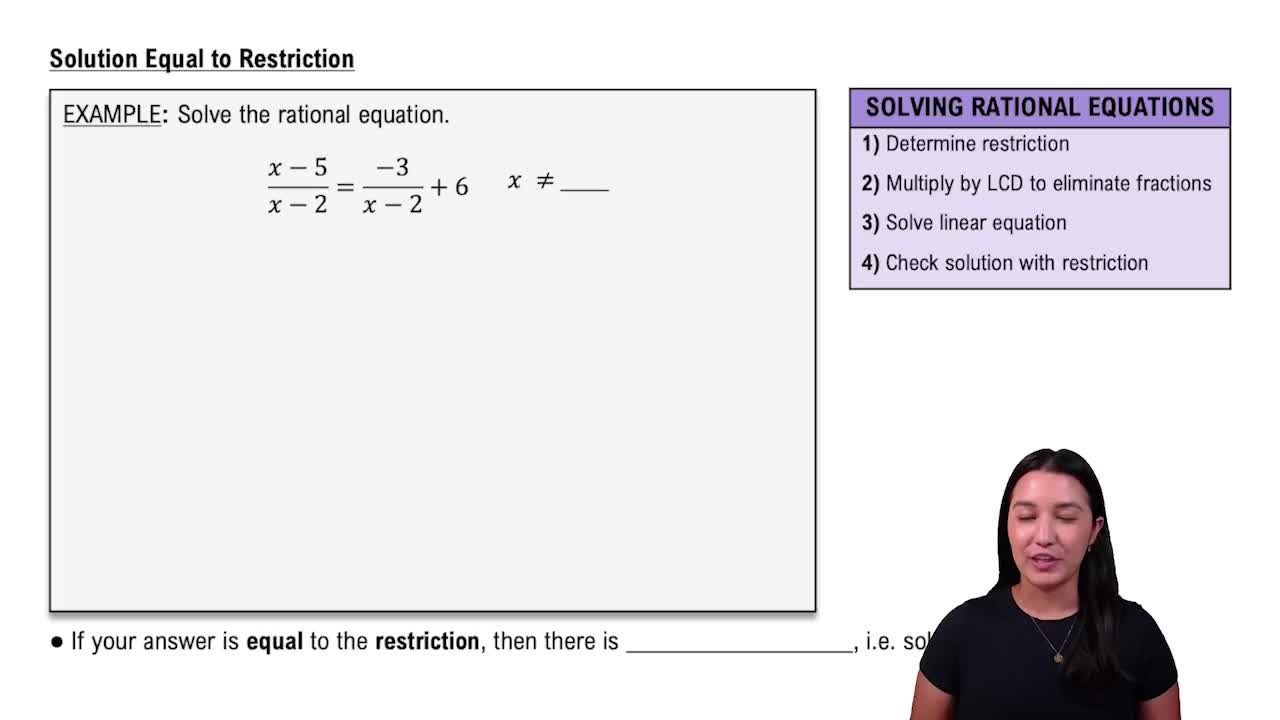
Restrictions on Rational Equations

Inequalities Involving Rational Expressions

When solving inequalities with rational expressions, the solution set includes values that satisfy the inequality and are within the domain. Values that cause division by zero are excluded, even if they satisfy the inequality algebraically.
Recommended video:
Guided course
02:58
Rationalizing Denominators

Exclusion of Points from Solution Sets

Points that make the expression undefined are excluded from the solution set regardless of the inequality. This ensures the solution set only contains valid inputs where the expression is defined and the inequality holds true.
Recommended video:
5:14
Probability of Mutually Exclusive Events