Ch. 1 - Equations and Inequalities
Lial - College Algebra 13th Edition
Lial13th EditionCollege AlgebraISBN: 9780136881063Not the one you use?Change textbook
Chapter 2, Problem 94

Solve each equation. (x+5)2/3+(x+5)1/3-20=0

Verified step by step guidance
1
Start by making a substitution to simplify the equation. Let \(y = (x+5)^{1/3}\), which means \(y^2 = (x+5)^{2/3}\).
Rewrite the original equation \((x+5)^{2/3} + (x+5)^{1/3} - 20 = 0\) in terms of \(y\) as \(y^2 + y - 20 = 0\).
Recognize that the equation \(y^2 + y - 20 = 0\) is a quadratic equation in standard form. Use the quadratic formula \(y = \frac{-b \pm \sqrt{b^2 - 4ac}}{2a}\) where \(a=1\), \(b=1\), and \(c=-20\) to find the values of \(y\).
After finding the values of \(y\), substitute back \(y = (x+5)^{1/3}\) to get equations of the form \((x+5)^{1/3} = y\) for each solution.
Solve each equation \((x+5)^{1/3} = y\) by cubing both sides to isolate \(x\): \(x + 5 = y^3\), then solve for \(x\) by subtracting 5.

Verified video answer for a similar problem:

This video solution was recommended by our tutors as helpful for the problem above.
Video duration:
6m
Was this helpful?

Key Concepts

Here are the essential concepts you must grasp in order to answer the question correctly.

Rational Exponents

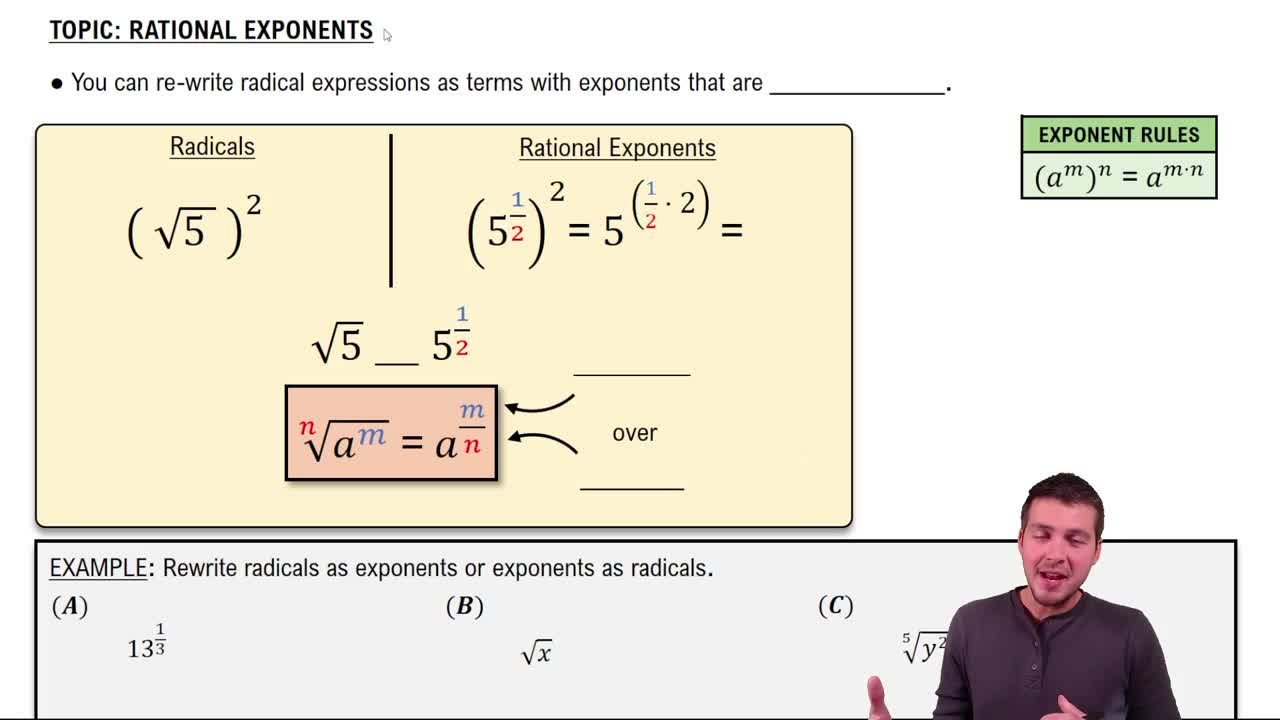
Rational exponents represent roots and powers simultaneously, where the numerator is the power and the denominator is the root. For example, x^(2/3) means the cube root of x squared. Understanding how to manipulate and simplify expressions with rational exponents is essential for solving equations like the given one.
Recommended video:
Guided course
04:06
Rational Exponents

Substitution Method

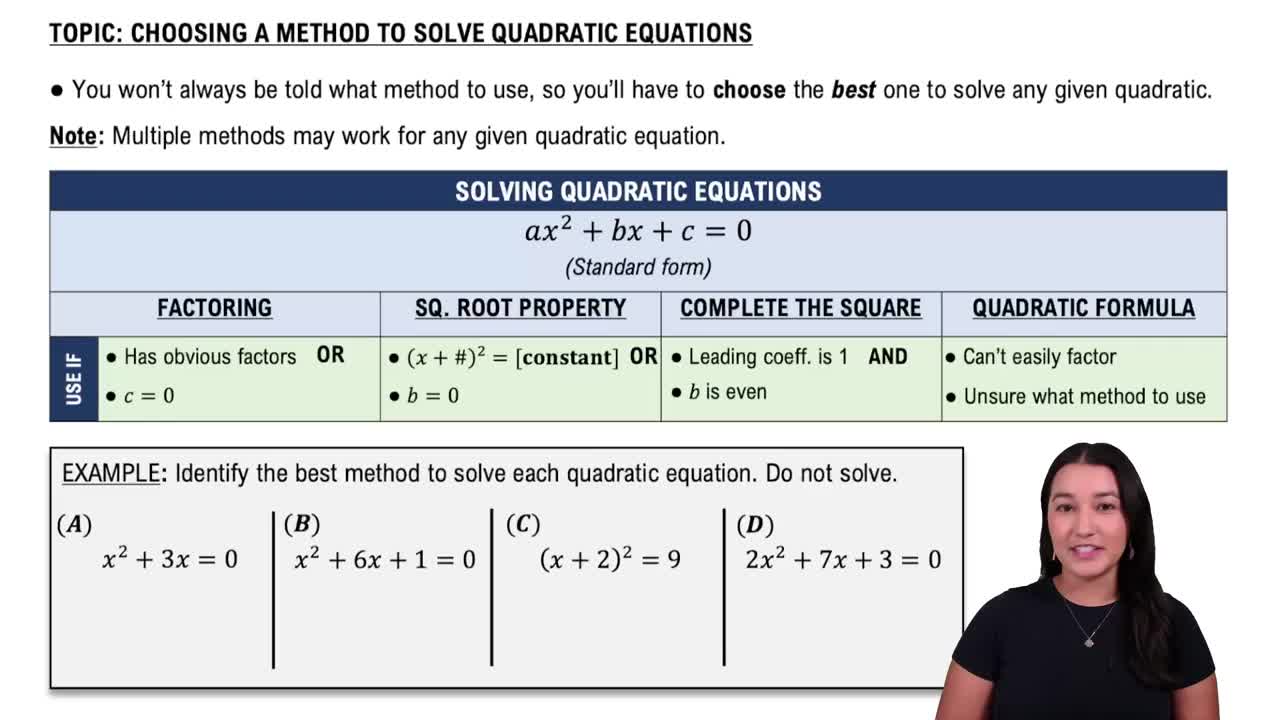
The substitution method involves replacing a complex expression with a single variable to simplify the equation. In this problem, letting y = (x+5)^(1/3) transforms the equation into a quadratic form, making it easier to solve. After solving for y, substitute back to find x.
Recommended video:
04:03
Choosing a Method to Solve Quadratics

Solving Quadratic Equations

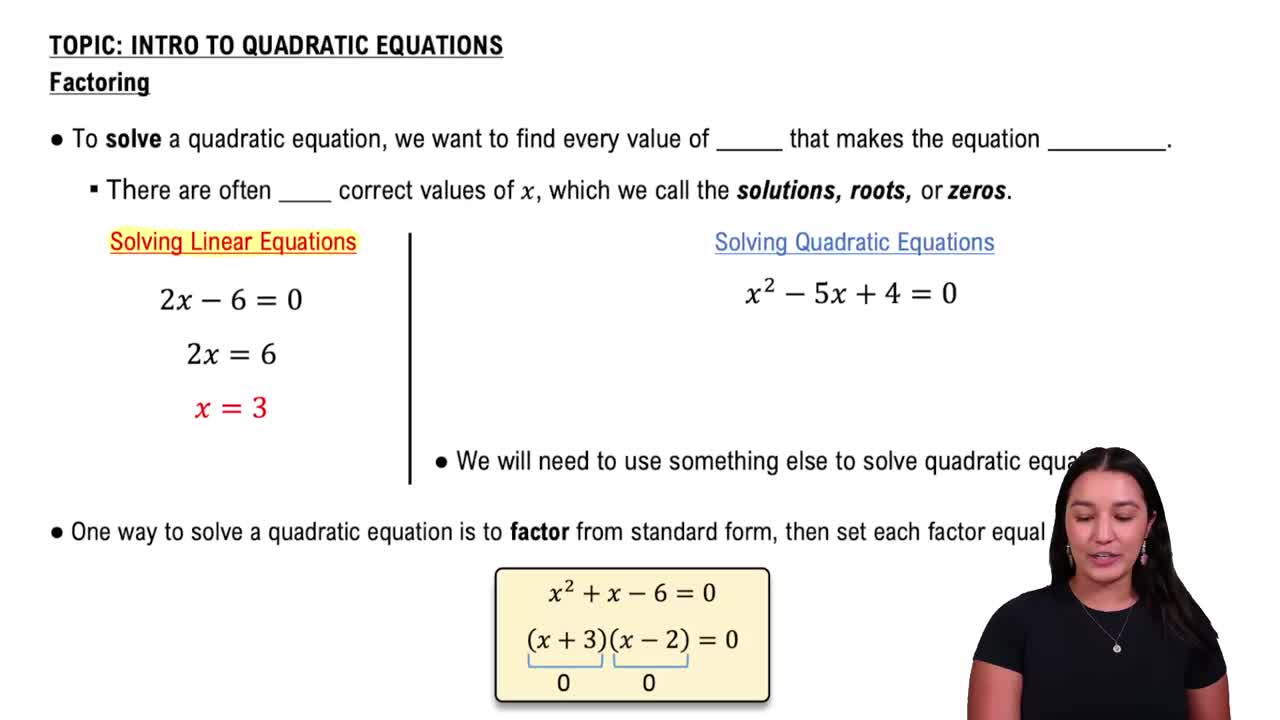
Quadratic equations are polynomial equations of degree two and can be solved by factoring, completing the square, or using the quadratic formula. Once the substitution reduces the original equation to a quadratic in terms of y, these methods help find the values of y, which then lead to the solutions for x.
Recommended video:
06:08
Solving Quadratic Equations by Factoring