Ch. 1 - Equations and Inequalities
Lial - College Algebra 13th Edition
Lial13th EditionCollege AlgebraISBN: 9780136881063Not the one you use?Change textbook
Chapter 2, Problem 60

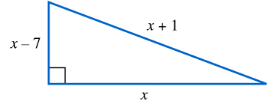
Dimensions of a Right Triangle The shortest side of a right triangle is 7 in. shorter than the middle side, while the longest side (the hypotenuse) is 1 in. longer than the middle side. Find the lengths of the sides.
Right triangle with sides labeled x, x minus 7, and x plus 1, showing a right angle at the shortest side.

Verified step by step guidance
1
Assign a variable to represent the length of the middle side. Let the middle side be \(x\) inches.
Express the shortest side in terms of \(x\). Since it is 7 inches shorter than the middle side, the shortest side is \(x - 7\) inches.
Express the longest side (hypotenuse) in terms of \(x\). Since it is 1 inch longer than the middle side, the hypotenuse is \(x + 1\) inches.
Use the Pythagorean theorem for right triangles, which states that the sum of the squares of the two shorter sides equals the square of the hypotenuse: \\$ (x - 7)^2 + x^2 = (x + 1)^2 $
Expand and simplify the equation, then solve the resulting quadratic equation for \(x\). After finding \(x\), substitute back to find the lengths of the shortest and longest sides.

Verified video answer for a similar problem:

This video solution was recommended by our tutors as helpful for the problem above.
Video duration:
5m
Was this helpful?

Key Concepts

Here are the essential concepts you must grasp in order to answer the question correctly.

Pythagorean Theorem

The Pythagorean theorem states that in a right triangle, the square of the hypotenuse (longest side) equals the sum of the squares of the other two sides. This relationship, a² + b² = c², is essential for finding unknown side lengths when two sides are known or expressed in terms of each other.

Algebraic Expressions and Variables

Using variables to represent unknown side lengths allows setting up equations based on given relationships. For example, if the middle side is x, the shortest side can be expressed as x - 7, and the hypotenuse as x + 1. This translation from words to algebraic expressions is crucial for solving the problem.
Recommended video:
Guided course
05:09
Introduction to Algebraic Expressions

Solving Quadratic Equations

After substituting the expressions into the Pythagorean theorem, the resulting equation is quadratic. Solving quadratic equations involves rearranging terms, factoring or using the quadratic formula, and interpreting the solutions in the context of the problem to find valid side lengths.
Recommended video:
06:08
Solving Quadratic Equations by Factoring