Ch. 1 - Equations and Inequalities
Lial - College Algebra 13th Edition
Lial13th EditionCollege AlgebraISBN: 9780136881063Not the one you use?Change textbook
Chapter 2, Problem 9

Use Choices A–D to answer each question. A. 3x2 - 17x - 6 = 0 B. (2x + 5)2 = 7 C. x2 + x = 12 D. (3x - 1)(x - 7) = 0 Which equation is set up for direct use of the zero-factor property? Solve it.

Verified step by step guidance
1
Identify the zero-factor property: it states that if a product of two factors equals zero, then at least one of the factors must be zero. This property is used to solve equations that are factored into a product set equal to zero.
Look at each given equation and determine which one is already factored and set equal to zero. The zero-factor property applies directly only when the equation is in the form (factor1)(factor2) = 0.
From the choices, equation D is (3x - 1)(x - 7) = 0, which is already factored and set equal to zero, making it ready for direct use of the zero-factor property.
Apply the zero-factor property by setting each factor equal to zero: 3x - 1 = 0 and x - 7 = 0.
Solve each simple linear equation separately: for 3x - 1 = 0, add 1 to both sides and then divide by 3; for x - 7 = 0, add 7 to both sides to find the solutions.

Verified video answer for a similar problem:

This video solution was recommended by our tutors as helpful for the problem above.
Video duration:
2m
Was this helpful?

Key Concepts

Here are the essential concepts you must grasp in order to answer the question correctly.

Zero-Factor Property

The zero-factor property states that if the product of two factors equals zero, then at least one of the factors must be zero. This property is used to solve equations set in factored form by setting each factor equal to zero and solving for the variable.
Recommended video:
Guided course
07:30
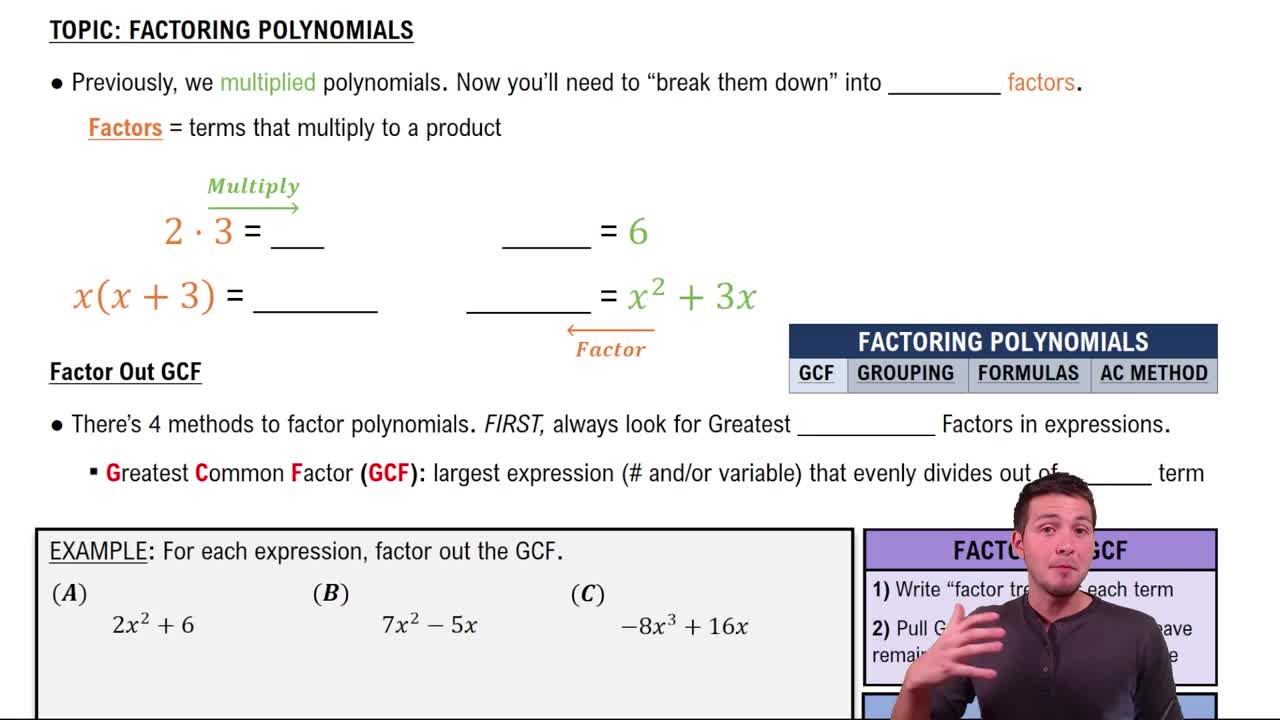
Introduction to Factoring Polynomials

Factored Form of Quadratic Equations

A quadratic equation in factored form is expressed as a product of two binomials set equal to zero, such as (ax + b)(cx + d) = 0. This form allows direct application of the zero-factor property to find the roots of the equation.
Recommended video:
06:08
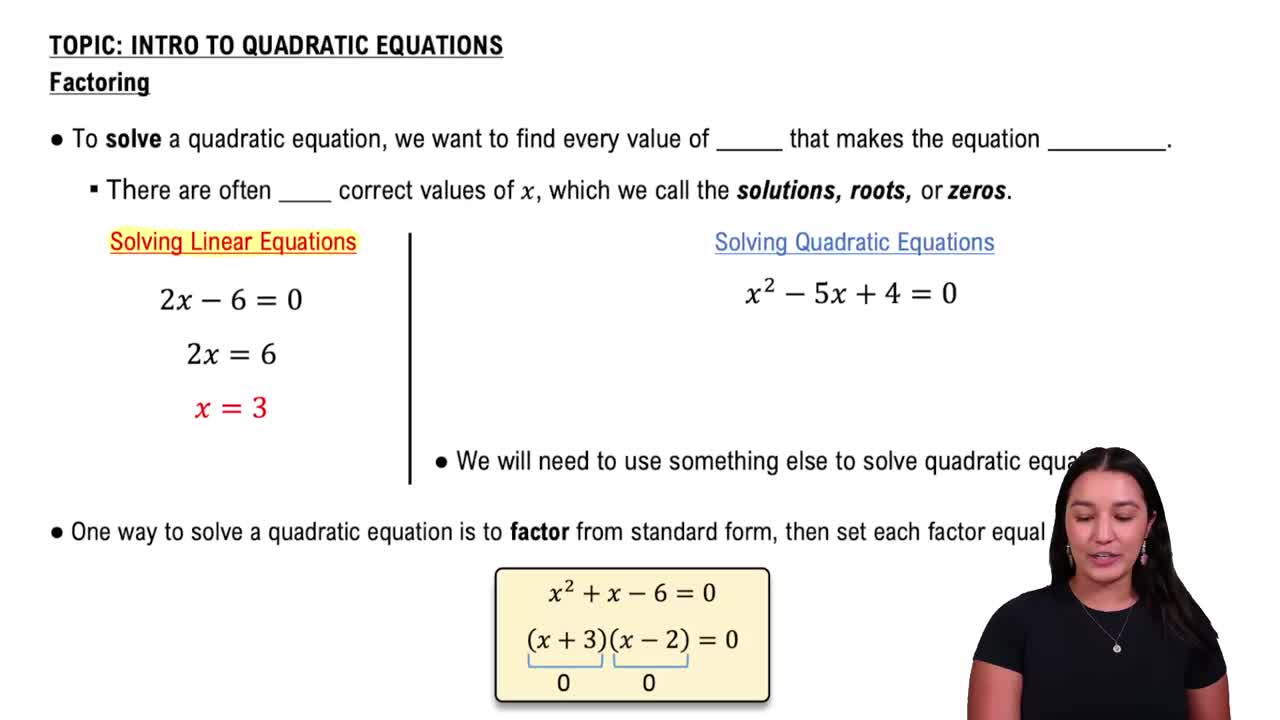
Solving Quadratic Equations by Factoring

Solving Quadratic Equations

Solving quadratic equations involves finding values of the variable that satisfy the equation. Methods include factoring, using the zero-factor property, completing the square, or applying the quadratic formula, depending on the equation's form.
Recommended video:
06:08
Solving Quadratic Equations by Factoring