Ch. 1 - Equations and Inequalities
Lial - College Algebra 13th Edition
Lial13th EditionCollege AlgebraISBN: 9780136881063Not the one you use?Change textbook
Chapter 2, Problem 12

Use Choices A–D to answer each question. A. 3x2 - 17x - 6 = 0 B. (2x + 5)2 = 7 C. x2 + x = 12 D. (3x - 1)(x - 7) = 0 Only one of the equations is set up so that the values of a, b, and c can be determined immediately. Which one is it? Solve it.

Verified step by step guidance
1
Identify the standard form of a quadratic equation, which is \(ax^2 + bx + c = 0\), where \(a\), \(b\), and \(c\) are constants.
Examine each given equation to see which one is already written in this standard form:
A. \(3x^2 - 17x - 6 = 0\) is in the form \(ax^2 + bx + c = 0\) with \(a=3\), \(b=-17\), and \(c=-6\).
B. \((2x + 5)^2 = 7\) is not in standard form; it needs to be expanded and rearranged.
C. \(x^2 + x = 12\) needs to be rearranged by subtracting 12 from both sides to get \(x^2 + x - 12 = 0\).
D. \((3x - 1)(x - 7) = 0\) is factored form; it can be expanded to standard form but is not immediately in that form.
Since equation A is already in standard form, use the quadratic formula to solve it: \(x = \frac{-b \pm \sqrt{b^2 - 4ac}}{2a}\).
Substitute \(a=3\), \(b=-17\), and \(c=-6\) into the quadratic formula and simplify under the square root and the entire expression to find the solutions for \(x\).

Verified video answer for a similar problem:

This video solution was recommended by our tutors as helpful for the problem above.
Video duration:
4m
Was this helpful?

Key Concepts

Here are the essential concepts you must grasp in order to answer the question correctly.

Standard Form of a Quadratic Equation

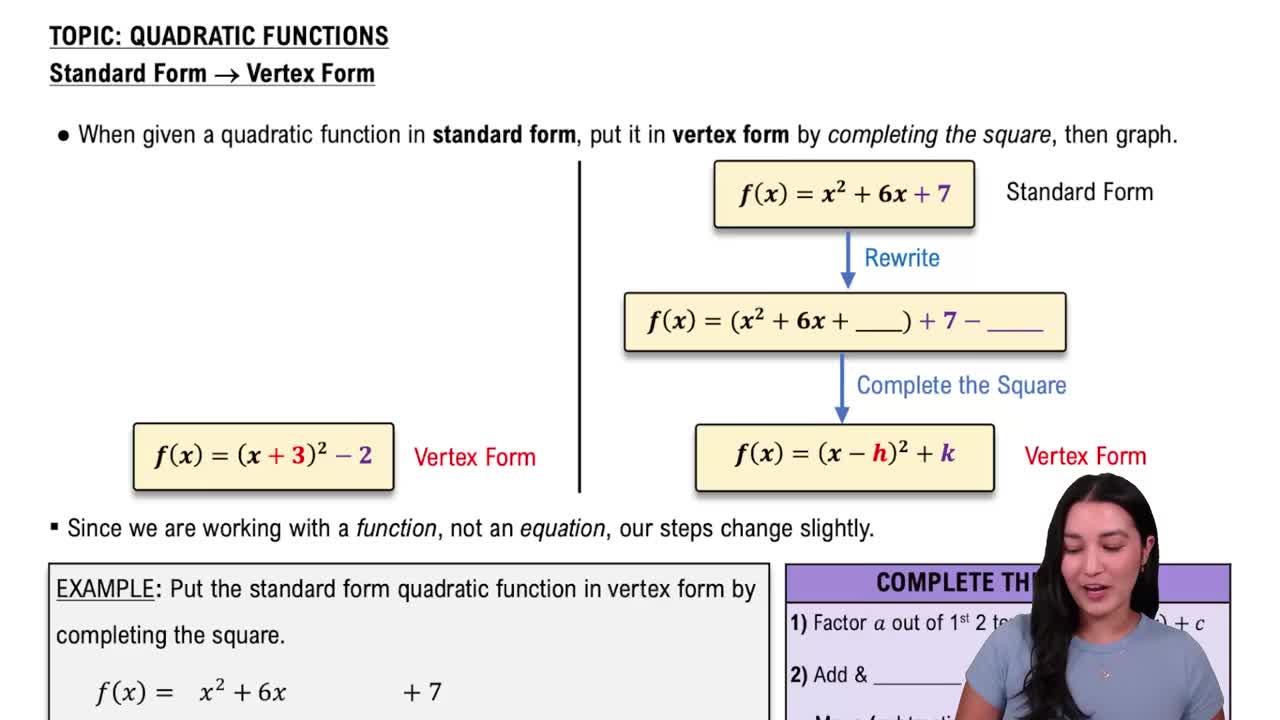
A quadratic equation is in standard form when written as ax² + bx + c = 0, where a, b, and c are constants. This form allows immediate identification of coefficients needed for solving the equation using methods like the quadratic formula.
Recommended video:
04:34
Converting Standard Form to Vertex Form

Identifying Coefficients a, b, and c

To solve a quadratic equation using formulas, you must know the values of a, b, and c. These are the coefficients of x², x, and the constant term, respectively, and must be clearly visible or easily extracted from the equation.
Recommended video:
05:01
Identifying Intervals of Unknown Behavior

Solving Quadratic Equations by Factoring

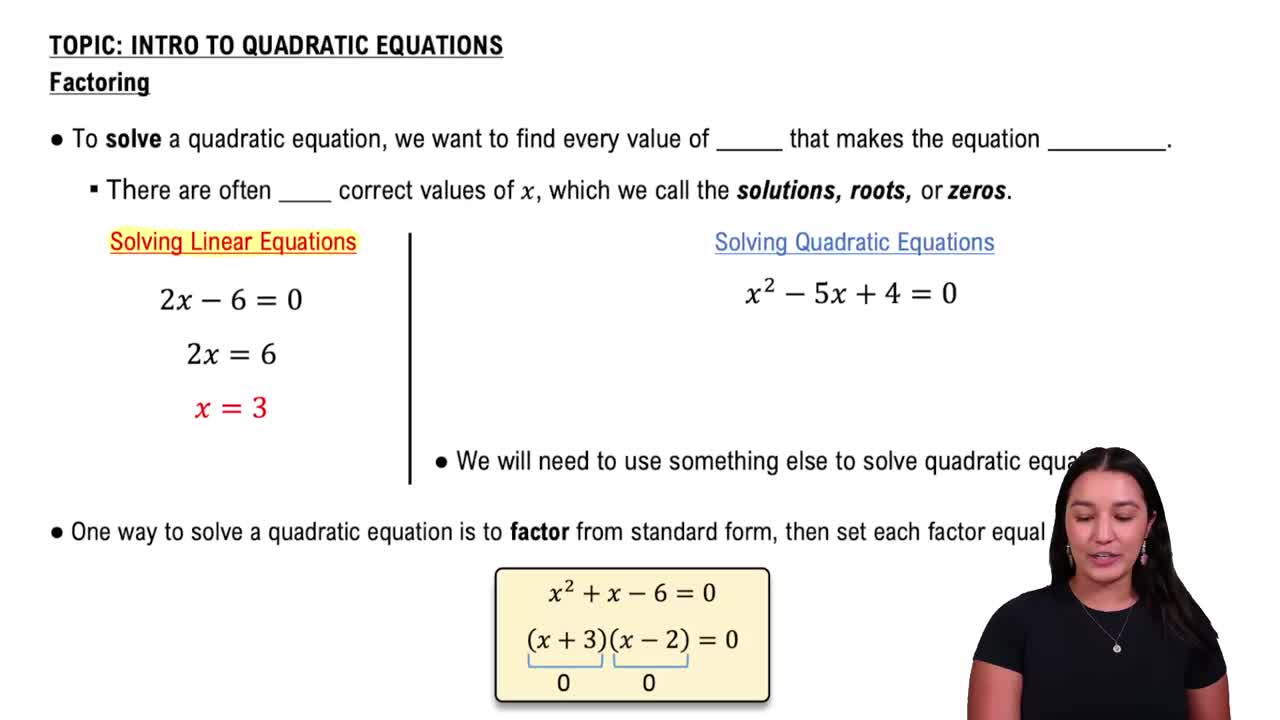
Factoring involves expressing a quadratic as a product of binomials set equal to zero. This method is efficient when the equation is factorable, allowing you to find solutions by setting each factor equal to zero and solving for x.
Recommended video:
06:08
Solving Quadratic Equations by Factoring