Ch. 1 - Equations and Inequalities
Lial - College Algebra 13th Edition
Lial13th EditionCollege AlgebraISBN: 9780136881063Not the one you use?Change textbook
Chapter 2, Problem 99

Use the method described in Exercises 83–86, if applicable, and properties of absolute value to solve each equation or inequality. (Hint: Exercises 99 and 100 can be solved by inspection.)
x4+2x2+1<0| x^4 + 2x^2 + 1 | < 0

Verified step by step guidance
1
Recognize that the expression inside the absolute value is \(x^4 + 2x^2 + 1\). Notice that this can be rewritten as a perfect square: \(x^4 + 2x^2 + 1 = (x^2 + 1)^2\).
Recall the property of absolute value: for any real number \(a\), \(|a| \geq 0\). This means the absolute value of any expression is always non-negative.
Since \(| (x^2 + 1)^2 | = (x^2 + 1)^2\) (because squares are always non-negative), the inequality \(|x^4 + 2x^2 + 1| < 0\) becomes \((x^2 + 1)^2 < 0\).
Consider the expression \((x^2 + 1)^2\). Since \(x^2 \geq 0\) for all real \(x\), \(x^2 + 1 \geq 1\), so \((x^2 + 1)^2 \geq 1\) for all real \(x\). Therefore, it is never less than zero.
Conclude that there are no real solutions to the inequality \(|x^4 + 2x^2 + 1| < 0\) because an absolute value expression cannot be negative.

Verified video answer for a similar problem:

This video solution was recommended by our tutors as helpful for the problem above.
Video duration:
53s
Was this helpful?

Key Concepts

Here are the essential concepts you must grasp in order to answer the question correctly.

Properties of Absolute Value

The absolute value of a number represents its distance from zero on the number line and is always non-negative. For any expression |A|, the result is either zero or positive, never negative. This property is crucial when solving inequalities involving absolute values, as it helps determine if certain inequalities are possible or not.
Recommended video:
5:36
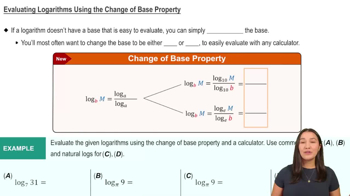
Change of Base Property

Polynomial Expressions and Their Values

Understanding how to evaluate polynomial expressions like x^4 + 2x^2 + 1 is essential. This particular polynomial is always positive or zero because it can be rewritten as (x^2 + 1)^2, which is a perfect square. Recognizing this helps in analyzing the inequality and determining if the expression inside the absolute value can be negative.
Recommended video:
Guided course
05:09
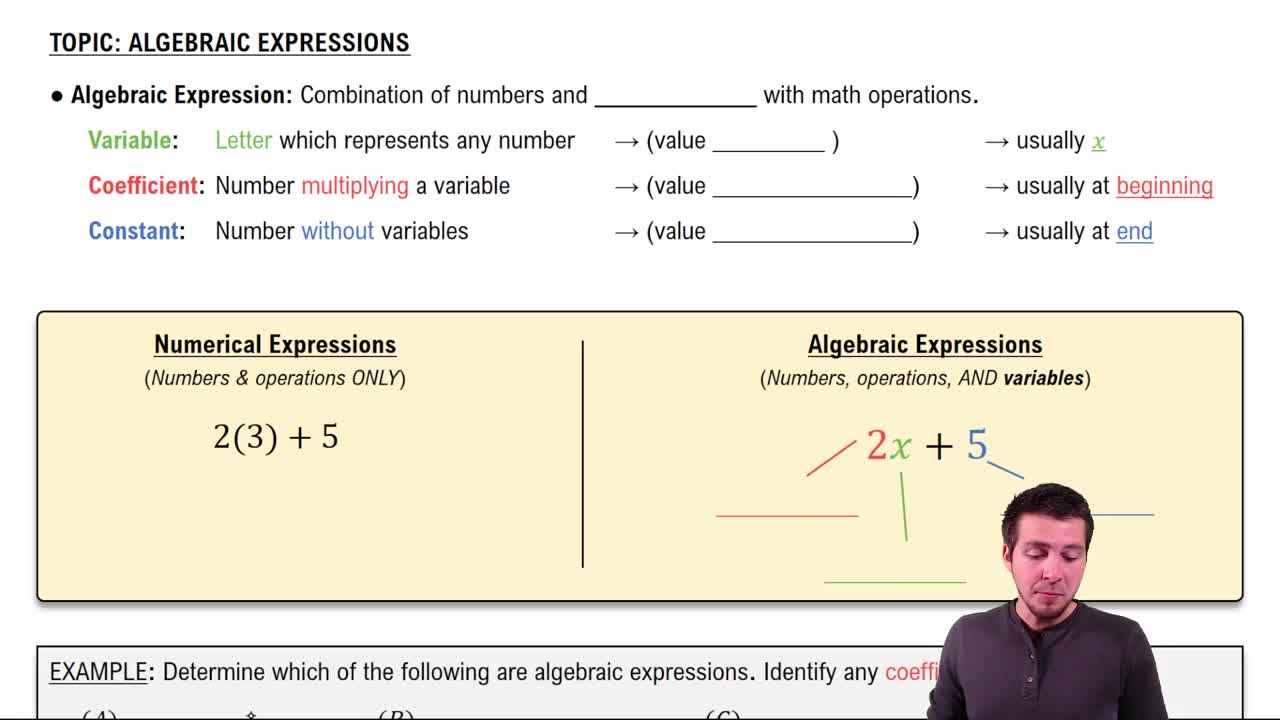
Introduction to Algebraic Expressions

Solving Inequalities Involving Absolute Values

When solving inequalities with absolute values, such as |expression| < 0, it is important to know that absolute values cannot be less than zero. This means such inequalities have no solution unless the inequality is non-strict (≤ 0) and the expression inside equals zero. This concept helps quickly identify if the inequality is solvable.
Recommended video:
06:07
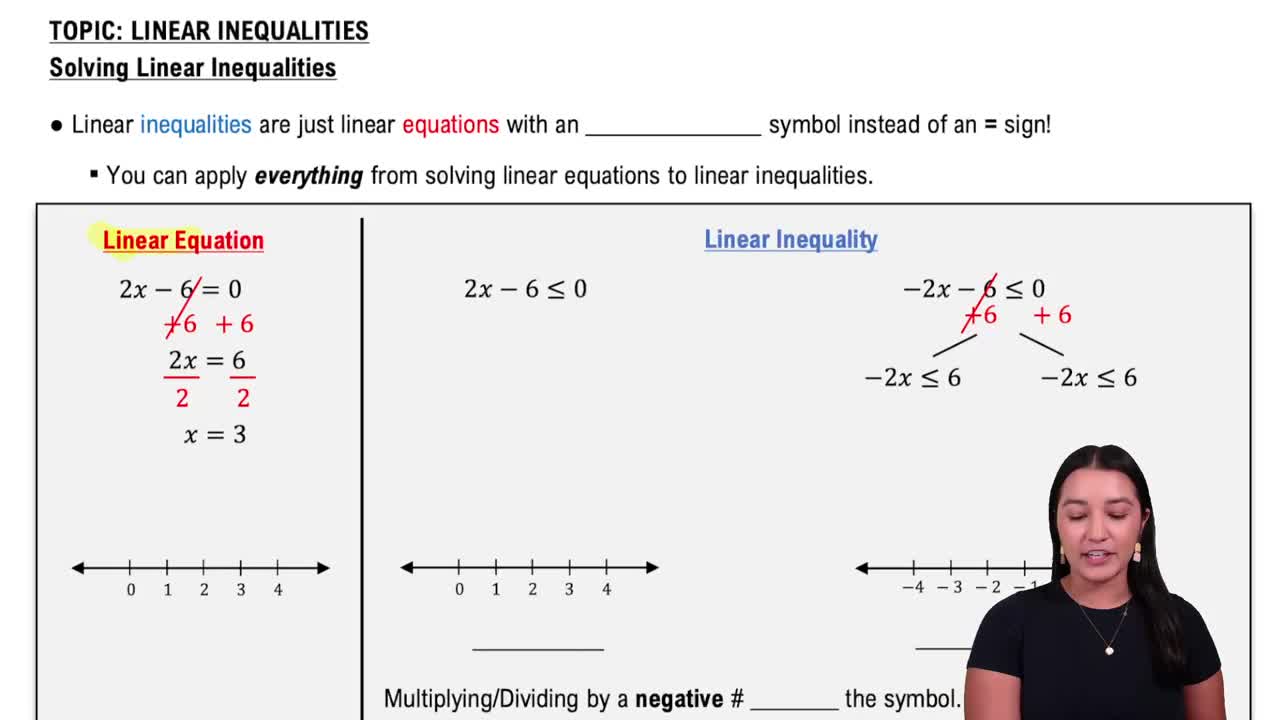
Linear Inequalities