Resistance of a Wire The resistance in ohms of a platinum wire temperature sensor varies directly as the temperature in kelvins (K). If the resistance is 646 ohms at a temperature of 190 K, find the resistance at a temperature of 250 K.
Ch. 3 - Polynomial and Rational Functions

Chapter 4, Problem 30
Find all rational zeros of each function.
Verified step by step guidance1
Identify the polynomial function: \(f(x) = 8x^4 - 14x^3 - 29x^2 - 4x + 3\).
List all possible rational zeros using the Rational Root Theorem. The possible rational zeros are of the form \(\pm \frac{p}{q}\), where \(p\) divides the constant term (3) and \(q\) divides the leading coefficient (8). So, possible values of \(p\) are \(\pm1, \pm3\) and possible values of \(q\) are \(\pm1, \pm2, \pm4, \pm8\).
Form the complete list of possible rational zeros: \(\pm1, \pm\frac{1}{2}, \pm\frac{1}{4}, \pm\frac{1}{8}, \pm3, \pm\frac{3}{2}, \pm\frac{3}{4}, \pm\frac{3}{8}\).
Test each possible rational zero by substituting it into \(f(x)\) to check if it equals zero. This can be done by direct substitution or synthetic division.
Once a zero is found, use polynomial division (synthetic or long division) to divide \(f(x)\) by the corresponding factor \((x - r)\), where \(r\) is the zero found, to reduce the polynomial degree and repeat the process to find all rational zeros.

Verified video answer for a similar problem:
This video solution was recommended by our tutors as helpful for the problem above.
Video duration:
3mWas this helpful?
Key Concepts
Here are the essential concepts you must grasp in order to answer the question correctly.
Rational Root Theorem
The Rational Root Theorem helps identify possible rational zeros of a polynomial by considering factors of the constant term and the leading coefficient. For ƒ(x), possible rational roots are ±(factors of 3) divided by ±(factors of 8). This narrows down candidates to test.
Recommended video:
Guided course
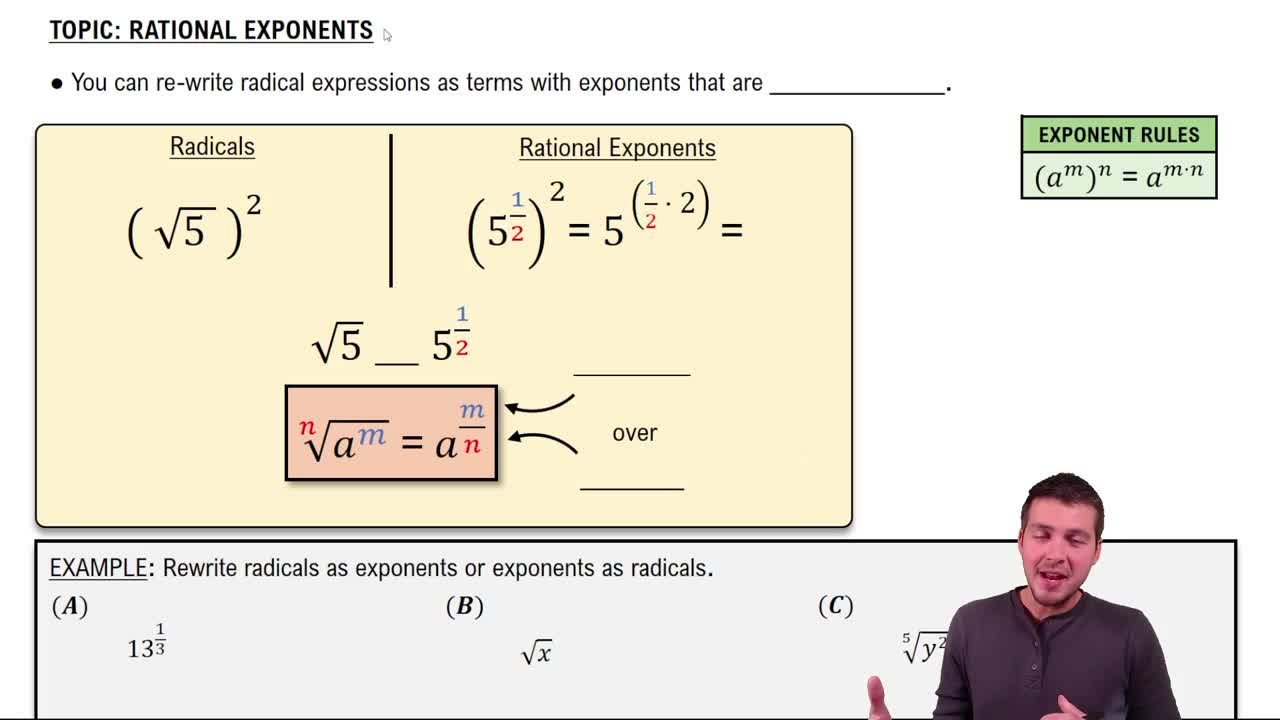
Rational Exponents
Polynomial Division (Synthetic or Long Division)
Polynomial division is used to divide the original polynomial by a candidate root's corresponding factor (x - r). If the remainder is zero, r is a root, and the quotient is a reduced polynomial to further factor or solve.
Recommended video:
Guided course
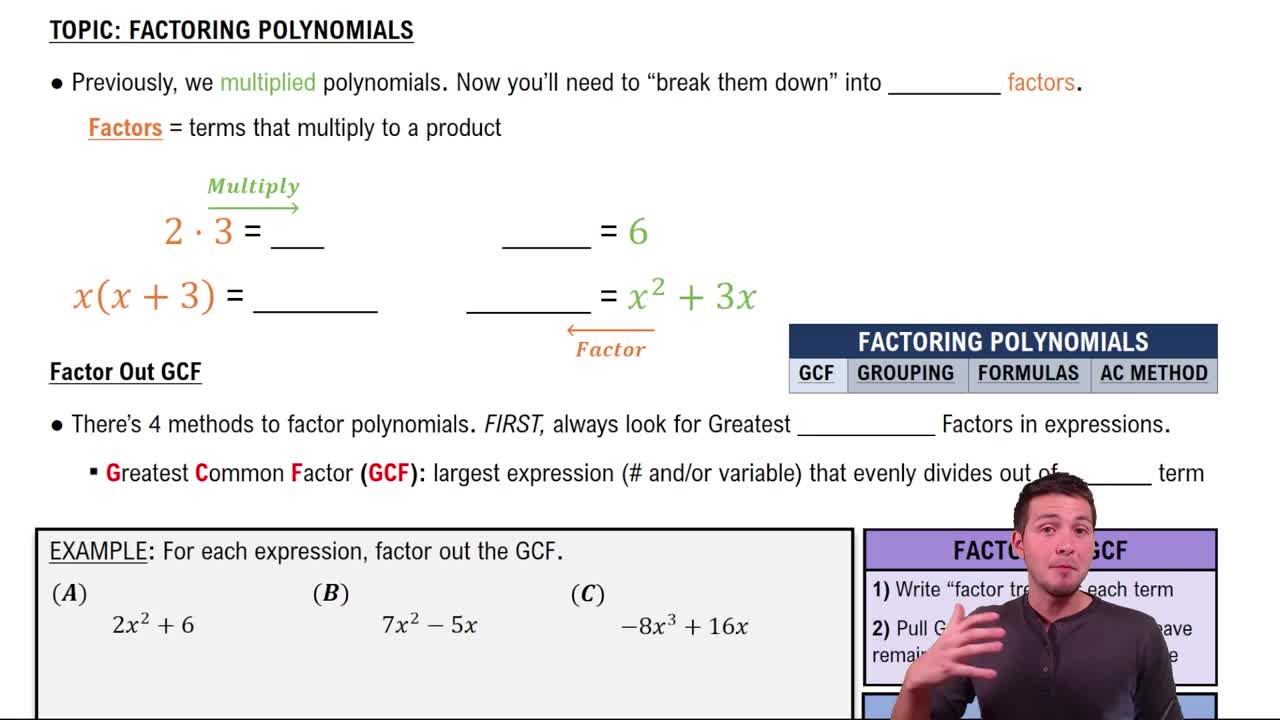
Introduction to Factoring Polynomials
Factoring and Solving Polynomial Equations
After identifying a root and dividing, the resulting polynomial can be factored further or solved using methods like factoring quadratics or applying the quadratic formula. This process helps find all rational zeros of the original polynomial.
Recommended video:
Guided course
Introduction to Factoring Polynomials
Related Practice
Textbook Question
496
views
Textbook Question
Graph each polynomial function. Factor first if the polynomial is not in factored form. ƒ(x)=-2x(x-3)(x+2)
1221
views
Textbook Question
Use synthetic division to divide ƒ(x) by x-k for the given value of k. Then express ƒ(x) in the form ƒ(x) = (x-k) q(x) + r. ƒ(x) = 3x4 + 4x3 - 10x2 + 15; k = -1
679
views
1
rank
Textbook Question
Match the rational function in Column I with the appropriate description in Column II. Choices in Column II can be used only once.
762
views
Textbook Question
Solve each polynomial inequality. Give the solution set in interval notation. (x - 3)(x - 4)(x - 5)2 ≤ 0
501
views
Textbook Question
Graph each quadratic function. Give the (a) vertex, (b) axis, (c) domain, and (d) range. ƒ(x) = x2 + 6x + 5
997
views
