Distance to the Horizon The distance that a person can see to the horizon on a clear day from a point above the surface of Earth varies directly as the square root of the height at that point. If a person 144 m above the surface of Earth can see 18 km to the horizon, how far can a person see to the horizon from a point 64 m above the surface?
Ch. 3 - Polynomial and Rational Functions

Chapter 4, Problem 31
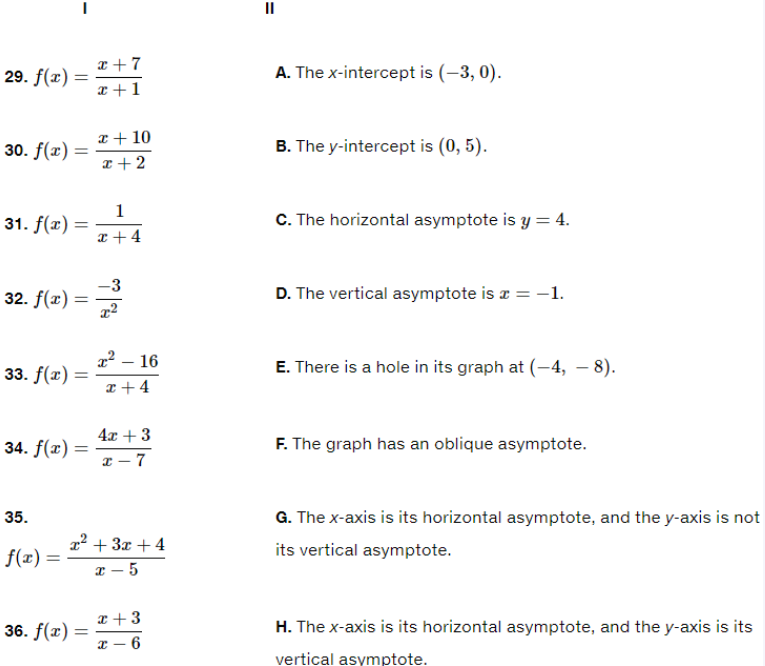
Match the rational function in Column I with the appropriate description in Column II. Choices in Column II can be used only once. ƒ(x)=1/(x+4)

Verified step by step guidance1
Identify the given rational function: \(f(x) = \frac{1}{x+4}\).
Recognize that the function is a transformation of the parent function \(f(x) = \frac{1}{x}\), shifted horizontally.
Determine the vertical asymptote by setting the denominator equal to zero: \(x + 4 = 0\), which gives \(x = -4\).
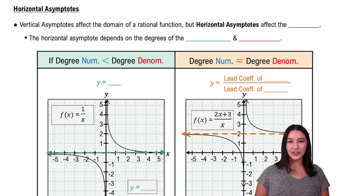
Note that the horizontal asymptote of the function remains \(y = 0\) because the degree of the numerator is less than the degree of the denominator.
Match the function to the description that mentions a vertical asymptote at \(x = -4\) and a horizontal asymptote at \(y = 0\), indicating a horizontal shift of the parent function.

Verified video answer for a similar problem:
This video solution was recommended by our tutors as helpful for the problem above.
Video duration:
1mWas this helpful?
Key Concepts
Here are the essential concepts you must grasp in order to answer the question correctly.
Rational Functions
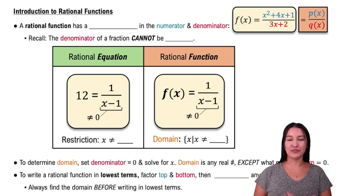
A rational function is a ratio of two polynomials, expressed as f(x) = P(x)/Q(x), where Q(x) ≠ 0. Understanding the form and behavior of rational functions helps in identifying their key features such as asymptotes and domain restrictions.
Recommended video:
Intro to Rational Functions
Domain of Rational Functions
The domain of a rational function includes all real numbers except where the denominator equals zero. For f(x) = 1/(x+4), the domain excludes x = -4, since division by zero is undefined, which is critical for matching the function to its description.
Recommended video:
Intro to Rational Functions
Vertical and Horizontal Asymptotes
Vertical asymptotes occur where the denominator is zero, indicating values the function cannot take. Horizontal asymptotes describe the end behavior of the function as x approaches infinity or negative infinity. For f(x) = 1/(x+4), x = -4 is a vertical asymptote, and y = 0 is a horizontal asymptote.
Recommended video:
Determining Horizontal Asymptotes
Related Practice
Textbook Question
511
views
Textbook Question
Factor into linear factors given that k is a zero. (multiplicity )
1010
views
Textbook Question
Show that each polynomial function has a real zero as described in parts (a) and (b). In Exercises 31 and 32, also work part (c). ƒ(x)=3x^3-8x^2+x+2 Find the zero in part (b) to three decimal places.
365
views
Textbook Question
Show that each polynomial function has a real zero as described in parts (a) and (b). In Exercises 31 and 32, also work part (c). ƒ(x)=3x^3-8x^2+x+2 between 2 and 3
369
views
Textbook Question
Solve each polynomial inequality. Give the solution set in interval notation. -(x - 3)(x - 4)2 (x - 5) > 0
475
views
Textbook Question
Show that each polynomial function has a real zero as described in parts (a) and (b). In Exercises 31 and 32, also work part (c). ƒ(x)=3x^3-8x^2+x+2 between -1 and 0
275
views
