Ch. 3 - Polynomial and Rational Functions
Lial - College Algebra 13th Edition
Lial13th EditionCollege AlgebraISBN: 9780136881063Not the one you use?Change textbook
Chapter 4, Problem 7f

Solve each problem. During the course of a year, the number of volunteers available to run a food bank each month is modeled by V(x)V(x), where V(x)=2x232x+150V(x)=2x^2-32x+150 between the months of January and August. Here x is time in months, with x=1 representing January. From August to December, V(x)V(x) is modeled by V(x)=31x226V(x)=31x-226. Find the number of volunteers in each of the following months. Sketch a graph of y=V(x)y=V(x) for January through December. In what month are the fewest volunteers available?

Verified step by step guidance
1
Identify the piecewise function for the number of volunteers, \(V(x)\), where \(x\) represents the month number: for January to August (\(x=1\) to \(x=8\)), use \(V(x) = 2x^2 - 32x + 150\), and for September to December (\(x=9\) to \(x=12\)), use \(V(x) = 31x - 226\).
Calculate the number of volunteers for each month by substituting the month number \(x\) into the appropriate formula: for \(x=1\) to \(8\), compute \(V(x) = 2x^2 - 32x + 150\), and for \(x=9\) to \(12\), compute \(V(x) = 31x - 226\).
List the values of \(V(x)\) for all months from January (\(x=1\)) through December (\(x=12\)) to have a complete set of volunteer numbers for the year.
Sketch the graph of \(y = V(x)\) by plotting the points \((x, V(x))\) for each month \(x=1\) to \(12\). Note that the graph will have two parts: a quadratic curve from January to August and a linear function from September to December.
Analyze the calculated values or the graph to determine the month with the fewest volunteers by identifying the minimum value of \(V(x)\) over the entire range \(x=1\) to \(12\).

Verified video answer for a similar problem:

This video solution was recommended by our tutors as helpful for the problem above.
Video duration:
12m
Was this helpful?

Key Concepts

Here are the essential concepts you must grasp in order to answer the question correctly.

Piecewise Functions

A piecewise function is defined by different expressions over different intervals of the domain. In this problem, V(x) is given by one quadratic formula from January to August and a linear formula from August to December. Understanding how to evaluate and interpret piecewise functions is essential for finding values and analyzing the behavior over specified intervals.
Recommended video:
4:56
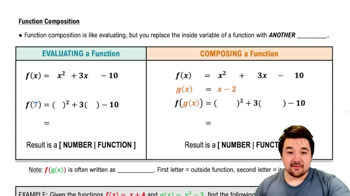
Function Composition

Evaluating Functions

Evaluating a function means substituting a given input value into the function's formula to find the output. Here, to find the number of volunteers in each month, you substitute the month number (x) into the appropriate formula for V(x). Accurate substitution and calculation are key to determining the correct volunteer counts.
Recommended video:
4:26
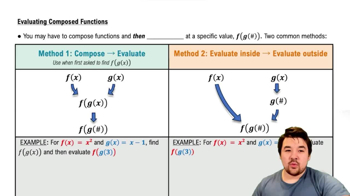
Evaluating Composed Functions

Graphing and Analyzing Functions

Graphing a function involves plotting points (x, V(x)) to visualize its behavior over a domain. For this problem, sketching V(x) from January to December helps identify trends and the month with the fewest volunteers. Understanding how to interpret graphs, including identifying minima, is crucial for answering questions about the function's real-world implications.
Recommended video:
5:26
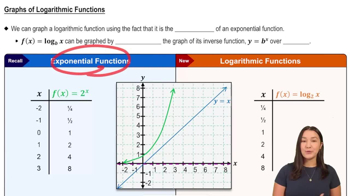
Graphs of Logarithmic Functions
Related Practice
Textbook Question

Use the graph to solve each equation or inequality. Use interval notation where appropriate. 2(x-2) / {(x-1)(x-3)} < 0

502
views
Textbook Question

Solve each problem. During the course of ayear, the number of volunteers available to run a food bank each month is modeled by V(x),V(x), where V(x)=2x232x+150V(x)=2x^2-32x+150 between the months of January and August. Here x is time in months, with x=1 representing January. From August to December, V(x)V(x) is modeled by V(x)=31x226V(x)=31x-226. Find the number of volunteers in each of the following months.

August

742
views
Textbook Question

Determine whether each statement is true or false. If false, explain why. The product of a complex number and its conjugate is always a real number.

550
views
Textbook Question

Solve each problem. During the course of a year, the number of volunteers available to run a food bank each month is modeled by V(x)V(x), where V(x)=2x232x+150V(x)=2x^2-32x+150 between the months of January and August. Here x is time in months, with x=1 representing January. From August to December, V(x)V(x) is modeled by V(x)=31x226V(x)=31x-226. Find the number of volunteers in each of the following months.

October

703
views
Textbook Question

Provide a short answer to each question. Is ƒ(x)=1/x an even or an odd function? What symmetry does its graph exhibit?

613
views
Textbook Question

Solve each problem. During the course of a year, the number of volunteers available to run a food bank each month is modeled by V(x)V(x), where V(x)=2x232x+150V(x)=2x^2-32x+150 between the months of January and August. Here x is time in months, with x=1 representing January. From August to December, V(x)V(x) is modeled by V(x)=31x226V(x)=31x-226. Find the number of volunteers in each of the following months.

December

517
views