Match the rational function in Column I with the appropriate description in Column II. Choices in Column II can be used only once. ƒ(x)=(x2-16)/(x+4)
Ch. 3 - Polynomial and Rational Functions

Chapter 4, Problem 34
Solve each problem. Use Descartes' rule of signs to determine the different possibilities for the numbers of positive, negative, and nonreal complex zeros of .
Verified step by step guidance1
Write down the polynomial function: \(f(x) = x^3 + 3x^2 - 4x - 2\).
Apply Descartes' Rule of Signs to find the possible number of positive real zeros by counting the sign changes in \(f(x)\). Look at the coefficients of \(f(x)\) in order: \(+1, +3, -4, -2\). Count how many times the sign changes from one term to the next.
To find the possible number of negative real zeros, evaluate \(f(-x)\) by substituting \(-x\) into the polynomial: \(f(-x) = (-x)^3 + 3(-x)^2 - 4(-x) - 2\). Simplify this expression and then count the sign changes in the coefficients of \(f(-x)\).
Use the counts of sign changes from steps 2 and 3 to list the possible numbers of positive and negative real zeros. Remember, the number of positive or negative real zeros is either equal to the number of sign changes or less than that by an even number (e.g., if there are 3 sign changes, possible zeros are 3 or 1).
Determine the number of nonreal complex zeros by using the fact that the total number of zeros (counting multiplicities) equals the degree of the polynomial (which is 3). Subtract the possible positive and negative zeros from 3 to find the possible number of nonreal complex zeros.

Verified video answer for a similar problem:
This video solution was recommended by our tutors as helpful for the problem above.
Video duration:
2mWas this helpful?
Key Concepts
Here are the essential concepts you must grasp in order to answer the question correctly.
Descartes' Rule of Signs
Descartes' Rule of Signs is a technique used to determine the possible number of positive and negative real zeros of a polynomial. It involves counting the number of sign changes in the polynomial's coefficients for f(x) to find positive zeros, and for f(-x) to find negative zeros. The actual number of positive or negative zeros is either equal to the number of sign changes or less than it by an even number.
Recommended video:
Guided course
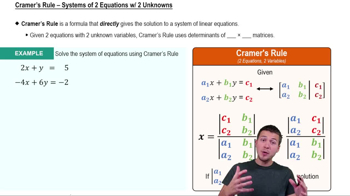
Cramer's Rule - 2 Equations with 2 Unknowns
Polynomial Zeros and Their Types
Polynomial zeros are the values of x that make the polynomial equal to zero. These zeros can be positive, negative, or nonreal complex numbers. Understanding the nature of zeros helps in analyzing the polynomial's graph and behavior, and in this problem, identifying the possible counts of each type is essential.
Recommended video:
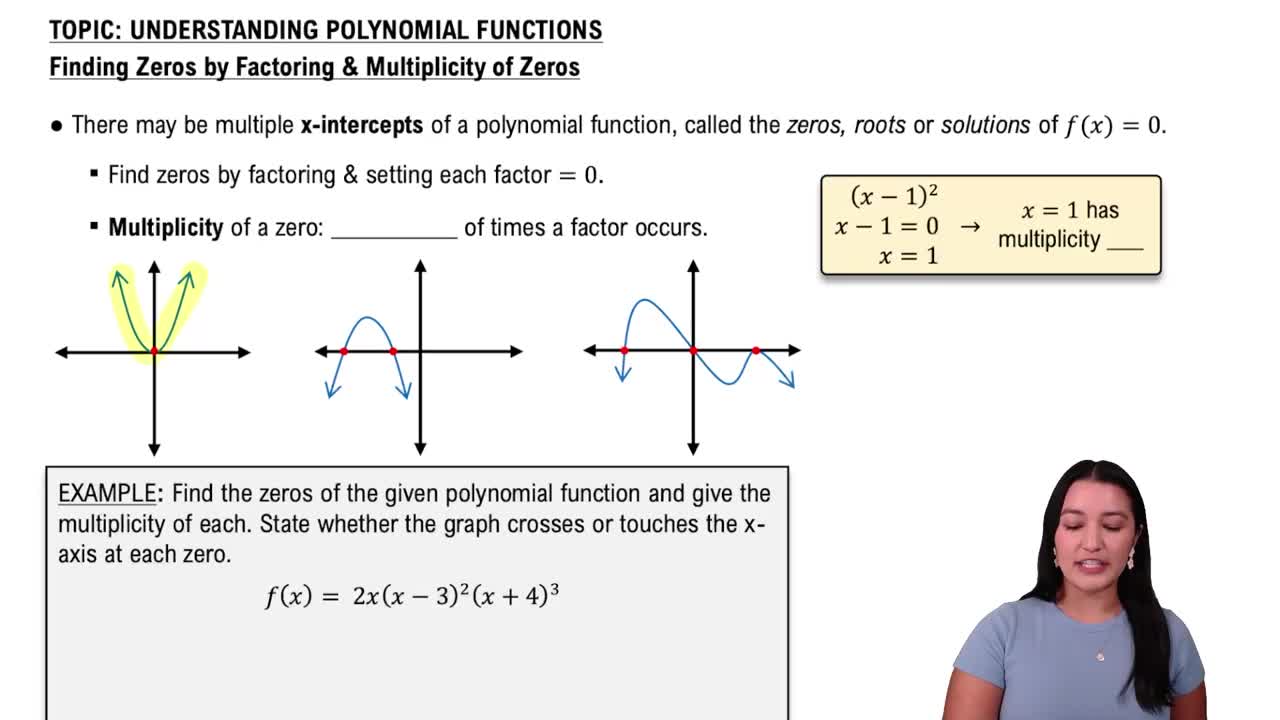
Finding Zeros & Their Multiplicity
Evaluating f(-x) to Find Negative Zeros
To apply Descartes' Rule of Signs for negative zeros, substitute -x into the polynomial to get f(-x). Then count the sign changes in the coefficients of f(-x). This process reveals the possible number of negative real zeros, complementing the count of positive zeros found from f(x).
Recommended video:
Guided course
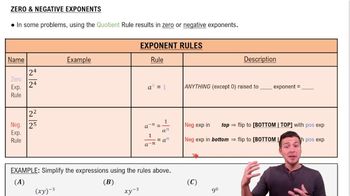
Zero and Negative Rules
Related Practice
Textbook Question
864
views
Textbook Question
Show that each polynomial function has a real zero as described in parts (a) and (b). In Exercises 31 and 32, also work part (c). ƒ(x)=6x^4+13x^3-11x^2-3x+5 no zero greater than 1
484
views
Textbook Question
For each polynomial function, one zero is given. Find all other zeros.
573
views
Textbook Question
Graph each quadratic function. Give the (a) vertex, (b) axis, (c) domain, and (d) range. ƒ(x) = -3x2 + 24x - 46
1436
views
Textbook Question
Show that each polynomial function has a real zero as described in parts (a) and (b). In Exercises 31 and 32, also work part (c). ƒ(x)=6x^4+13x^3-11x^2-3x+5 no zero less than -3
420
views
Textbook Question
Graph each polynomial function. Factor first if the polynomial is not in factored form. ƒ(x)=x2(x-5)(x+3)(x-1)
73
views