Graph each quadratic function. Give the (a) vertex, (b) axis, (c) domain, and (d) range. ƒ(x) = (x - 5)2 - 4
Ch. 3 - Polynomial and Rational Functions

Chapter 4, Problem 26
Use synthetic division to divide ƒ(x) by x-k for the given value of k. Then express ƒ(x) in the form ƒ(x) = (x-k) q(x) + r. ƒ(x) = 2x3 + 3x2 - 16x+10; k = -4
Verified step by step guidance1
Write down the coefficients of the polynomial ƒ(x) = 2x^3 + 3x^2 - 16x + 10. These are: 2, 3, -16, and 10.
Set up synthetic division using k = -4. Write -4 to the left and the coefficients in a row: 2, 3, -16, 10.
Bring down the first coefficient (2) as it is. Then multiply this number by k (-4) and write the result under the next coefficient.
Add the numbers in the second column, write the sum below, then repeat the multiply and add process for each column until you reach the last coefficient.
The numbers you get at the bottom (except the last one) are the coefficients of the quotient polynomial q(x). The last number is the remainder r. Express ƒ(x) as ƒ(x) = (x - (-4)) q(x) + r, or ƒ(x) = (x + 4) q(x) + r.

Verified video answer for a similar problem:
This video solution was recommended by our tutors as helpful for the problem above.
Video duration:
6mWas this helpful?
Key Concepts
Here are the essential concepts you must grasp in order to answer the question correctly.
Synthetic Division
Synthetic division is a shortcut method for dividing a polynomial by a linear factor of the form x - k. It simplifies the long division process by using only the coefficients of the polynomial and performing arithmetic operations in a tabular form. This method quickly provides the quotient and remainder.
Recommended video:
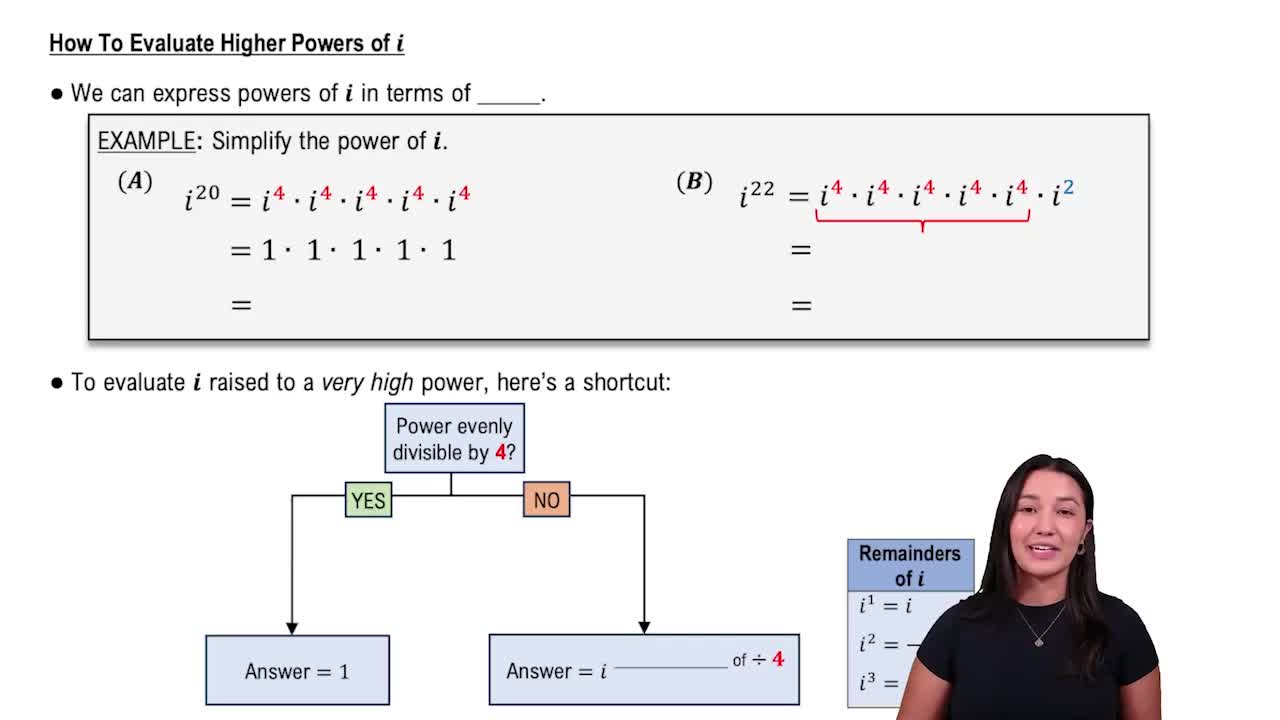
Higher Powers of i
Polynomial Division and Remainder Theorem
When dividing a polynomial ƒ(x) by (x - k), the result can be expressed as ƒ(x) = (x - k)q(x) + r, where q(x) is the quotient polynomial and r is the remainder. The Remainder Theorem states that the remainder r equals ƒ(k), the value of the polynomial evaluated at k.
Recommended video:
Guided course
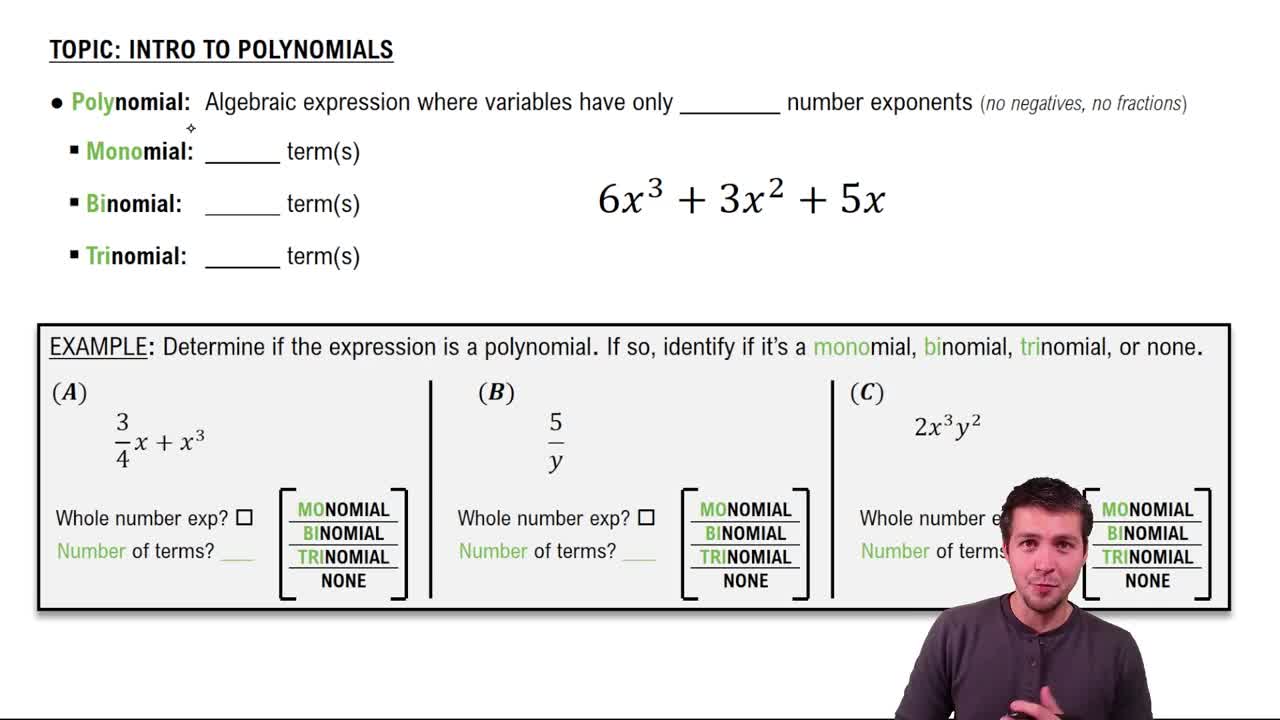
Introduction to Polynomials
Expressing the Polynomial in Division Form
After performing synthetic division, the original polynomial is rewritten as the product of the divisor (x - k) and the quotient q(x), plus the remainder r. This form clearly shows the relationship between the original polynomial and its factors, aiding in factorization and root analysis.
Recommended video:
Guided course
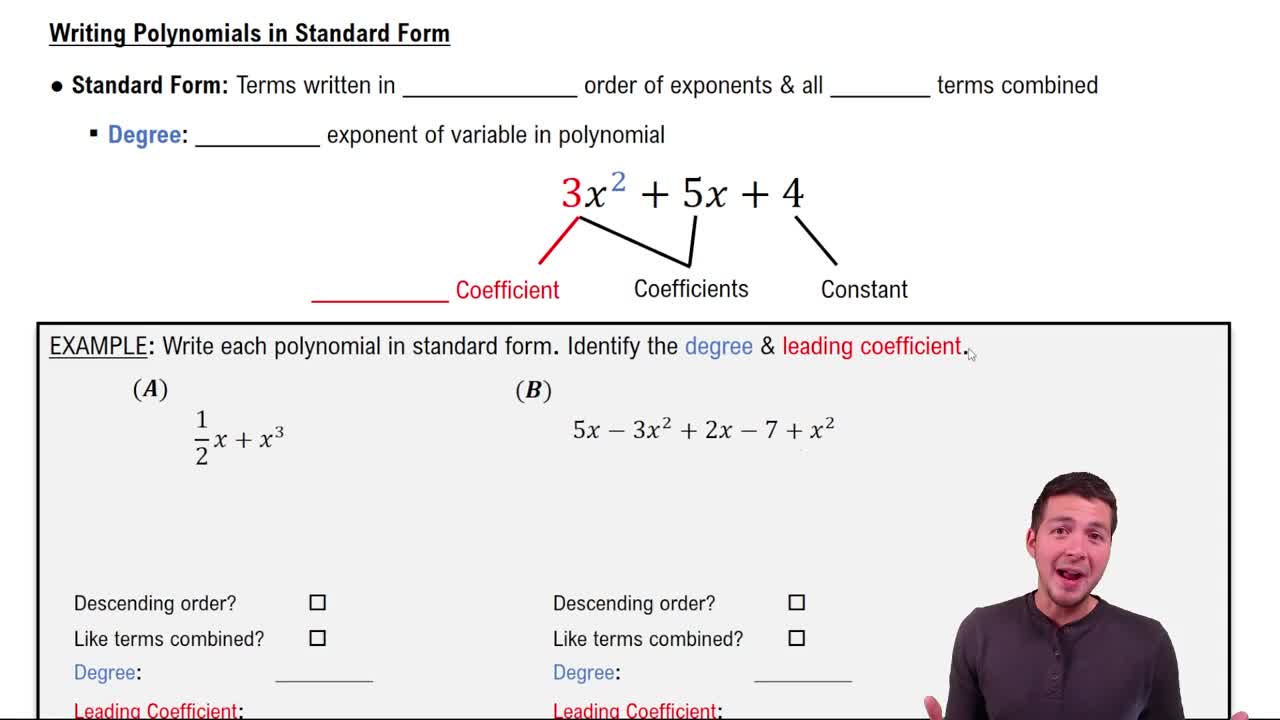
Standard Form of Polynomials
Related Practice
Textbook Question
1055
views
Textbook Question
Find a polynomial function ƒ(x) of least degree with real coefficients having zeros as given. -2+√5, -2-√5, -2, 1
370
views
Textbook Question
Use an end behavior diagram, as shown below, to describe the end behavior of the graph of each polynomial function. ƒ(x)=3+2x-4x2-5x10
1040
views
Textbook Question
Use an end behavior diagram, as shown below, to describe the end behavior of the graph of each polynomial function. ƒ(x)=10x6-x5+2x-2
928
views
Textbook Question
Circumference of a Circle The circumference of a circle varies directly as the radius. A circle with radius 7 in. has circumference 43.96 in. Find the circumference of the circle if the radius changes to 11 in.
928
views
Textbook Question
Graph each quadratic function. Give the (a) vertex, (b) axis, (c) domain, and (d) range. ƒ(x) = -(1/2)(x + 1)2 - 3
934
views