Write each formula as an English phrase using the word varies or proportional. C=2πr, where C is the circumference of a circle of radius r.
Ch. 3 - Polynomial and Rational Functions

Chapter 4, Problem 21
Use synthetic division to perform each division. (x3 - 1) / (x-1)
Verified step by step guidance1
Identify the divisor and the dividend. The dividend is \(x^3 - 1\) and the divisor is \(x - 1\).
Set up synthetic division by writing the coefficients of the dividend. For \(x^3 - 1\), the coefficients are \(1\) (for \(x^3\)), \(0\) (for \(x^2\)), \(0\) (for \(x\)), and \(-1\) (constant term).
Determine the value to use in synthetic division from the divisor \(x - 1\). Since the divisor is \(x - 1\), use \(1\) (the root of \(x - 1 = 0\)) for synthetic division.
Perform synthetic division: bring down the first coefficient, multiply it by \(1\), add to the next coefficient, and repeat this process across all coefficients.
Write the result of synthetic division as the quotient polynomial with one degree less than the dividend, and identify the remainder if any.

Verified video answer for a similar problem:
This video solution was recommended by our tutors as helpful for the problem above.
Video duration:
5mWas this helpful?
Key Concepts
Here are the essential concepts you must grasp in order to answer the question correctly.
Synthetic Division
Synthetic division is a shortcut method for dividing a polynomial by a linear binomial of the form x - c. It simplifies the long division process by using only the coefficients of the polynomial, making calculations faster and less error-prone.
Recommended video:
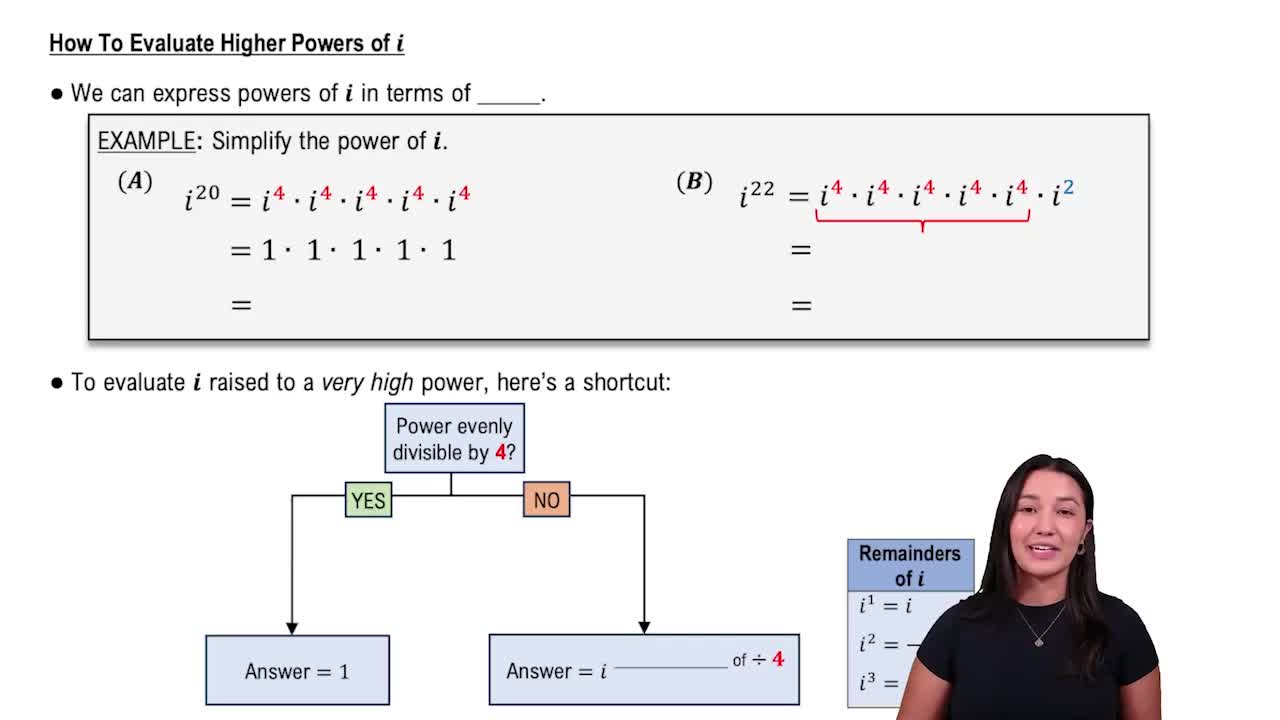
Higher Powers of i
Polynomial Division
Polynomial division involves dividing one polynomial by another, similar to numerical division. Understanding how to divide polynomials helps in simplifying expressions, finding factors, and solving polynomial equations.
Recommended video:
Guided course
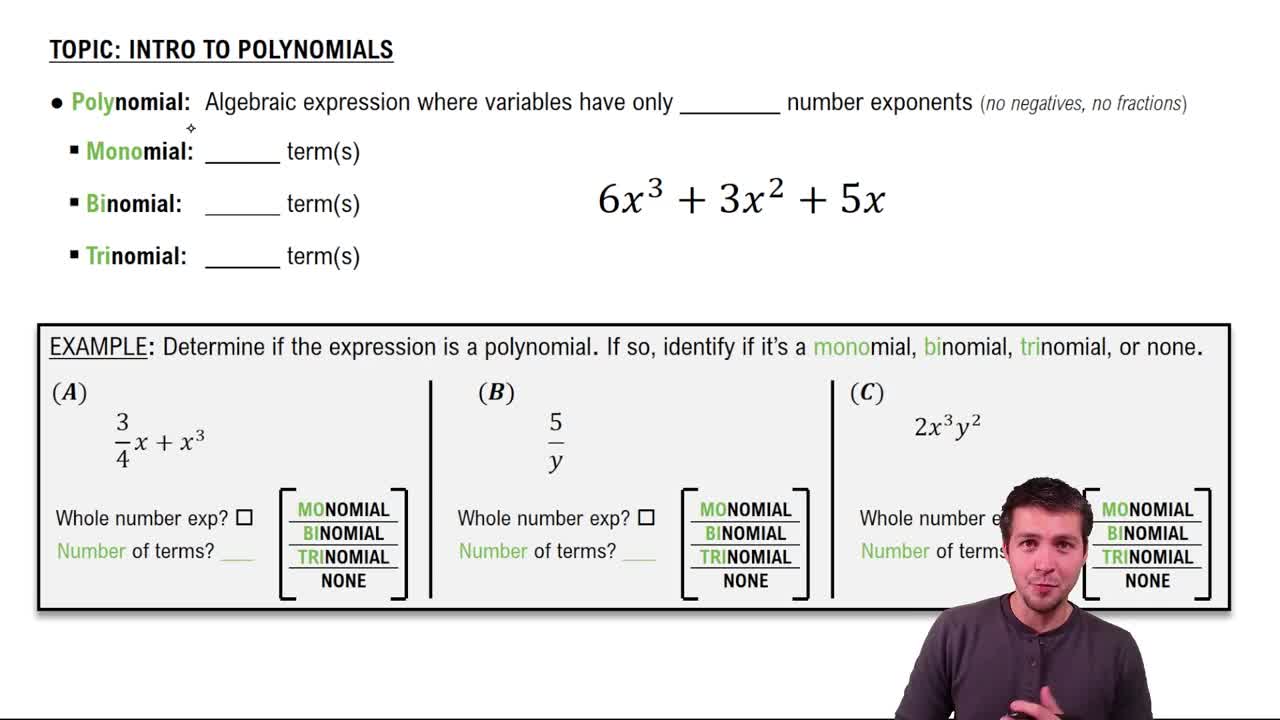
Introduction to Polynomials
Remainder Theorem
The Remainder Theorem states that when a polynomial f(x) is divided by x - c, the remainder is f(c). This concept helps verify the result of synthetic division and understand the relationship between division and function evaluation.
Recommended video:
Higher Powers of i
Related Practice
Textbook Question
559
views
Textbook Question
If ƒ(x) is a polynomial function with real coefficients, and if 7+2i is a zero of the function, then what other complex number must also be a zero?
489
views
Textbook Question
Solve each quadratic inequality. Give the solution set in interval notation. 2x2 + 5 ≤ 11x
549
views
Textbook Question
Use an end behavior diagram, as shown below, to describe the end behavior of the graph of each polynomial function. ƒ(x)=5x5+2x3-3x+4
1665
views
Textbook Question
Graph the following on the same coordinate system.
(a) y = x2
(b) y = 3x2
(c) y = 1/3x2
(d) How does the coefficient of x2 affect the shape of the graph?
1164
views
Textbook Question
Use the factor theorem and synthetic division to determine whether the second polynomial is a factor of the first. See Example 1.
398
views