Graph the solution set of each system of inequalities.
Ch. 5 - Systems and Matrices

Chapter 6, Problem 59
Find each product, if possible.
Verified step by step guidance1
Identify the dimensions of the two matrices: the first matrix is a 3x2 matrix (3 rows and 2 columns), and the second matrix is a 2x3 matrix (2 rows and 3 columns).
Recall the rule for matrix multiplication: the number of columns in the first matrix must equal the number of rows in the second matrix. Here, the first matrix has 2 columns and the second has 2 rows, so multiplication is possible.
Determine the dimensions of the resulting product matrix: it will have the number of rows of the first matrix and the number of columns of the second matrix, so the product will be a 3x3 matrix.
To find each entry in the product matrix, multiply corresponding elements from the rows of the first matrix and the columns of the second matrix, then sum those products. For example, the entry in row i and column j of the product is calculated as: \(\sum_{k=1}^{2} (a_{ik} \times b_{kj})\) where \(a_{ik}\) is an element from the first matrix and \(b_{kj}\) is an element from the second matrix.
Repeat this process for all entries in the 3x3 product matrix to complete the multiplication.

Verified video answer for a similar problem:
This video solution was recommended by our tutors as helpful for the problem above.
Video duration:
8mWas this helpful?
Key Concepts
Here are the essential concepts you must grasp in order to answer the question correctly.
Matrix Dimensions and Compatibility
Matrix multiplication is only possible when the number of columns in the first matrix equals the number of rows in the second matrix. For example, a 3x2 matrix can be multiplied by a 2x3 matrix because the inner dimensions (2 and 2) match, resulting in a 3x3 matrix.
Recommended video:
Guided course
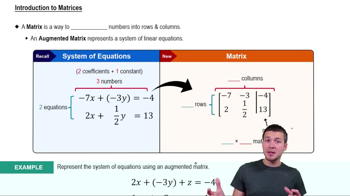
Introduction to Matrices
Matrix Multiplication Procedure
To multiply matrices, multiply elements of the rows of the first matrix by corresponding elements of the columns of the second matrix, then sum these products. Each element in the resulting matrix is computed this way, combining row-by-column products.
Recommended video:
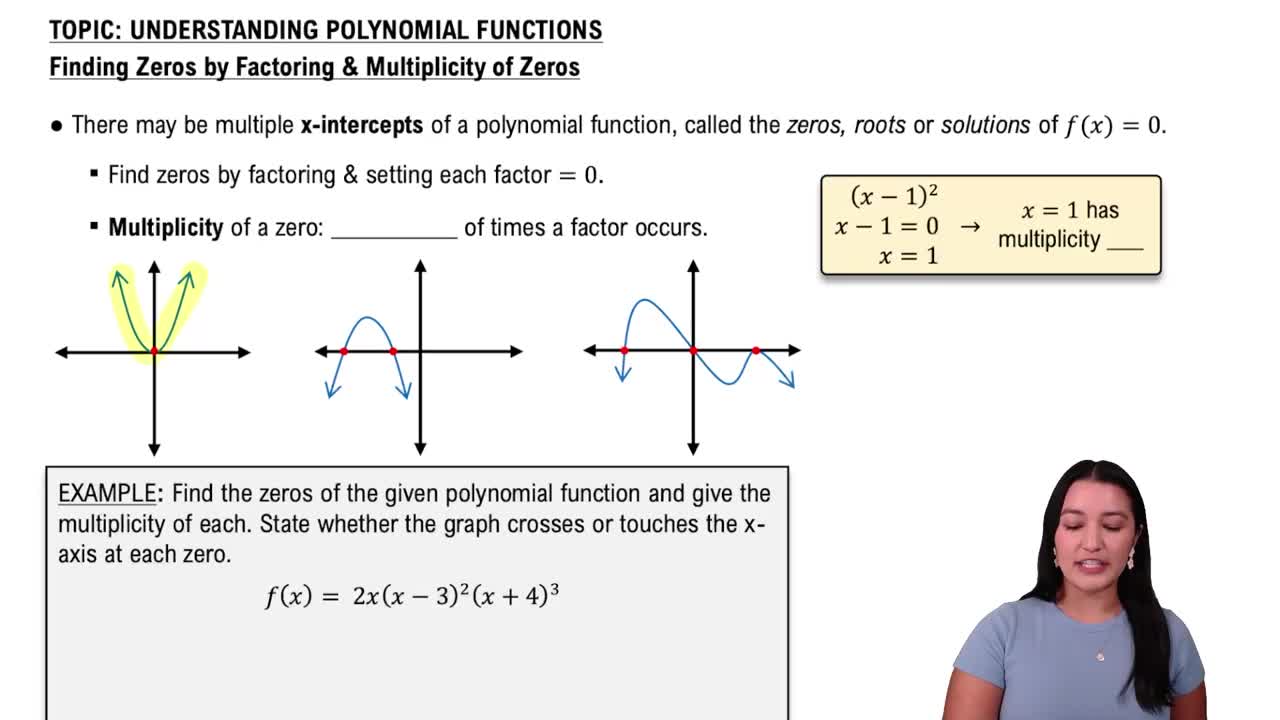
Finding Zeros & Their Multiplicity
Resulting Matrix Size
The size of the product matrix is determined by the outer dimensions of the multiplied matrices. Multiplying a 3x2 matrix by a 2x3 matrix produces a 3x3 matrix, where the number of rows comes from the first matrix and the number of columns from the second.
Recommended video:
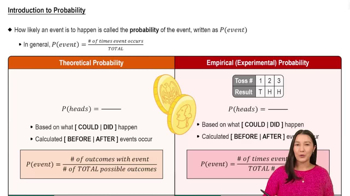
Introduction to Probability
Related Practice
Textbook Question
837
views
Textbook Question
Solve each problem using a system of equations in two variables. See Example 6. The longest side of a right triangle is 13 m in length. One of the other sides is 7 m longer than the shortest side. Find the lengths of the two shorter sides of the triangle.
527
views
Textbook Question
Solve each problem using a system of equations in two variables. See Example 6. Find two numbers whose ratio is 9 to 2 and whose product is 162.
545
views
Textbook Question
Use the determinant theorems to evaluate each determinant.
714
views
Textbook Question
Solve each problem using a system of equations in two variables. See Example 6. Find two numbers whose ratio is 4 to 3 and are such that the sum of their squares is 100.
570
views
Textbook Question
Use the determinant theorems to evaluate each determinant. See Example 4.
724
views