Ch. R - Review of Basic Concepts
Lial - College Algebra 13th Edition
Lial13th EditionCollege AlgebraISBN: 9780136881063Not the one you use?Change textbook
Chapter 1, Problem 35

Find each product. (2z-1)(-z2+3z-4)

Verified step by step guidance
1
Distribute each term in the first polynomial \((2z - 1)\) to each term in the second polynomial \((-z^2 + 3z - 4)\).
Multiply \(2z\) by each term in \((-z^2 + 3z - 4)\): \(2z \cdot (-z^2)\), \(2z \cdot 3z\), and \(2z \cdot (-4)\).
Multiply \(-1\) by each term in \((-z^2 + 3z - 4)\): \(-1 \cdot (-z^2)\), \(-1 \cdot 3z\), and \(-1 \cdot (-4)\).
Combine all the products from the previous steps: \(2z \cdot (-z^2) + 2z \cdot 3z + 2z \cdot (-4) + (-1) \cdot (-z^2) + (-1) \cdot 3z + (-1) \cdot (-4)\).
Simplify the expression by combining like terms to get the final polynomial expression.

Verified video answer for a similar problem:

This video solution was recommended by our tutors as helpful for the problem above.
Video duration:
2m
Was this helpful?

Key Concepts

Here are the essential concepts you must grasp in order to answer the question correctly.

Polynomial Multiplication

Polynomial multiplication involves multiplying each term in one polynomial by every term in the other polynomial. This process requires applying the distributive property to combine like terms and simplify the expression.
Recommended video:
03:42
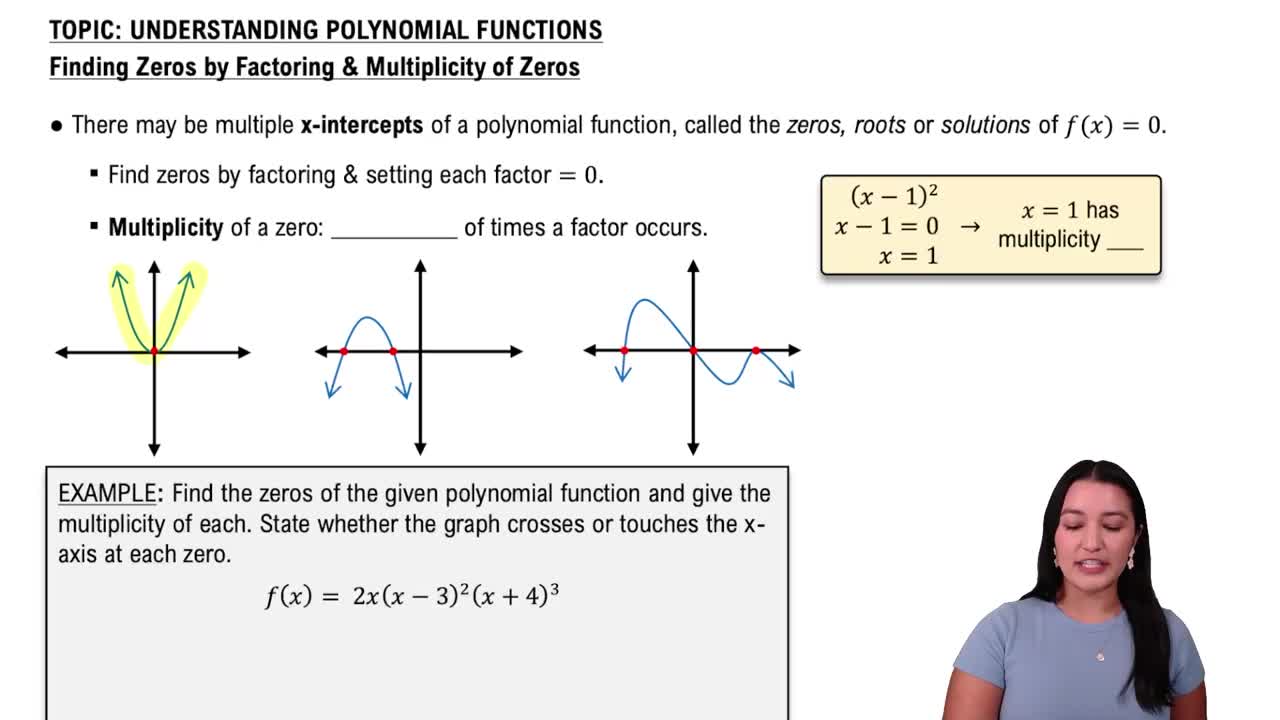
Finding Zeros & Their Multiplicity

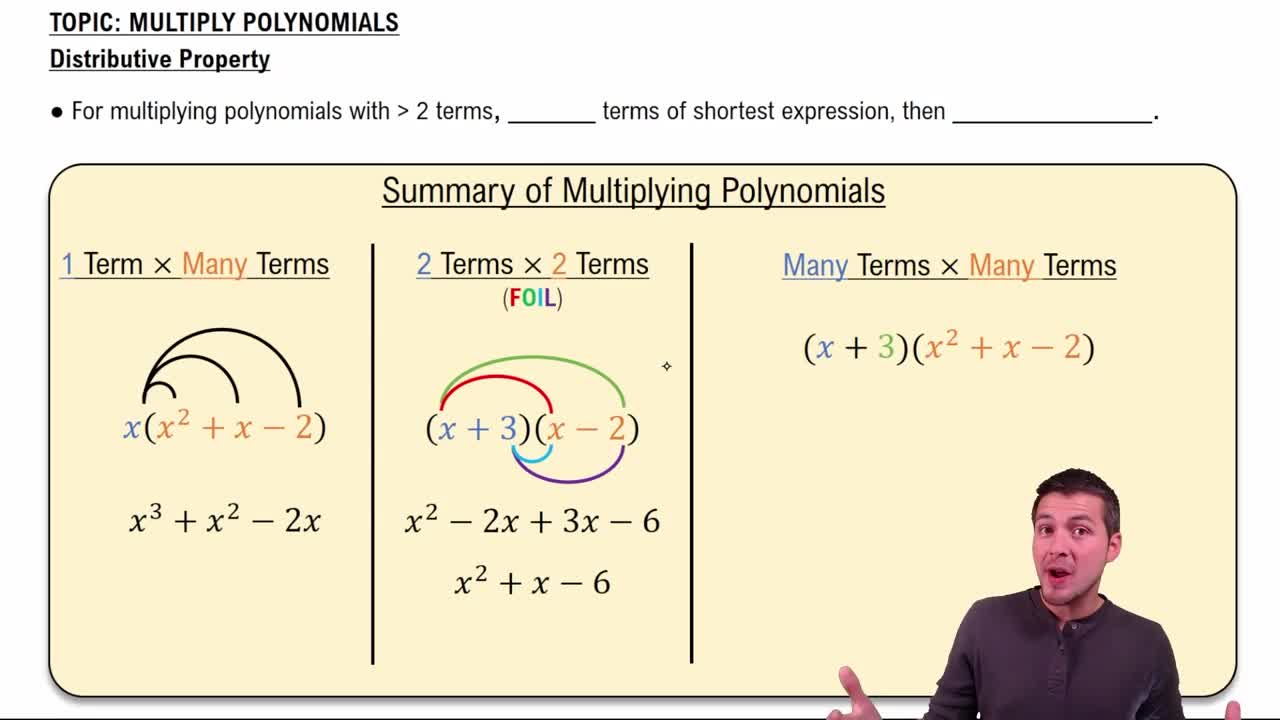
Distributive Property

The distributive property states that a(b + c) = ab + ac. It allows you to multiply a single term by each term inside a parenthesis, which is essential when expanding products of polynomials.
Recommended video:
Guided course
04:15
Multiply Polynomials Using the Distributive Property

Combining Like Terms

After multiplying polynomials, you combine like terms—terms with the same variable raised to the same power—to simplify the expression into its standard form.
Recommended video:
5:22
Combinations