Back

Financial Accounting: Receivables and Revenue Recognition

Control buttons has been changed to "navigation" mode.
1/20
  • When is revenue recognized under GAAP?

    Revenue is recognized when it is earned, meaning goods are delivered or services performed, and recorded at the amount of cash received or fair market value of assets received.
  • What are the five steps to revenue recognition under GAAP?

    1. Identify the contract(s)
    2. Identify the performance obligations
    3. Determine the transaction price
    4. Allocate the transaction price to the performance obligations
    5. Recognize revenue when obligations are satisfied
  • What is the difference between FOB shipping point and FOB destination?

    FOB shipping point: Ownership transfers and revenue recognized when goods leave the shipping dock.
    FOB destination: Ownership transfers and revenue recognized at delivery to customer.
  • What is a sales discount and how is it typically expressed?

    A sales discount is a percentage reduction offered to customers for early payment, commonly expressed as terms like 2/10, n/30 meaning 2% discount if paid within 10 days, otherwise full amount due in 30 days.
  • What is a credit memo in sales returns and allowances?

    A credit memo is a document authorizing a credit to the customer's accounts receivable for returned or unsatisfactory goods.
  • How do companies estimate sales returns and allowances?

    Companies estimate sales returns based on historical return rates and record estimated refunds and inventory adjustments at period end.
  • What are receivables and how are they classified?

    Receivables are monetary claims against others, classified as current assets, including accounts receivable from sales and notes receivable from loans.
  • What is the allowance method for bad debts?

    The allowance method estimates uncollectible accounts based on past experience, recording an allowance for bad debts as a contra account to accounts receivable.
  • How is the net realizable value of accounts receivable calculated?

    Net realizable value = Accounts receivable balance minus allowance for bad debts; it represents the amount expected to be collected.
  • What are the two main methods to estimate uncollectible accounts?

    Percent-of-sales method: Estimates bad debt expense as a percentage of revenue.
    Aging-of-receivables method: Analyzes specific accounts based on how long they have been outstanding.
  • What is the direct write-off method and why is it less preferred?

    The direct write-off method records bad debt expense only when a specific account is deemed uncollectible; it is less preferred because it does not match expenses to the period revenue is earned.
  • What is a promissory note in accounting?

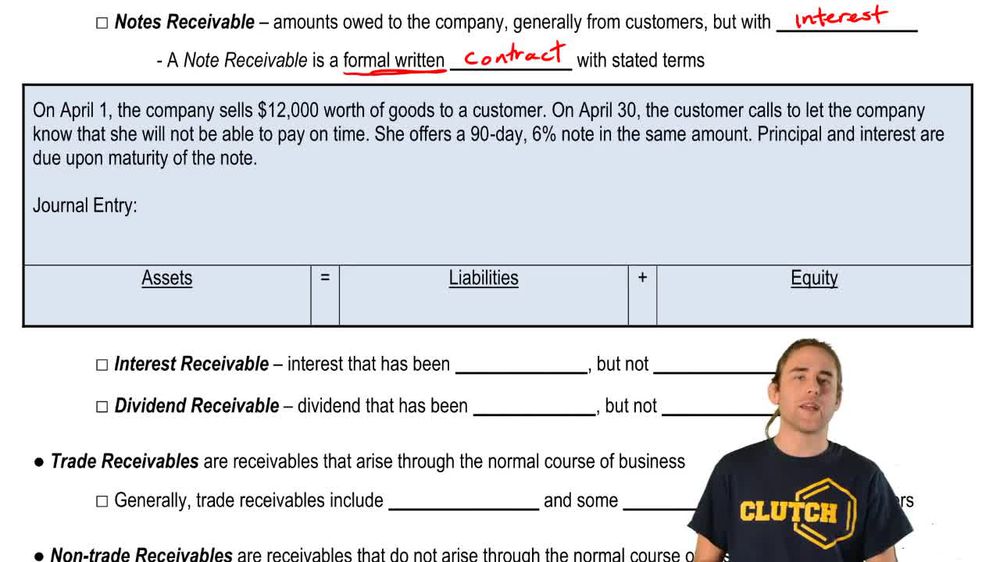
    A promissory note is a written promise to pay a specified amount of money at a future date, involving a creditor (lender) and debtor (borrower).
  • How is interest on notes receivable calculated?

    Interest = Principal × Interest rate × Time (expressed as fraction of year, e.g., months/12 or days/365).
  • What is the quick (acid-test) ratio and what does it indicate?

    Quick ratio = (Cash + Short-term investments + Net receivables) / Current liabilities; a higher ratio indicates better ability to pay current liabilities.
  • What does accounts receivable turnover measure?

    Accounts receivable turnover shows how many times a company collects its average accounts receivable in a year; a higher number indicates faster collection.
  • How is days sales outstanding (DSO) calculated and interpreted?

    DSO = 365 / Accounts receivable turnover; it measures the average number of days to collect receivables, with a lower number indicating quicker collection.
  • What is the purpose of an aging schedule for accounts receivable?

    An aging schedule categorizes receivables by how long they are past due to help estimate uncollectible accounts and manage credit risk.
  • How can Excel pivot tables assist in analyzing receivables?

    Pivot tables summarize large data sets, allowing users to aggregate invoice amounts by age categories to analyze receivables collectibility.
  • What journal entry records the sale of goods on account?

    Debit Accounts Receivable and credit Sales Revenue for the amount of the sale.
  • How is bad debt expense recorded using the allowance method?

    Debit Bad Debt Expense and credit Allowance for Bad Debts to estimate uncollectible accounts.