
Ch.15 - Chemical Equilibrium
Brown - Chemistry: The Central Science 15th Edition
Brown15th EditionChemistry: The Central ScienceISBN: 9780137542970Not the one you use?Change textbook
Chapter 15, Problem 76b

A sample of nitrosyl bromide (NOBr) decomposes according to the equation 2 NOBr(𝑔) ⇌ 2 NO(𝑔) + Br2(𝑔) An equilibrium mixture in a 5.00-L vessel at 100°C contains 3.22 g of NOBr, 2.46 g of NO, and 6.55 g of Br2. (b) What is the total pressure exerted by the mixture of gases?

Verified step by step guidance
1
Determine the molar masses of NOBr, NO, and Br_2 using the periodic table.
Convert the given masses of NOBr, NO, and Br_2 to moles by dividing each mass by its respective molar mass.
Use the ideal gas law, PV = nRT, to calculate the partial pressure of each gas. Here, P is the pressure, V is the volume (5.00 L), n is the number of moles, R is the ideal gas constant (0.0821 L·atm/mol·K), and T is the temperature in Kelvin (convert 100°C to Kelvin by adding 273.15).
Calculate the partial pressure for each gas: P_NOBr, P_NO, and P_Br2.
Sum the partial pressures of NOBr, NO, and Br_2 to find the total pressure exerted by the mixture of gases.

Key Concepts

Here are the essential concepts you must grasp in order to answer the question correctly.

Ideal Gas Law

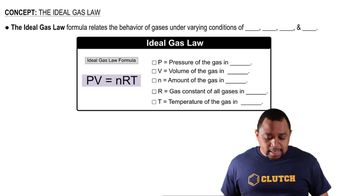
The Ideal Gas Law relates the pressure, volume, temperature, and number of moles of a gas through the equation PV = nRT. This law is essential for calculating the total pressure of a gas mixture, as it allows us to determine how the quantities of gases present affect the overall pressure in a given volume.
Recommended video:
Guided course
01:15
Ideal Gas Law Formula

Molar Mass and Mass to Moles Conversion

To find the total pressure exerted by the gas mixture, it is necessary to convert the mass of each gas into moles using their respective molar masses. This conversion is crucial because the Ideal Gas Law requires the number of moles (n) to calculate pressure, making it a fundamental step in solving the problem.
Recommended video:
Guided course
02:28
Mass and Moles Conversion

Dalton's Law of Partial Pressures

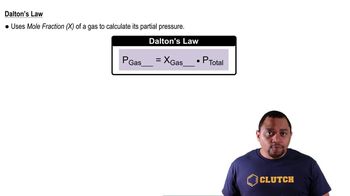
Dalton's Law states that the total pressure of a gas mixture is equal to the sum of the partial pressures of each individual gas. This principle is important for determining the total pressure in the vessel, as it allows us to calculate the contribution of each gas based on its mole fraction and the total number of moles present.
Recommended video:
Guided course
00:27
Dalton's Law and Partial Pressure