
The graph below shows the change in pressure as the temperature increases for a 1-mol sample of a gas confined to a 1-L container. The four plots correspond to an ideal gas and three real gases: CO2, N2, and Cl2. (a) At room temperature, all three real gases have a pressure less than the ideal gas. Which van der Waals constant, a or b, accounts for the influence intermolecular forces have in lowering the pressure of a real gas?
Ch.10 - Gases
Brown14th EditionChemistry: The Central ScienceISBN: 9780134414232Not the one you use?Change textbook
Chapter 10, Problem 11
A thin glass tube 1 m long is filled with Ar gas at 101.3 kPa, and the ends are stoppered with cotton plugs as shown below. HCl gas is introduced at one end of the tube, and simultaneously NH3 gas is introduced at the other end. When the two gases diffuse through the cotton plugs down the tube and meet, a white ring appears due to the formation of NH4Cl1s2. At which location—a, b, or c—do you expect the ring to form?
Verified step by step guidance1
Identify the gases involved: HCl and NH3. When they meet, they form NH4Cl, which is visible as a white ring.
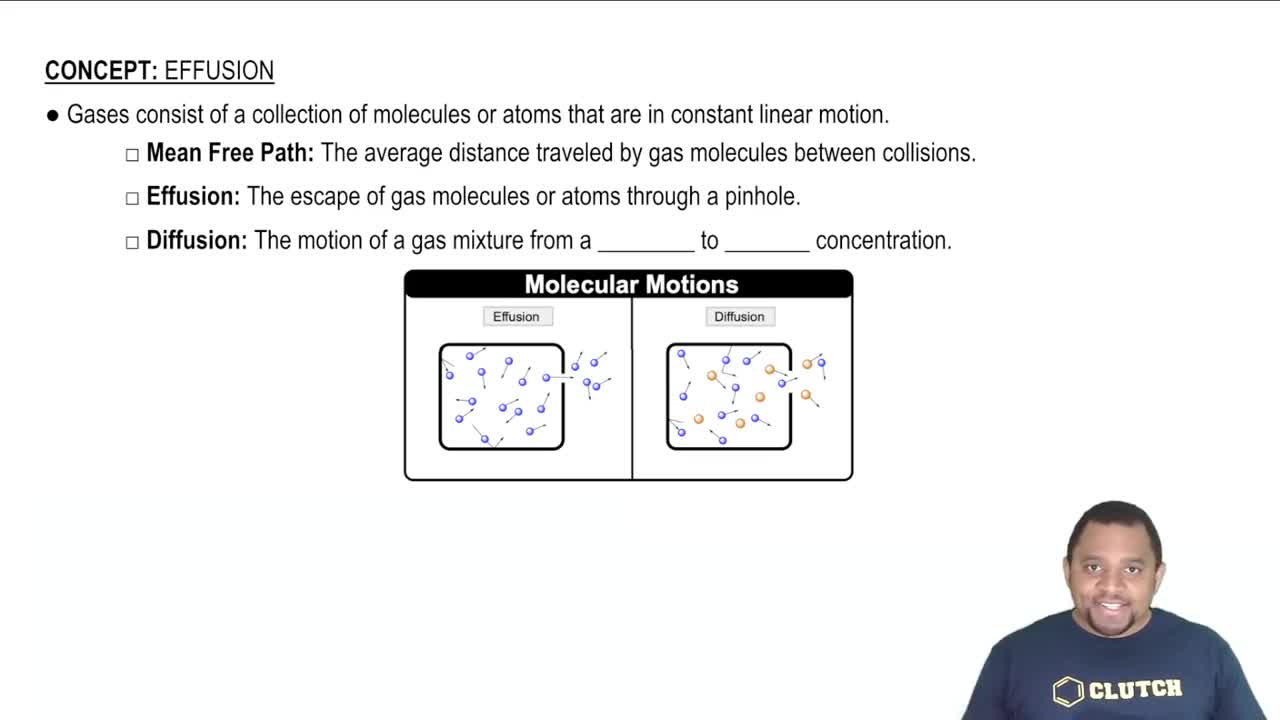
Understand the concept of diffusion: Gases diffuse from areas of higher concentration to lower concentration. The rate of diffusion is inversely proportional to the square root of the molar mass of the gas (Graham's Law).
Apply Graham's Law of Effusion: \( \frac{r_1}{r_2} = \sqrt{\frac{M_2}{M_1}} \), where \( r_1 \) and \( r_2 \) are the rates of diffusion of NH3 and HCl, and \( M_1 \) and \( M_2 \) are their molar masses.
Calculate the molar masses: NH3 has a molar mass of approximately 17 g/mol, and HCl has a molar mass of approximately 36.5 g/mol.
Determine the relative rates of diffusion: Since NH3 is lighter, it will diffuse faster than HCl. Therefore, the white ring will form closer to the HCl end of the tube.

Verified video answer for a similar problem:
This video solution was recommended by our tutors as helpful for the problem above.
Video duration:
2mWas this helpful?
Key Concepts
Here are the essential concepts you must grasp in order to answer the question correctly.
Graham's Law of Effusion
Graham's Law states that the rate of effusion of a gas is inversely proportional to the square root of its molar mass. This means lighter gases will diffuse faster than heavier gases. In this scenario, NH3 (ammonia) has a lower molar mass than HCl (hydrochloric acid), which suggests that NH3 will travel further down the tube before the two gases meet.
Recommended video:
Guided course
Graham's Law of Effusion
Diffusion
Diffusion is the process by which gas molecules spread from areas of high concentration to areas of low concentration. In the context of the question, both HCl and NH3 gases will diffuse through the cotton plugs towards each other, and the rate at which they diffuse will determine where they meet and react to form NH4Cl.
Recommended video:
Guided course
Effusion vs Diffusion
Chemical Reaction and Product Formation
When HCl and NH3 gases meet, they react to form ammonium chloride (NH4Cl), which appears as a white ring. The location of this ring depends on the relative rates of diffusion of the two gases. Understanding the reaction and the conditions under which it occurs is crucial for predicting where the ring will form in the tube.
Recommended video:
Guided course
Production of Hydrogen Example
Related Practice
Textbook Question
716
views
Textbook Question
Consider the following graph. (b) If A and B refer to the same gas at two different temperatures, which represents the higher temperature?
333
views
Textbook Question
The graph below shows the change in pressure as the temperature increases for a 1-mol sample of a gas confined to a 1-L container. The four plots correspond to an ideal gas and three real gases: CO2, N2, and Cl2. (b) Use the van der Waals constants in Table 10.3 to match the labels in the plot (A, B, and C) with the respective gases 1CO2, N2, and Cl22.
746
views
Textbook Question
Consider the following samples of gases:
If the three samples are all at the same temperature, rank them with respect to (c) density
431
views
