

The reaction between ethyl iodide and hydroxide ion in ethanol (C2H5OH) solution, C2H5I(alc) + OH-(alc) → C2H5OH(l) + I-(alc), has an activation energy of 86.8 kJ/mol and a frequency factor of 2.10 × 10¹¹ M-1 s-1. (d) Assuming the frequency factor and activation energy do not change as a function of temperature, calculate the rate constant for the reaction at 50 C.
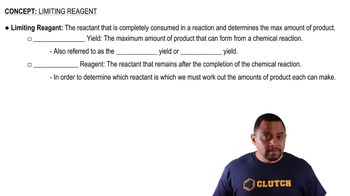
The reaction between ethyl iodide and hydroxide ion in ethanol (C2H5OH) solution, C2H5I(alc) + OH-(alc) → C2H5OH(l) + I-(alc), has an activation energy of 86.8 kJ/mol and a frequency factor of 2.10 × 10¹¹ M-1 s-1. (c) Which reagent in the reaction is limiting, assuming the reaction proceeds to completion?
Verified step by step guidance
Verified video answer for a similar problem:
Key Concepts
Limiting Reagent
Stoichiometry
Activation Energy
The gas-phase reaction of NO with F2 to form NOF and F has an activation energy of Ea = 6.3 kJ>mol. and a frequency factor of A = 6.0 * 108 M-1 s-1. The reaction is believed to be bimolecular: NO1g2 + F21g2 ¡ NOF1g2 + F1g2 (e) Suggest a reason for the low activation energy for the reaction.
Enzymes are often described as following the two-step mechanism:
E + S ⇌ ES (fast)
ES → E + P (slow)
where E = enzyme, S = substrate, ES = enzyme9substrate complex, and P = product.
(b) Molecules that can bind to the active site of an enzyme but are not converted into product are called enzyme inhibitors. Write an additional elementary step to add into the preceding mechanism to account for the reaction of E with I, an inhibitor.
The gas-phase reaction of NO with F2 to form NOF and F has an activation energy of Ea = 6.3 kJ/mol. and a frequency factor of A = 6.0 × 10⁸ M-1 s-1. The reaction is believed to be bimolecular: NO(g) + F2(g) → NOF(g) + F(g) (b) Draw the Lewis structures for the NO and the NOF molecules, given that the chemical formula for NOF is misleading because the nitrogen atom is actually the central atom in the molecule.
