Ch.15 - Chemical Equilibrium
Brown - Chemistry: The Central Science 14th Edition
Brown14th EditionChemistry: The Central ScienceISBN: 9780134414232Not the one you use?Change textbook
Chapter 15, Problem 65a

Consider the following equilibrium between oxides of nitrogen 3 NO(g) ⇌ NO2(g) + N2O(g) (a) Use data in Appendix C to calculate ΔH° for this reaction.

Verified step by step guidance
1
Identify the standard enthalpies of formation (ΔH°f) for each compound involved in the reaction from Appendix C. You will need the values for NO(g), NO2(g), and N2O(g).
Write the balanced chemical equation for the reaction: 3 NO(g) ⇌ NO2(g) + N2O(g).
Apply the formula for the standard enthalpy change of the reaction (ΔH°rxn): ΔH°rxn = ΣΔH°f(products) - ΣΔH°f(reactants). Remember to multiply the ΔH°f of each substance by its stoichiometric coefficient in the balanced equation.
Calculate the sum of the standard enthalpies of formation for the products: (1 mole of NO2(g) × ΔH°f of NO2(g)) + (1 mole of N2O(g) × ΔH°f of N2O(g)).
Calculate the sum of the standard enthalpies of formation for the reactants: 3 moles of NO(g) × ΔH°f of NO(g).

Key Concepts

Here are the essential concepts you must grasp in order to answer the question correctly.

Hess's Law

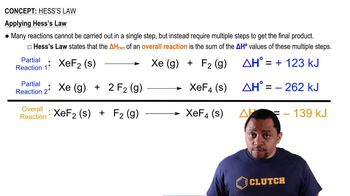
Hess's Law states that the total enthalpy change for a chemical reaction is the sum of the enthalpy changes for the individual steps of the reaction, regardless of the pathway taken. This principle allows for the calculation of ΔH° for reactions that may not be easily measured directly by using known enthalpy changes of related reactions.
Recommended video:

Standard Enthalpy of Formation (ΔH°f)

The standard enthalpy of formation (ΔH°f) is the change in enthalpy when one mole of a compound is formed from its elements in their standard states. This value is crucial for calculating the enthalpy change of a reaction using Hess's Law, as it provides a reference point for the energy content of reactants and products.

Equilibrium Constant (K)

The equilibrium constant (K) is a numerical value that expresses the ratio of the concentrations of products to reactants at equilibrium for a given reaction at a specific temperature. Understanding K is essential for analyzing the position of equilibrium and how changes in conditions can affect the reaction, which is relevant when considering the enthalpy changes in reactions involving gases.
Recommended video:
Guided course
01:14
Equilibrium Constant K