
Ch.5 - Gases
Tro - Chemistry: A Molecular Approach 4th Edition
Tro4th EditionChemistry: A Molecular ApproachISBN: 9780134112831Not the one you use?Change textbook
Chapter 5, Problem 116

A particular balloon can be stretched to a maximum surface area of 1257 cm². The balloon is filled with 3.0 L of helium gas at a pressure of 755 torr and a temperature of 298 K. The balloon is then allowed to rise in the atmosphere. If the atmospheric temperature is 273 K, what pressure will the balloon burst at? (Assume the balloon is the shape of a sphere.)

Verified step by step guidance
1
Identify the initial conditions: initial volume (V1) = 3.0 L, initial pressure (P1) = 755 torr, initial temperature (T1) = 298 K.
Determine the final temperature (T2) when the balloon rises: T2 = 273 K.
Use the ideal gas law to relate the initial and final states of the gas: \( \frac{P_1 \cdot V_1}{T_1} = \frac{P_2 \cdot V_2}{T_2} \).
Calculate the maximum volume (V2) the balloon can reach using the maximum surface area: \( A = 4\pi r^2 \) and \( V = \frac{4}{3}\pi r^3 \). Solve for V using the given surface area.
Substitute the known values into the ideal gas law equation to solve for the final pressure (P2) at which the balloon will burst.

Key Concepts

Here are the essential concepts you must grasp in order to answer the question correctly.

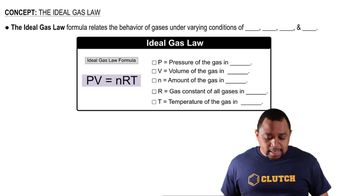
Ideal Gas Law

The Ideal Gas Law relates the pressure, volume, temperature, and number of moles of a gas through the equation PV = nRT. This law is essential for understanding how gases behave under varying conditions. In this scenario, it helps determine how changes in temperature and volume affect the pressure of the helium gas in the balloon.
Recommended video:
Guided course
01:15
Ideal Gas Law Formula

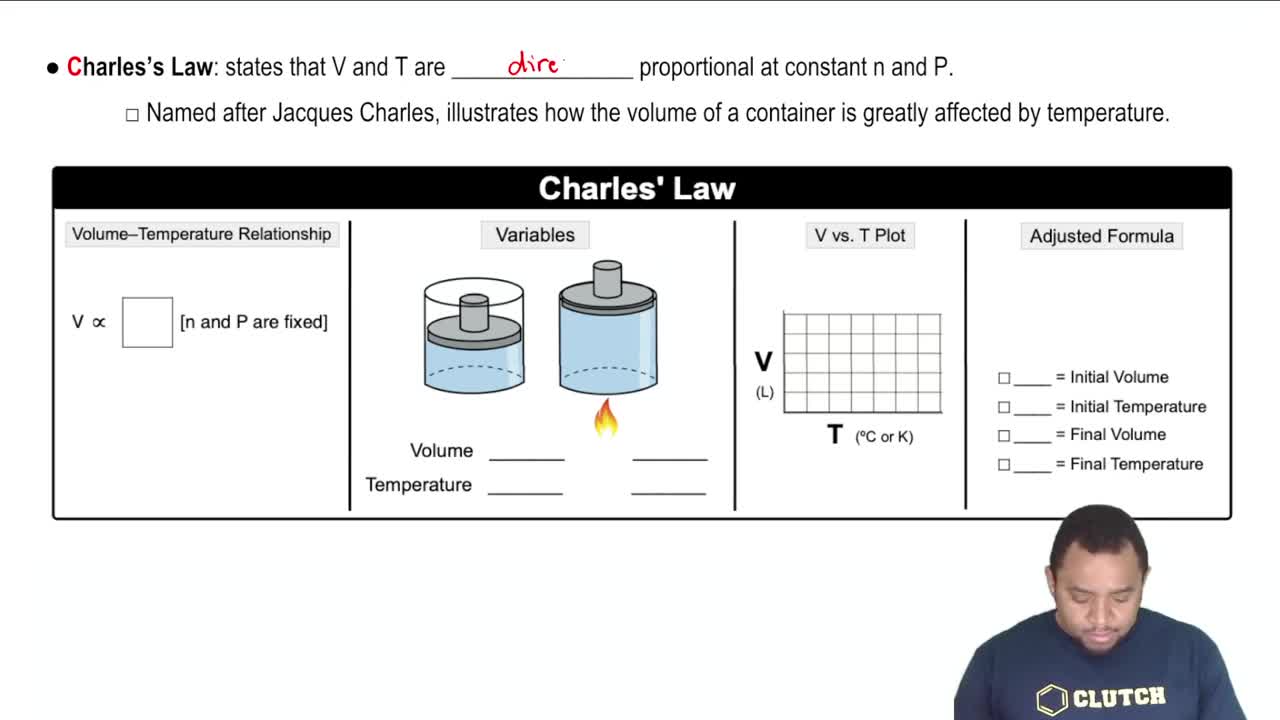
Charles's Law

Charles's Law states that the volume of a gas is directly proportional to its temperature when pressure is held constant. This concept is crucial for understanding how the volume of the balloon changes as it rises and the temperature decreases, affecting the gas's pressure. It allows us to predict how the gas will expand or contract with temperature changes.
Recommended video:
Guided course
02:06
Charles's Law

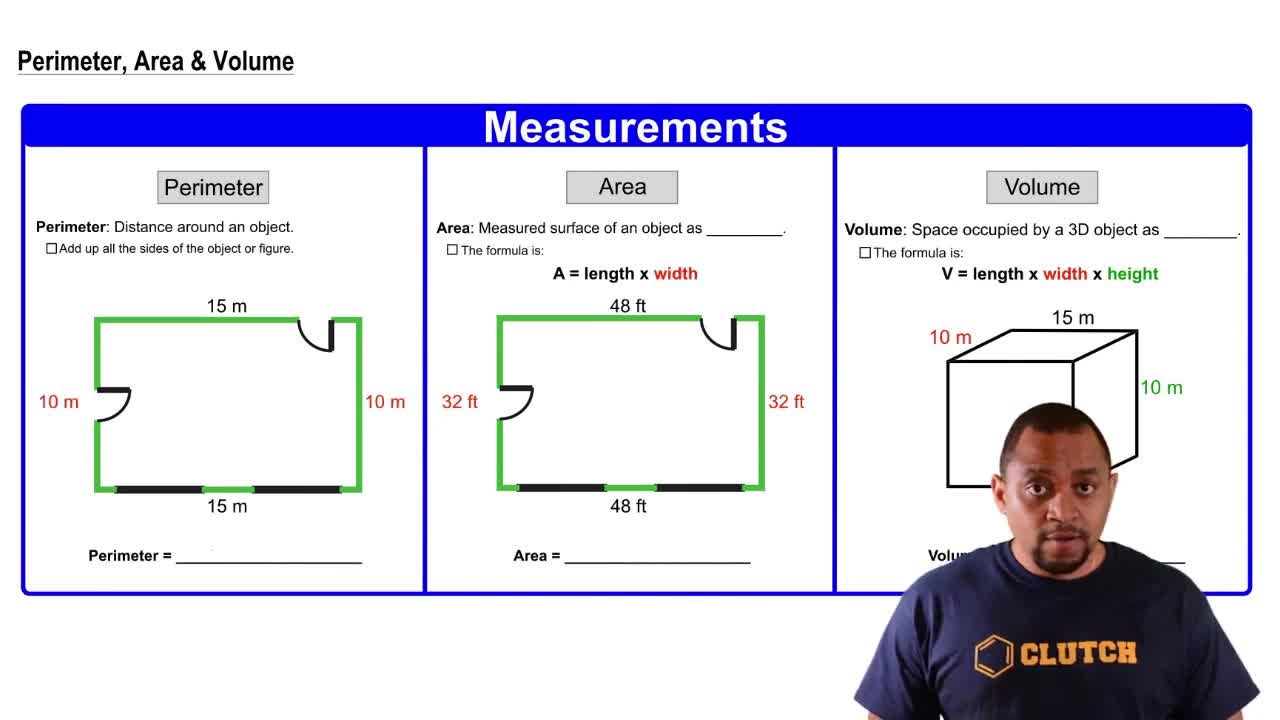
Surface Area and Pressure Relationship

The relationship between surface area and pressure is significant in understanding how a balloon behaves as it expands. As the balloon rises and the external pressure decreases, the internal pressure must adjust to maintain equilibrium. The maximum surface area of the balloon indicates the point at which it can no longer contain the gas, leading to a burst when internal pressure exceeds external pressure.
Recommended video:
Guided course
03:47
Perimeter, Area, Volume