
Sodium azide is a shock-sensitive compound that releases N2 upon physical impact. The compound is used in automobile airbags. The azide ion is N3-. (a) Draw the Lewis structure of the azide ion that minimizes formal charge (it does not form a triangle). Is it linear or bent?
Ch.9 - Molecular Geometry and Bonding Theories
Brown14th EditionChemistry: The Central ScienceISBN: 9780134414232Not the one you use?Change textbook
Chapter 9, Problem 96b
(b) The anion IO4- has a tetrahedral structure: three oxygen atoms form double bonds with the central iodine atom and one oxygen atom which carries a negative charge forms a single bond. Predict the molecular geometry of IO65-.
Verified step by step guidance1
Identify the central atom in the IO6^5- ion, which is iodine (I).
Determine the total number of valence electrons available. Iodine has 7 valence electrons, and each oxygen has 6 valence electrons. Since there are 6 oxygen atoms, calculate the total valence electrons from oxygen and iodine, and account for the 5- charge by adding 5 more electrons.
Use the VSEPR (Valence Shell Electron Pair Repulsion) theory to predict the molecular geometry. Count the number of electron pairs around the central iodine atom, including both bonding pairs and lone pairs.
Assign the electron pairs to positions around the iodine atom to minimize repulsion, considering that the IO6^5- ion has 6 bonding pairs and no lone pairs on the central atom.
Based on the arrangement of electron pairs, determine the molecular geometry. For 6 bonding pairs and no lone pairs, the geometry is expected to be octahedral.

Verified video answer for a similar problem:
This video solution was recommended by our tutors as helpful for the problem above.
Video duration:
1mWas this helpful?
Key Concepts
Here are the essential concepts you must grasp in order to answer the question correctly.
Molecular Geometry
Molecular geometry refers to the three-dimensional arrangement of atoms within a molecule. It is determined by the number of bonding pairs and lone pairs of electrons around the central atom, which influences the shape according to VSEPR (Valence Shell Electron Pair Repulsion) theory. Understanding molecular geometry is crucial for predicting the behavior and reactivity of molecules.
Recommended video:
Guided course
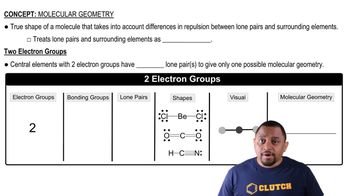
Molecular Geometry with Two Electron Groups
VSEPR Theory
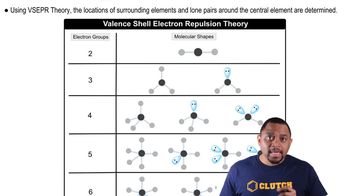
VSEPR theory posits that electron pairs around a central atom will arrange themselves to minimize repulsion, leading to specific molecular shapes. This theory helps predict the geometry of molecules based on the number of bonding and non-bonding electron pairs. For example, a tetrahedral arrangement occurs when there are four regions of electron density around a central atom.
Recommended video:
Guided course
Molecular Shapes and VSEPR
Oxidation States
Oxidation states indicate the degree of oxidation of an atom in a compound, reflecting the number of electrons lost or gained. In the case of IO<sub>6</sub><sup>5-</sup>, understanding the oxidation states of iodine and oxygen is essential for determining the overall charge and the bonding characteristics of the molecule. This knowledge aids in predicting the molecular structure and stability.
Recommended video:
Guided course
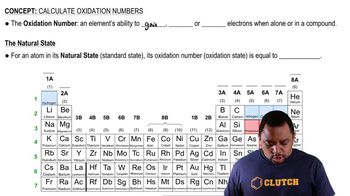
Oxidation Numbers
Related Practice
Textbook Question
537
views
Textbook Question
a) Predict the electron-domain geometry around the central S atom in SF2, SF4, and SF6.
701
views
Textbook Question
Sodium azide is a shock-sensitive compound that releases N2 upon physical impact. The compound is used in automobile airbags. The azide ion is N3-. (b) State the hybridization of the central N atom in the azide ion.
720
views
Textbook Question
An AB5 molecule adopts the geometry shown here. (c) Suppose the B atoms are halogen atoms. Of which group in the periodic table is atom A a member: (i) Group 15, (ii) Group 16, (iii) Group 17, (iv) Group 18, or (v) More information is needed?
618
views
