
Ch.10 - Gases
Brown - Chemistry: The Central Science 14th Edition
Brown14th EditionChemistry: The Central ScienceISBN: 9780134414232Not the one you use?Change textbook
Chapter 10, Problem 94c

Calculate the pressure that CCl4 will exert at 80 °C if 1.00 mol occupies 33.3 L, assuming that (c) Which would you expect to deviate more from ideal behavior under these conditions, Cl2 or CCl4? Explain.

Verified step by step guidance
1
Step 1: Begin by identifying the ideal gas law equation, which is \( PV = nRT \). This equation relates the pressure \( P \), volume \( V \), number of moles \( n \), the ideal gas constant \( R \), and temperature \( T \).
Step 2: Convert the temperature from Celsius to Kelvin, as the ideal gas law requires temperature in Kelvin. Use the formula \( T(K) = T(°C) + 273.15 \). For 80 °C, calculate \( T(K) = 80 + 273.15 \).
Step 3: Substitute the known values into the ideal gas law equation. You have \( n = 1.00 \) mol, \( V = 33.3 \) L, \( R = 0.0821 \) L·atm/(mol·K), and the temperature in Kelvin from Step 2. Rearrange the equation to solve for pressure \( P \): \( P = \frac{nRT}{V} \).
Step 4: Consider the deviation from ideal behavior. Real gases deviate from ideal behavior due to intermolecular forces and the volume occupied by the gas particles themselves. Compare Cl2 and CCl4: CCl4 is a larger molecule with stronger intermolecular forces (London dispersion forces) compared to Cl2, which is smaller and has weaker forces.
Step 5: Conclude that CCl4 would deviate more from ideal behavior under these conditions due to its larger size and stronger intermolecular forces, which cause it to behave less ideally compared to Cl2.

Verified video answer for a similar problem:

This video solution was recommended by our tutors as helpful for the problem above.
Video duration:
1m
Was this helpful?

Key Concepts

Here are the essential concepts you must grasp in order to answer the question correctly.

Ideal Gas Law

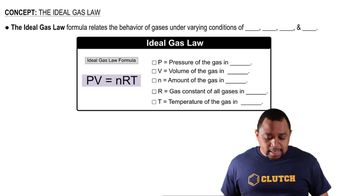
The Ideal Gas Law relates the pressure, volume, temperature, and number of moles of a gas through the equation PV = nRT. This law assumes that gas particles do not interact and occupy no volume, which is a simplification. Understanding this law is crucial for calculating the pressure exerted by gases under specific conditions.
Recommended video:
Guided course
01:15
Ideal Gas Law Formula

Real Gas Behavior

Real gases deviate from ideal behavior due to intermolecular forces and the volume occupied by gas particles. At high pressures and low temperatures, these deviations become significant. Recognizing the conditions under which gases behave ideally versus non-ideally helps in predicting which gas will deviate more from ideal behavior.
Recommended video:
Guided course
01:15
Ideal Gas Law Formula

Molecular Structure and Polarity

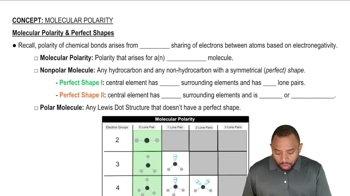
The molecular structure and polarity of a substance influence its intermolecular forces. CCl<sub>4</sub> is a nonpolar molecule, while Cl<sub>2</sub> is also nonpolar but has different molecular interactions. Understanding these properties helps in assessing how each gas will behave under varying conditions, particularly in terms of deviation from ideal gas behavior.
Recommended video:
Guided course
02:38
Molecular Polarity