
Mothballs are composed of naphthalene, C10H8, a molecule that consists of two six-membered rings of carbon fused along an edge, as shown in this incomplete Lewis structure:(a) Draw all of the resonance structures of naphthalene. How many are there?
(a) Which of these compounds is an exception to the octet rule: carbon dioxide, water, ammonia, phosphorus trifluoride, or arsenic pentafluoride?
Verified step by step guidance
Verified video answer for a similar problem:
Key Concepts
Octet Rule
Exceptions to the Octet Rule
Molecular Geometry and Bonding
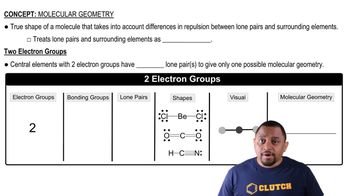
In the vapor phase, BeCl2 exists as a discrete molecule. (a) Draw the Lewis structure of this molecule, using only single bonds. Does this Lewis structure satisfy the octet rule?
Mothballs are composed of naphthalene, C10H8, a molecule that consists of two six-membered rings of carbon fused along an edge, as shown in this incomplete Lewis structure:
(c) Not all of the C—C bond lengths in naphthalene are equivalent. Based on your resonance structures, how many C—C bonds in the molecule do you expect to be shorter than the others?
Mothballs are composed of naphthalene, C10H8, a molecule that consists of two six-membered rings of carbon fused along an edge, as shown in this incomplete Lewis structure:
(b) Do you expect the C—C bond lengths in the molecule to be similar to those of C—C single bonds, C ═C double bonds, or intermediate between C—C single and C ═C double bonds?
Draw the Lewis structures for each of the following molecules or ions. Identify instances where the octet rule is not obeyed; state which atom in each compound does not follow the octet rule; and state how many electrons surround these atoms: (a) PF6-, (b) BeCl2, (c) NH3, (d) XeF2O (the Xe is the central atom), (e) SO42- .
