
Ch.10 - Gases
Brown - Chemistry: The Central Science 15th Edition
Brown15th EditionChemistry: The Central ScienceISBN: 9780137542970Not the one you use?Change textbook
Chapter 10, Problem 53

In the Dumas-bulb technique for determining the molar mass of an unknown liquid, you vaporize the sample of a liquid that boils below 100°C in a boiling-water bath and determine the mass of vapor required to fill the bulb. From the following data, calculate the molar mass of the unknown liquid: mass of unknown vapor, 1.012 g; volume of bulb, 354 cm3; pressure, 742 torr; temperature, 99°C.

Verified step by step guidance
1
Convert the pressure from torr to atm using the conversion factor: 1 atm = 760 torr.
Convert the temperature from Celsius to Kelvin by adding 273.15 to the Celsius temperature.
Convert the volume from cm³ to liters by dividing by 1000, since 1 L = 1000 cm³.
Use the ideal gas law equation, PV = nRT, to solve for the number of moles (n) of the vapor. Here, P is the pressure in atm, V is the volume in liters, R is the ideal gas constant (0.0821 L·atm/mol·K), and T is the temperature in Kelvin.
Calculate the molar mass of the unknown liquid by dividing the mass of the vapor (in grams) by the number of moles (n) obtained from the ideal gas law calculation.

Verified video answer for a similar problem:

This video solution was recommended by our tutors as helpful for the problem above.
Video duration:
5m
Was this helpful?

Key Concepts

Here are the essential concepts you must grasp in order to answer the question correctly.

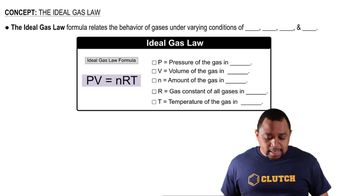
Ideal Gas Law

The Ideal Gas Law relates the pressure, volume, temperature, and number of moles of a gas through the equation PV = nRT. In this context, it allows us to calculate the number of moles of vapor produced from the unknown liquid, which is essential for determining its molar mass.
Recommended video:
Guided course
01:15
Ideal Gas Law Formula

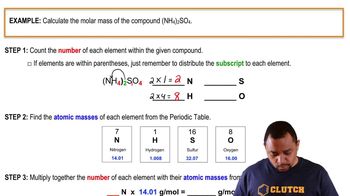
Molar Mass Calculation

Molar mass is defined as the mass of one mole of a substance, typically expressed in grams per mole (g/mol). To find the molar mass of the unknown liquid, we use the formula: Molar Mass = mass of vapor (g) / moles of vapor (n), where n is derived from the Ideal Gas Law.
Recommended video:
Guided course
03:12
Molar Mass Calculation Example

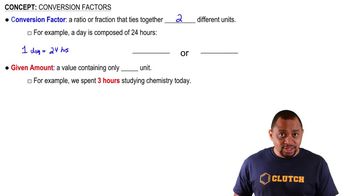
Conversions and Units

Understanding unit conversions is crucial in this problem, particularly converting pressure from torr to atmospheres and temperature from Celsius to Kelvin. Accurate conversions ensure that the calculations align with the standard units used in the Ideal Gas Law, leading to correct results.
Recommended video:
Guided course
01:56
Conversion Factors
Related Practice
Textbook Question

Magnesium can be used as a “getter” in evacuated enclosures to react with the last traces of oxygen. (The magnesium is usually heated by passing an electric current through a wire or ribbon of the metal.) If an enclosure of 0.452 L has a partial pressure of O2 of 3.5×10⁻⁶ torr at 27°C, what mass of magnesium will react according to the following equation?

1
views
Textbook Question

Which of the following statements best explains why a closed balloon filled with helium gas rises in air? (a) Helium is a monatomic gas, whereas nearly all the molecules that make up air, such as nitrogen and oxygen, are diatomic. (b) The average speed of helium atoms is greater than the average speed of air molecules, and the greater speed of collisions with the balloon walls propels the balloon upward. (c) Because the helium atoms are of lower mass than the average air molecule, the helium gas is less dense than air. The mass of the balloon is thus less than the mass of the air displaced by its volume. (d) Because helium has a lower molar mass than the average air molecule, the helium atoms are in faster motion. This means that the temperature of the helium is greater than the air temperature. Hot gases tend to rise.

1663
views
Textbook Question

(a) Calculate the density of NO2 gas at 0.970 atm and 35 °C.

559
views
Textbook Question

Calcium hydride, CaH2, reacts with water to form hydrogen gas:


CaH2(𝑠)+2 H2O(𝑙)⟶Ca(OH)2(𝑎𝑞)+2 H2(𝑔)

This reaction is sometimes used to inflate life rafts, weather balloons, and the like, when a simple, compact means of generating H2 is desired. How many grams of CaH2 are needed to generate 145 L of H2 gas if the pressure of H2 is 825 torr at 21°C?

Textbook Question

Calculate the molar mass of a vapor that has a density of 7.135 g/L at 12°C and 743 torr.