Join thousands of students who trust us to help them ace their exams!
Multiple Choice
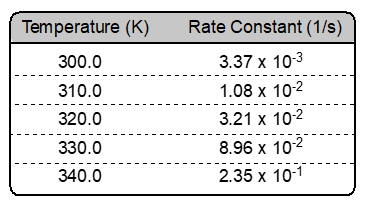
The following data shows the rate constant of a reaction measured at numerous temperatures. Use the Arrhenius plot to determine the frequency factor for the reaction.
A
1.08×10⁴
B
3.00×10⁻³
C
30.4
D
1.57×10¹³
E
6.45×10⁻⁶
6 Comments
Verified step by step guidance
1
First, understand that the Arrhenius equation is given by: k = A * e^(-Ea/(RT)), where k is the rate constant, A is the frequency factor, Ea is the activation energy, R is the gas constant (8.314 J/mol·K), and T is the temperature in Kelvin.
To determine the frequency factor (A), we need to linearize the Arrhenius equation by taking the natural logarithm of both sides, resulting in: ln(k) = ln(A) - (Ea/R) * (1/T). This equation is in the form of y = mx + c, where y = ln(k), m = -Ea/R, x = 1/T, and c = ln(A).
Using the data provided, calculate the natural logarithm of the rate constants and the reciprocal of the temperatures. For example, for the first data point: ln(3.37 x 10^-3) and 1/300.0.
Plot ln(k) versus 1/T using the calculated values. The slope of the line will be equal to -Ea/R, and the y-intercept will be ln(A).
Determine the y-intercept from the plot, which is ln(A). Exponentiate this value to find the frequency factor A, as A = e^(ln(A)).


 Verified step by step guidance

