(b) If you take a 10.0-mL portion of the stock solution and dilute it to a total volume of 0.500 L, what will be the concentration of the final solution?
Ch.4 - Reactions in Aqueous Solution
Brown14th EditionChemistry: The Central ScienceISBN: 9780134414232Not the one you use?Change textbook
Chapter 4, Problem 74a
(a) How many milliliters of a stock solution of 6.0 M HNO3 would you have to use to prepare 110 mL of 0.500 M HNO3?
Verified step by step guidance1
Identify the type of problem: This is a dilution problem where you need to find the volume of a concentrated solution required to make a diluted solution.
Use the dilution equation: \( C_1V_1 = C_2V_2 \), where \( C_1 \) and \( V_1 \) are the concentration and volume of the stock solution, and \( C_2 \) and \( V_2 \) are the concentration and volume of the diluted solution.
Substitute the known values into the equation: \( 6.0 \, \text{M} \times V_1 = 0.500 \, \text{M} \times 110 \, \text{mL} \).
Solve for \( V_1 \) by dividing both sides of the equation by \( 6.0 \, \text{M} \).
Calculate \( V_1 \) to find the volume of the stock solution needed.

Verified video answer for a similar problem:
This video solution was recommended by our tutors as helpful for the problem above.
Video duration:
1mWas this helpful?
Key Concepts
Here are the essential concepts you must grasp in order to answer the question correctly.
Molarity (M)
Molarity is a measure of concentration defined as the number of moles of solute per liter of solution. It is expressed in moles per liter (M). Understanding molarity is crucial for diluting solutions and performing calculations involving concentrations, as it allows chemists to relate the amount of solute to the volume of solution.
Recommended video:
Guided course
Molarity Concept
Dilution Equation
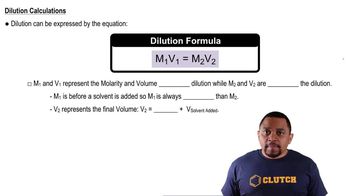
The dilution equation, often expressed as M1V1 = M2V2, relates the molarity and volume of a concentrated solution (M1 and V1) to the molarity and volume of the diluted solution (M2 and V2). This equation is essential for calculating how to prepare a desired concentration from a stock solution, ensuring accurate and precise solution preparation.
Recommended video:
Guided course
Dilution Equation
Volume Conversion
Volume conversion is the process of changing units of volume, such as from liters to milliliters. In this context, understanding how to convert between these units is important for accurately measuring and mixing solutions, as the dilution equation requires consistent units to yield correct results.
Related Practice
Textbook Question
1221
views
Textbook Question
Indicate the concentration of each ion present in the solution formed by mixing: (c) 3.60 g KCl in 75.0 mL of 0.250 M CaCl2 solution. Assume that the volumes are additive.
490
views
Textbook Question
Pure acetic acid, known as glacial acetic acid, is a liquid with a density of 1.049 g/mL at 25 C. Calculate the molarity of a solution of acetic acid made by dissolving 20.00 mL of glacial acetic acid at 25 C in enough water to make 250.0 mL of solution.
4577
views
2
rank
Textbook Question
(b) If you dilute 10.0 mL of the stock solution to a final volume of 0.250 L, what will be the concentration of the diluted solution?
1106
views
Textbook Question
(a) You have a stock solution of 14.8 M NH3. How many milliliters of this solution should you dilute to make 1000.0 mL of 0.250 M NH3?