Join thousands of students who trust us to help them ace their exams!
Multiple Choice
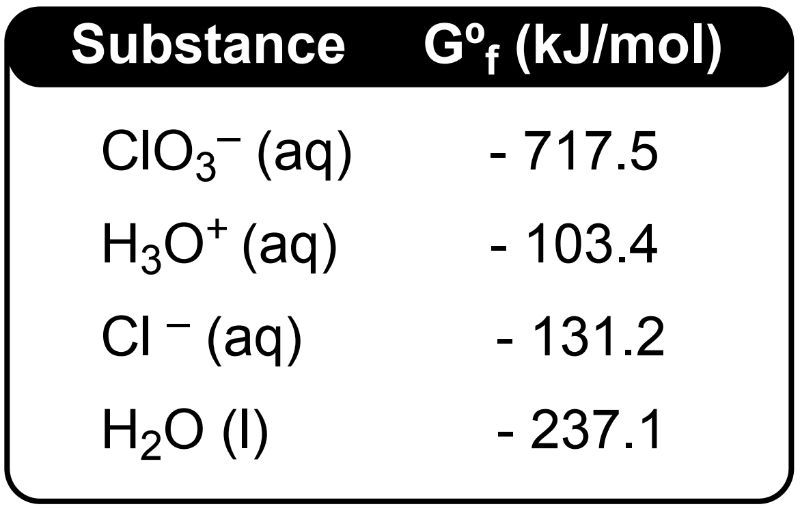
The reduction of chlorate is given by the equation: ClO3– (aq) + 6 H3O+ (aq) → Cl – (aq) + 9 H2O (l) If the standard cell potential is given as 1.373 V, how many electrons are transferred under standard conditions?
A
7
B
5
C
2
D
3
0 Comments
Verified step by step guidance
1
Identify the half-reactions involved in the reduction of chlorate. The given equation is: ClO3– (aq) + 6 H3O+ (aq) → Cl– (aq) + 9 H2O (l).
Determine the oxidation states of chlorine in ClO3– and Cl–. In ClO3–, chlorine is in the +5 oxidation state, and in Cl–, chlorine is in the -1 oxidation state.
Calculate the change in oxidation state for chlorine. The change is from +5 to -1, which is a decrease of 6 units.
Since the change in oxidation state is 6 units, this implies that 6 electrons are transferred per chlorine atom in the reduction process.
Verify the number of electrons transferred by considering the stoichiometry of the balanced equation. The balanced equation suggests that 6 electrons are transferred for each ClO3– reduced to Cl–.


 Verified step by step guidance

