
The accompanying graph shows plots of ln k versus 1>T for two different reactions. The plots have been extrapolated to the y-intercepts. Which reaction (red or blue) has (b) the larger value for the frequency factor, A? [Section 14.5]
Given the following diagrams at t = 0 min and t = 30 min

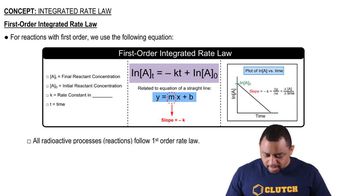
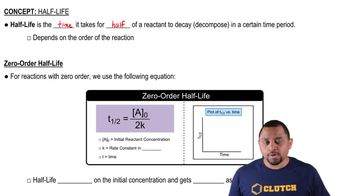
After four half-life periods for a first-order reaction, what fraction of reactant remains? [Section 14.4]
Verified step by step guidance
Verified video answer for a similar problem:
Key Concepts
First-Order Reaction
Half-Life
Fraction of Reactant Remaining
The following graph shows two different reaction pathways for the same overall reaction at the same temperature. Is each of the following statements true or false? (b) For both paths, the rate of the reverse reaction is slower than the rate of the forward reaction.
The following diagrams represent mixtures of NO(g) and O21g2. These two substances react as follows: 2 NO1g2 + O21g2¡2 NO21g2 It has been determined experimentally that the rate is second order in NO and first order in O2. Based on this fact, which of the following mixtures will have the fastest initial rate? [Section 14.3]
You study the rate of a reaction, measuring both the concentration of the reactant and the concentration of the product as a function of time, and obtain the following results:
Which chemical equation is consistent with these data: (i) A → B, (ii) B → A, (iii) A → 2 B, (iv) B → 2 A?
Consider the following graph of the concentration of a substance X over time. Is each of the following statements true or false? (d) As time progresses, the curve will eventually turn downward toward the x-axis. [Section 14.2]
