
Ch.10 - Gases
Brown - Chemistry: The Central Science 14th Edition
Brown14th EditionChemistry: The Central ScienceISBN: 9780134414232Not the one you use?Change textbook
Chapter 10, Problem 82c1

(c) Calculate the most probable speeds of CO molecules at 300 K.

Verified step by step guidance
1
Identify the formula for the most probable speed, which is given by \( v_{mp} = \sqrt{\frac{2kT}{m}} \), where \( k \) is the Boltzmann constant, \( T \) is the temperature in Kelvin, and \( m \) is the mass of a molecule.
Convert the molar mass of CO to kilograms per molecule. The molar mass of CO is approximately 28.01 g/mol. Use the conversion factor \( 1 \text{ mol} = 6.022 \times 10^{23} \text{ molecules} \) to find the mass of one molecule in kilograms.
Substitute the values into the formula: \( k = 1.38 \times 10^{-23} \text{ J/K} \), \( T = 300 \text{ K} \), and the mass of one CO molecule in kilograms.
Calculate the expression under the square root to find the most probable speed.
Interpret the result in the context of molecular speeds, understanding that the most probable speed is the speed at which the largest number of molecules are moving at a given temperature.

Verified video answer for a similar problem:

This video solution was recommended by our tutors as helpful for the problem above.
Video duration:
3m
Was this helpful?

Key Concepts

Here are the essential concepts you must grasp in order to answer the question correctly.

Kinetic Molecular Theory

Kinetic Molecular Theory explains the behavior of gases in terms of particles in constant motion. It posits that gas molecules are in rapid, random motion and that their kinetic energy is directly related to the temperature of the gas. This theory helps in understanding how temperature affects the speed of gas molecules, which is crucial for calculating the most probable speed.
Recommended video:
Guided course
01:19
Kinetic Molecular Theory

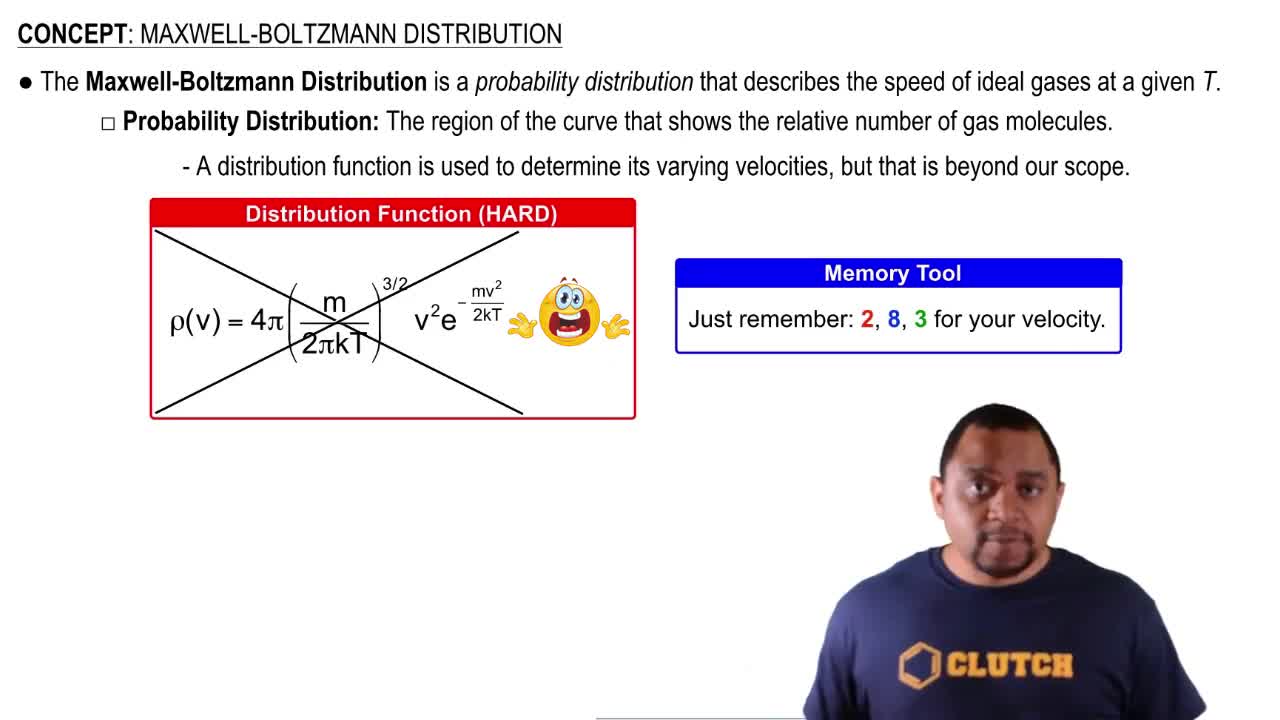
Maxwell-Boltzmann Distribution

The Maxwell-Boltzmann Distribution describes the distribution of speeds among molecules in a gas. It shows that at a given temperature, molecules have a range of speeds, with a specific speed being the most probable. This concept is essential for determining the most probable speed of CO molecules at a specific temperature, such as 300 K.
Recommended video:
Guided course
00:54
Maxwell-Boltzmann Distribution

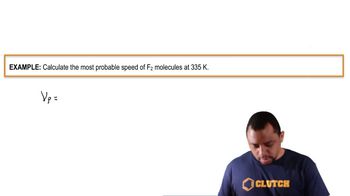
Most Probable Speed Formula

The most probable speed of gas molecules can be calculated using the formula v_mp = sqrt((2kT)/m), where v_mp is the most probable speed, k is the Boltzmann constant, T is the temperature in Kelvin, and m is the mass of a gas molecule. This formula allows for the calculation of the speed of CO molecules at 300 K, providing a quantitative measure of their motion.
Recommended video:
Guided course
01:35
Most Probable Speed Example
Related Practice
Textbook Question

Which one or more of the following statements are true? (a) O2 will effuse faster than Cl2. (b) Effusion and diffusion are different names for the same process. (c) Perfume molecules travel to your nose by the process of effusion. (d) The higher the density of a gas, the shorter the mean free path.

1028
views
Textbook Question

(c) Calculate the most probable speeds of Cl2 molecules at 300 K.

131
views
Textbook Question

Hydrogen has two naturally occurring isotopes, 1H and 2H. Chlorine also has two naturally occurring isotopes, 35Cl and 37Cl. Thus, hydrogen chloride gas consists of four distinct types of molecules: 1H35Cl, 1H37Cl, 2H35Cl, and 2H37Cl. Place these four molecules in order of increasing rate of effusion.

1412
views
Textbook Question

At constant pressure, the mean free path 1l2 of a gas molecule is directly proportional to temperature. At constant temperature, l is inversely proportional to pressure. If you compare two different gas molecules at the same temperature and pressure, l is inversely proportional to the square of the diameter of the gas molecules. Put these facts together to create a formula for the mean free path of a gas molecule with a proportionality constant (call it Rmfp, like the ideal-gas constant) and define units for Rmfp.

951
views
Textbook Question

(b) Calculate the rms speed of NF3 molecules at 25 °C.

1243
views
Textbook Question

(c) Calculate the most probable speed of an ozone molecule in the stratosphere, where the temperature is 270 K.

521
views