


Chlorine has two stable nuclides, 35Cl and 37Cl. In contrast, 36Cl is a radioactive nuclide that decays by beta emission. (b) Based on the empirical rules about nuclear stability, explain why the nucleus of 36Cl is less stable than either 35Cl or 37Cl.
Ch.21 - Nuclear Chemistry
Brown14th EditionChemistry: The Central ScienceISBN: 9780134414232Not the one you use?Change textbook
Chapter 21, Problem 69b
A laboratory rat is exposed to an alpha-radiation source whose activity is 14.3 mCi. (b) The rat has a mass of 385 g and is exposed to the radiation for 14.0 s, absorbing 35% of the emitted alpha particles, each having an energy of 9.12 * 10-13 J. Calculate the absorbed dose in millirads and grays.
Verified step by step guidance1
Convert the activity from millicuries (mCi) to disintegrations per second (becquerels, Bq) using the conversion factor: 1 mCi = 3.7 x 10^7 Bq.
Calculate the total number of disintegrations during the exposure time by multiplying the activity in Bq by the exposure time in seconds.
Determine the total energy absorbed by the rat by multiplying the total number of disintegrations by the energy per alpha particle and the absorption percentage (35%).
Calculate the absorbed dose in grays (Gy) by dividing the total energy absorbed (in joules) by the mass of the rat (in kilograms).
Convert the absorbed dose from grays to millirads using the conversion factor: 1 Gy = 100,000 millirads.

Verified video answer for a similar problem:
This video solution was recommended by our tutors as helpful for the problem above.
Video duration:
10mWas this helpful?
Key Concepts
Here are the essential concepts you must grasp in order to answer the question correctly.
Radioactivity and Alpha Particles
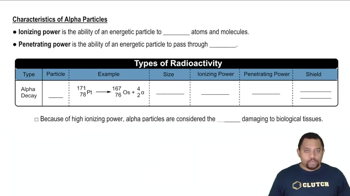
Radioactivity is the process by which unstable atomic nuclei lose energy by emitting radiation. Alpha particles are a type of ionizing radiation consisting of two protons and two neutrons, emitted from the nucleus of an atom. They have a relatively low penetration power but can cause significant damage to biological tissues if absorbed.
Recommended video:
Guided course
Characteristics of Alpha Particles
Absorbed Dose
The absorbed dose is a measure of the energy deposited by ionizing radiation in a given mass of tissue, expressed in grays (Gy) or rads. One gray is defined as the absorption of one joule of radiation energy per kilogram of matter. The absorbed dose is crucial for assessing the potential biological effects of radiation exposure.
Recommended video:
Guided course
Endothermic & Exothermic Reactions
Conversion between Units
In radiation measurement, it is often necessary to convert between different units, such as millirads and grays. One rad is equivalent to 0.01 gray, and one millirad is one-thousandth of a rad. Understanding these conversions is essential for accurately reporting and interpreting radiation doses in various contexts.
Recommended video:
Guided course
Conversion Factors
Related Practice
Textbook Question
Textbook Question
A laboratory rat is exposed to an alpha-radiation source whose activity is 14.3 mCi. (a) What is the activity of the radiation in disintegrations per second? In becquerels?
512
views
Textbook Question
The table to the right gives the number of protons (p) and neutrons (n) for four isotopes. (a) Write the symbol for each of the isotopes.
274
views
Textbook Question
Which are classified as ionizing radiation: X rays, alpha particles, microwaves from a cell phone, and gamma rays?
864
views
Textbook Question
Radon-222 decays to a stable nucleus by a series of three alpha emissions and two beta emissions. What is the stable nucleus that is formed?
1435
views
