
Ch.20 - Electrochemistry
Brown - Chemistry: The Central Science 15th Edition
Brown15th EditionChemistry: The Central ScienceISBN: 9780137542970Not the one you use?Change textbook
Chapter 20, Problem 25

Complete and balance the following half-reactions in basic solution. In each case, indicate whether the half-reaction is an oxidation or a reduction.
a. O2(𝑔)⟢H2O(𝑙)
b. Mn2+(π‘Žπ‘ž)⟢MnO2(𝑠)
c. Cr(OH)3(𝑠)⟢CrO42βˆ’(π‘Žπ‘ž)
d. N2H4(π‘Žπ‘ž)⟢N2(𝑔)

Verified step by step guidance
1
Step 1: Identify the oxidation states of the elements in the reactants and products to determine if the half-reaction is an oxidation or a reduction.
Step 2: For each half-reaction, balance the atoms other than oxygen and hydrogen first.
Step 3: Balance the oxygen atoms by adding H2O molecules to the side that needs oxygen.
Step 4: Balance the hydrogen atoms by adding H+ ions to the side that needs hydrogen.
Step 5: Since the solution is basic, add OH- ions to both sides of the equation to neutralize the H+ ions, forming water, and then simplify the equation by canceling out water molecules if possible.

Verified video answer for a similar problem:

This video solution was recommended by our tutors as helpful for the problem above.
Video duration:
4m
Was this helpful?

Key Concepts

Here are the essential concepts you must grasp in order to answer the question correctly.

Half-Reaction Method

The half-reaction method is a technique used to balance redox reactions by separating the oxidation and reduction processes. Each half-reaction shows the species being oxidized or reduced, along with the electrons involved. This method is particularly useful in basic solutions, where hydroxide ions (OH-) are added to balance the charges and atoms, ensuring that both mass and charge are conserved.
Recommended video:
Guided course
01:49
Method 1 of Radioactive Half-Life

Oxidation and Reduction

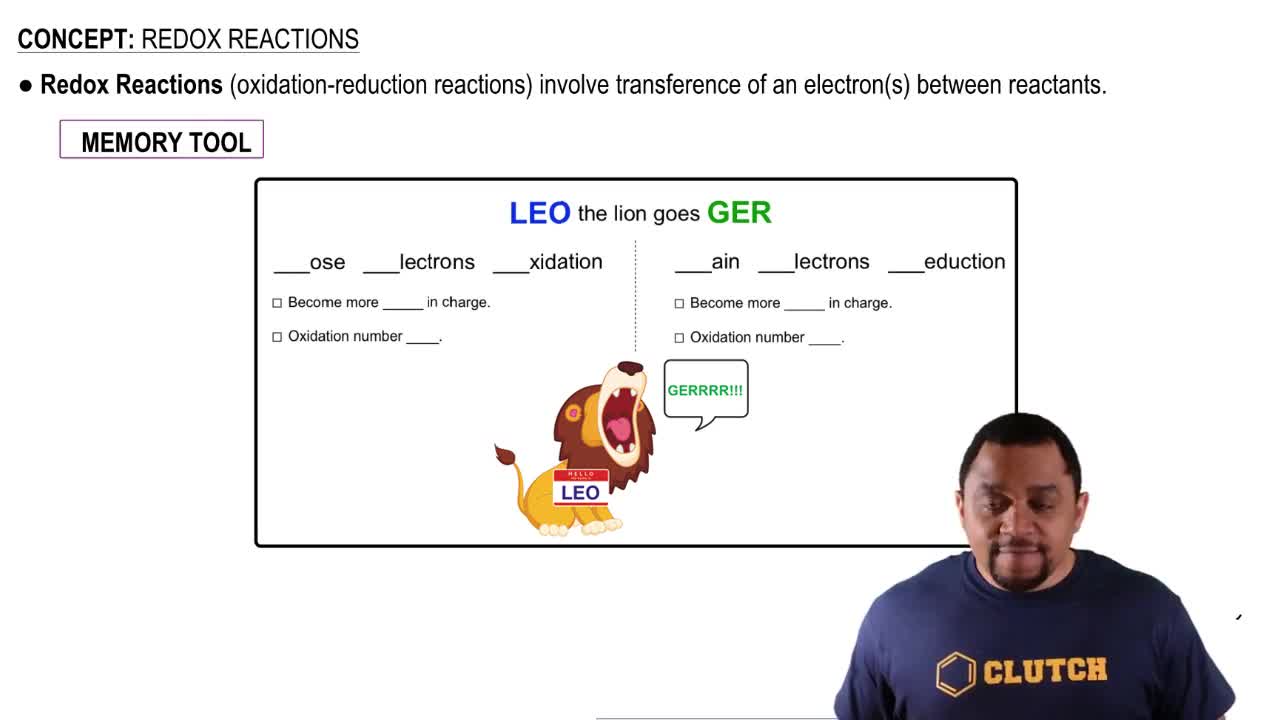
Oxidation refers to the loss of electrons from a substance, resulting in an increase in oxidation state, while reduction involves the gain of electrons, leading to a decrease in oxidation state. In redox reactions, one species is oxidized and another is reduced. Identifying which species undergoes these changes is crucial for balancing half-reactions and understanding the overall reaction mechanism.
Recommended video:
Guided course
01:53
Oxidation and Reduction Reactions

Basic Solution Conditions

In basic solutions, the presence of hydroxide ions (OH-) affects how half-reactions are balanced. When balancing in basic conditions, it is often necessary to add OH- ions to neutralize any H+ ions produced during the balancing process. This ensures that the final balanced equation accurately reflects the conditions of the reaction and maintains charge and mass balance.
Related Practice
Textbook Question

Complete and balance the following half-reactions. In each case, indicate whether the half-reaction is an oxidation or a reduction. (a) Sn2+(aq) β†’ Sn4+(aq) (acidic solution) (b) TiO2(s) β†’ Ti2+(aq) (acidic solution) (c) ClO3-(aq) β†’ Cl-(aq) (acidic solution) (d) N2(g) β†’ NH4+(aq) (acidic solution)

666
views
Textbook Question

Hydrazine (N2H4) and dinitrogen tetroxide (N2O4) form a self-igniting mixture that has been used as a rocket propellant. The reaction products are N2 and H2O. (c) Which substance serves as the reducing agent and which as the oxidizing agent?

1005
views
Textbook Question

Complete and balance the following equations, and identify the oxidizing and reducing agents: (a) Cr2O72-(aq) + I-(aq) β†’ Cr3+(aq) + IO3-(aq) (acidic solution) (b) MnO4-(aq) + CH3O(1aq) β†’ Mn2+(aq) + HCOOH(aq) (acidic solution) (c) I2(s) + OCl-(aq) β†’ IO3-(aq) + Cl-(aq) (acidic solution)

771
views
Textbook Question

Complete and balance the following half-reactions in basic solution. In each case, indicate whether the half-reaction is an oxidation or a reduction. c. Cr(OH)3(𝑠)⟢CrO42βˆ’(π‘Žπ‘ž)

Textbook Question

Complete and balance the following half-reactions in basic solution. In each case, indicate whether the half-reaction is an oxidation or a reduction.


a. OHβˆ’(π‘Žπ‘ž)⟢O2(𝑔)

b. SO32βˆ’(π‘Žπ‘ž)⟢SO42βˆ’(π‘Žπ‘ž)

c. N2(𝑔)⟢NH3(𝑔)

d. HO2βˆ’(π‘Žπ‘ž)⟢OHβˆ’(π‘Žπ‘ž)

Textbook Question

Complete and balance the following equations, and identify the oxidizing and reducing agents: MnO4-(aq) + Br-(aq) β†’ MnO2(s) + BrO3-(aq) (basic solution)

703
views