
The arsenic in a 1.22-g sample of a pesticide was converted to AsO43- by suitable chemical treatment. It was then titrated using Ag+ to form Ag3AsO4 as a precipitate. (b) Name Ag3AsO4 by analogy to the corresponding compound containing phosphorus in place of arsenic.
Ch.4 - Reactions in Aqueous Solution
Brown14th EditionChemistry: The Central ScienceISBN: 9780134414232Not the one you use?Change textbook
Chapter 4, Problem 111
Ritalin is the trade name of a drug, methylphenidate, used to treat attention-deficit/hyperactivity disorder in young adults. The chemical structure of methylphenidate is (c) Ritalin has a half-life of 3 hours in the blood, which means that after 3 hours the concentration in the blood has decreased by half of its initial value. For the man in part (b), what is the concentration of Ritalin in his blood after 6 hours?
Verified step by step guidance1
Identify that the problem involves the concept of half-life, which is the time required for a quantity to reduce to half its initial value.
Recognize that the half-life of Ritalin is given as 3 hours, meaning every 3 hours, the concentration of Ritalin in the blood is halved.
Determine that after 6 hours, which is two half-lives (since 6 hours / 3 hours per half-life = 2), the concentration will be halved twice.
Calculate the concentration after the first half-life (3 hours) by dividing the initial concentration by 2.
Calculate the concentration after the second half-life (6 hours) by dividing the concentration after the first half-life by 2 again.

Verified video answer for a similar problem:
This video solution was recommended by our tutors as helpful for the problem above.
Video duration:
2mWas this helpful?
Key Concepts
Here are the essential concepts you must grasp in order to answer the question correctly.
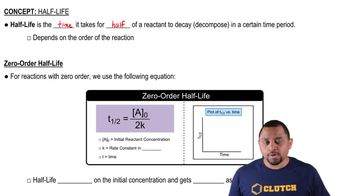
Half-life
Half-life is the time required for the concentration of a substance in the body to reduce to half its initial value. In pharmacology, understanding half-life is crucial for determining dosing schedules and predicting how long a drug will remain effective in the bloodstream. For Ritalin, with a half-life of 3 hours, the concentration decreases significantly over time, impacting therapeutic effects.
Recommended video:
Guided course
Zero-Order Half-life
Exponential Decay
Exponential decay describes the process by which a quantity decreases at a rate proportional to its current value. In the context of drug concentration, this means that after each half-life, the remaining amount of the drug is halved. This concept is essential for calculating the concentration of Ritalin in the blood after multiple half-lives, as it follows a predictable pattern.
Recommended video:
Guided course
Beta Decay
Concentration Calculation
Concentration calculation involves determining the amount of a substance in a given volume of solution, often expressed in units like mg/L or μg/mL. For Ritalin, knowing the initial concentration and applying the half-life allows for the calculation of remaining concentration after a specified time, which is vital for assessing drug levels in patients and ensuring effective treatment.
Recommended video:
Guided course
Calculate Concentration of the Basic Form
Related Practice
Textbook Question
757
views
1
rank
Textbook Question
In 2014, a major chemical leak at a facility in West Virginia released 28,390 L of MCHM (4-methylcyclohexylmethanol, C8H16O) into the Elk River. The density of MCHM is 0.9074 g/mL. (a) Calculate the initial molarity of MCHM in the river, assuming that the first part of the river is 2.00 m deep, 90.0 m wide, and 90.0 m long.
378
views
Textbook Question
A sample of 8.69 g of Zn(OH)2 is added to 155.0 mL of 0.750 M H2SO4. (c) How many moles of Zn(OH)2, H2SO4, ZnSO4 are present after the reaction is complete?
408
views
Textbook Question
The arsenic in a 1.22-g sample of a pesticide was converted to AsO43- by suitable chemical treatment. It was then titrated using Ag+ to form Ag3AsO4 as a precipitate. (a) What is the oxidation state of As in AsO43-?
