

Ch.5 - Thermochemistry
Brown - Chemistry: The Central Science 14th Edition
Brown14th EditionChemistry: The Central ScienceISBN: 9780134414232Not the one you use?Change textbook
Chapter 5, Problem 107b

(b) Assuming that there is an uncertainty of 0.002 °C in each temperature reading and that the masses of samples are measured to 0.001 g, what is the estimated uncertainty in the value calculated for the heat of combustion per mole of caffeine?

Verified step by step guidance
1
Step 1: Identify the formula for the heat of combustion. The heat of combustion (q) can be calculated using the formula q = m * c * ΔT, where m is the mass, c is the specific heat capacity, and ΔT is the change in temperature.
Step 2: Determine the variables involved in the calculation. In this problem, the variables are the mass (m), the specific heat capacity (c), and the change in temperature (ΔT).
Step 3: Understand the uncertainties in the measurements. The uncertainty in the temperature reading is ±0.002 °C, and the uncertainty in the mass measurement is ±0.001 g.
Step 4: Use the propagation of uncertainty formula to estimate the uncertainty in the heat of combustion. The formula for propagation of uncertainty in multiplication is: (Δq/q) = (Δm/m) + (Δc/c) + (ΔΔT/ΔT).
Step 5: Calculate the uncertainty in the heat of combustion per mole of caffeine. Convert the uncertainty in q to per mole by considering the molar mass of caffeine and apply the propagation of uncertainty to find the final uncertainty.

Verified video answer for a similar problem:

This video solution was recommended by our tutors as helpful for the problem above.
Video duration:
4m
Was this helpful?

Key Concepts

Here are the essential concepts you must grasp in order to answer the question correctly.

Uncertainty in Measurements

Uncertainty in measurements refers to the doubt that exists about the result of a measurement. It is crucial in experimental science, as it quantifies the range within which the true value is expected to lie. In this context, the uncertainty in temperature readings and mass measurements directly affects the calculated heat of combustion, highlighting the importance of precision in experimental data.
Recommended video:
Guided course
02:05
Uncertainty Principle Formula

Heat of Combustion

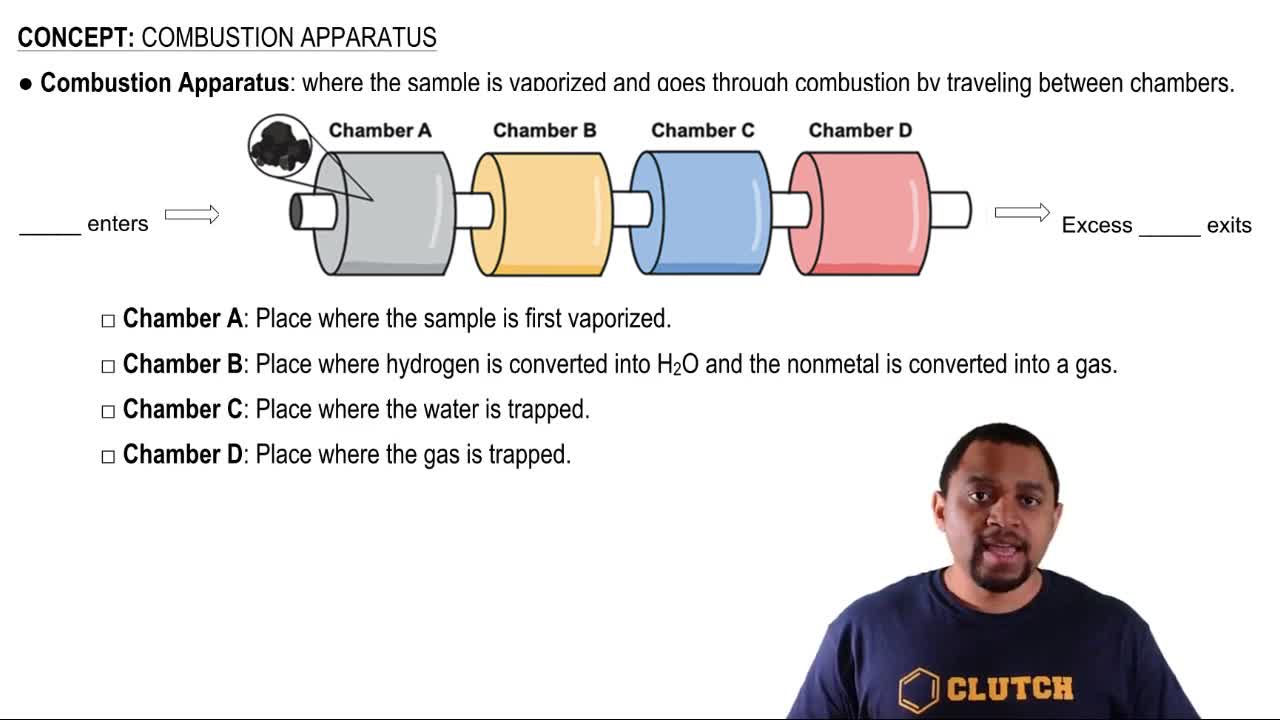
The heat of combustion is the amount of energy released when a substance undergoes complete combustion with oxygen. It is typically expressed in kilojoules per mole (kJ/mol) and is a critical parameter in thermochemistry. Understanding how to calculate this value, including the role of uncertainties in the measurements of temperature and mass, is essential for accurate thermodynamic assessments.
Recommended video:
Guided course
02:24
Combustion Apparatus

Propagation of Uncertainty

Propagation of uncertainty is a method used to determine the overall uncertainty in a calculated result based on the uncertainties of the individual measurements involved. When multiple measurements are combined in calculations, such as in determining the heat of combustion, the uncertainties must be combined using specific mathematical rules to estimate the total uncertainty in the final result.
Recommended video:
Guided course
02:05
Uncertainty Principle Formula