Back

Alcohol Reactions: Oxidation Reactions quiz

Control buttons has been changed to "navigation" mode.
1/15
  • What is the main goal of alcohol oxidation reactions in organic chemistry?

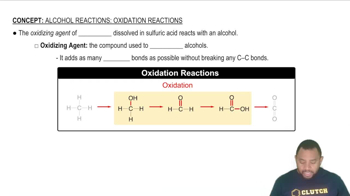
    The main goal is to increase the number of carbon-oxygen bonds without breaking carbon-carbon bonds.
  • Which part of sodium or potassium dichromate acts as the oxidizing agent in alcohol oxidation?

    The dichromate portion is the actual oxidizing agent, not the sodium or potassium.
  • Why are sodium dichromate and potassium dichromate considered interchangeable in alcohol oxidation?

    They are interchangeable because sodium and potassium are both group 1A elements; the dichromate is the active oxidizer.
  • What solvent is typically used to dissolve dichromate oxidizing agents for alcohol oxidation?

    Sulfuric acid is typically used as the solvent.
  • What is the first product formed when an alcohol is oxidized?

    The first product is a carbonyl compound, which can be either an aldehyde or a ketone.
  • What can aldehydes formed from alcohol oxidation be further oxidized into?

    Aldehydes can be further oxidized to form carboxylic acids.
  • What functional groups are involved in the sequence of alcohol oxidation reactions?

    The sequence involves alcohols, aldehydes or ketones, and carboxylic acids.
  • What rule must be followed to obtain the proper oxidized product in alcohol oxidation?

    You must add as many carbon-oxygen bonds as possible without breaking any carbon-carbon bonds.
  • What is the role of an oxidizing agent in alcohol oxidation reactions?

    The oxidizing agent is used to oxidize alcohols by increasing their carbon-oxygen bonds.
  • What happens to the hydrocarbon portion during alcohol oxidation reactions?

    The hydrocarbon portion is typically grayed out and not the focus; attention is on the functional group transformation.
  • What is the significance of carbonyl compounds in alcohol oxidation?

    Carbonyl compounds, such as aldehydes and ketones, are key intermediates formed during alcohol oxidation.
  • Can ketones formed from alcohol oxidation be further oxidized under normal conditions?

    Ketones are generally resistant to further oxidation under normal conditions.
  • What is the main functional group change when an alcohol is oxidized to an aldehyde?

    The alcohol group is converted into a carbonyl group, forming an aldehyde.
  • Why is it important not to break carbon-carbon bonds during alcohol oxidation?

    Breaking carbon-carbon bonds would alter the molecular structure and is not desired in typical oxidation reactions.
  • What is the ultimate oxidation product of a primary alcohol?

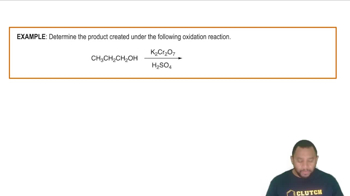
    The ultimate product is a carboxylic acid, after passing through the aldehyde stage.