Back

Average Rate of Reaction quiz

Control buttons has been changed to "navigation" mode.
1/15
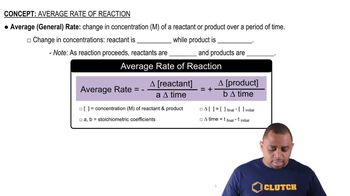
  • What does the average rate of a chemical reaction measure?

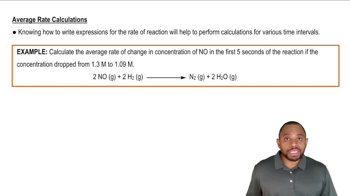
    It measures the change in concentration of a reactant or product over a period of time.
  • How is the sign of the rate different for reactants and products?

    The rate is negative for reactants (since they are consumed) and positive for products (since they are formed).
  • What is the general formula for the average rate of reaction?

    Rate = change in concentration / change in time.
  • How do you calculate the change in concentration for a substance?

    Change in concentration is final concentration minus initial concentration.
  • What do the brackets [ ] around a chemical species represent?

    They represent the concentration of that species, usually in molarity.
  • In the rate expression, what does 'a' represent for reactants?

    'a' is the stoichiometric coefficient of the reactant from the balanced chemical equation.
  • How is the rate of disappearance of a reactant expressed mathematically?

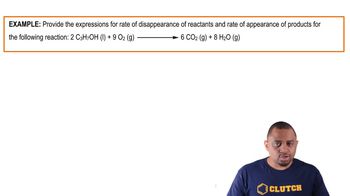
    It is expressed as -1/a × (change in concentration of reactant / change in time).
  • How is the rate of appearance of a product expressed mathematically?

    It is expressed as +1/b × (change in concentration of product / change in time), where b is the stoichiometric coefficient.
  • Why is the rate of reactant consumption negative?

    Because reactants are being used up, so their concentration decreases over time.
  • Why is the rate of product formation positive?

    Because products are being formed, so their concentration increases over time.
  • What does the change in time (Δt) represent in the rate equation?

    It is the final time minus the initial time over which the concentration change is measured.
  • How are stoichiometric coefficients used in rate expressions?

    They adjust the rate expressions so that the rate of disappearance of reactants equals the rate of appearance of products.
  • What is the relationship between the rates of reactant disappearance and product appearance?

    When adjusted for stoichiometric coefficients, the rates are equal in magnitude but opposite in sign.
  • Why is it important to use a balanced chemical equation when calculating average rates?

    Because the stoichiometric coefficients ensure the correct relationship between the rates of all species involved.
  • What does the average rate tell us about a chemical reaction?

    It tells us how quickly reactants are consumed or products are formed over a specific time interval.