Back

Balancing Chemical Equations quiz

Control buttons has been changed to "navigation" mode.
1/15
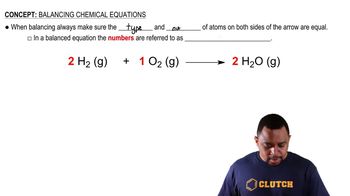
  • What must be equal on both sides of a balanced chemical equation?

    Both the type and number of atoms must be equal on each side of the reaction arrow.
  • What are the numbers placed before compounds in a chemical equation called?

    They are called coefficients.
  • How do coefficients affect the number of atoms in a chemical equation?

    Coefficients are multiplied by the number of atoms in the compound they precede to determine the total number of each atom.
  • If a coefficient of 2 is placed before H2, how many hydrogen atoms are present?

    There are 4 hydrogen atoms present (2 times 2).
  • What does a coefficient of 1 mean when balancing equations?

    A coefficient of 1 means the number of atoms in the compound remains unchanged.
  • Why is it important to balance chemical equations?

    Balancing ensures the law of conservation of mass is maintained, with equal atoms of each element on both sides.
  • What is the law of conservation of mass in relation to chemical equations?

    It states that the total mass and number of atoms must remain constant during a chemical reaction.
  • How do you determine the total number of atoms for an element in a compound with a coefficient?

    Multiply the coefficient by the number of that atom in the compound.
  • What does it mean for a chemical equation to be balanced?

    It means the number and type of each atom are the same on both sides of the equation.
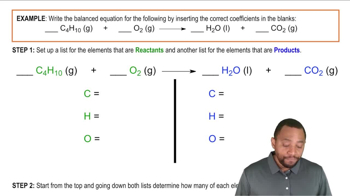
  • What is the first step when balancing a chemical equation?

    Check that the type and number of atoms are equal on both sides of the arrow.
  • In the equation 2H2 + O2 → 2H2O, how many oxygen atoms are on each side?

    There are 2 oxygen atoms on both the reactant and product sides.
  • What role do coefficients play in balancing equations?

    They adjust the number of molecules to ensure equal numbers of each atom on both sides.
  • What should you do if the number of atoms for an element is not equal on both sides?

    Adjust the coefficients to balance the number of atoms for that element.
  • Why is balancing chemical equations a key skill in chemistry?

    It forms the basis of stoichiometry and ensures accurate chemical calculations.
  • What happens if a chemical equation is not balanced?

    The law of conservation of mass is violated, and the equation does not accurately represent the reaction.